Department of Psychology, University of Wisconsin-Madison, 1202 West Johnson Street, Madison, WI 53706, USA.
Dev Psychol. 2010 Jan;46(1):18-28. doi: 10.1037/a0017820.
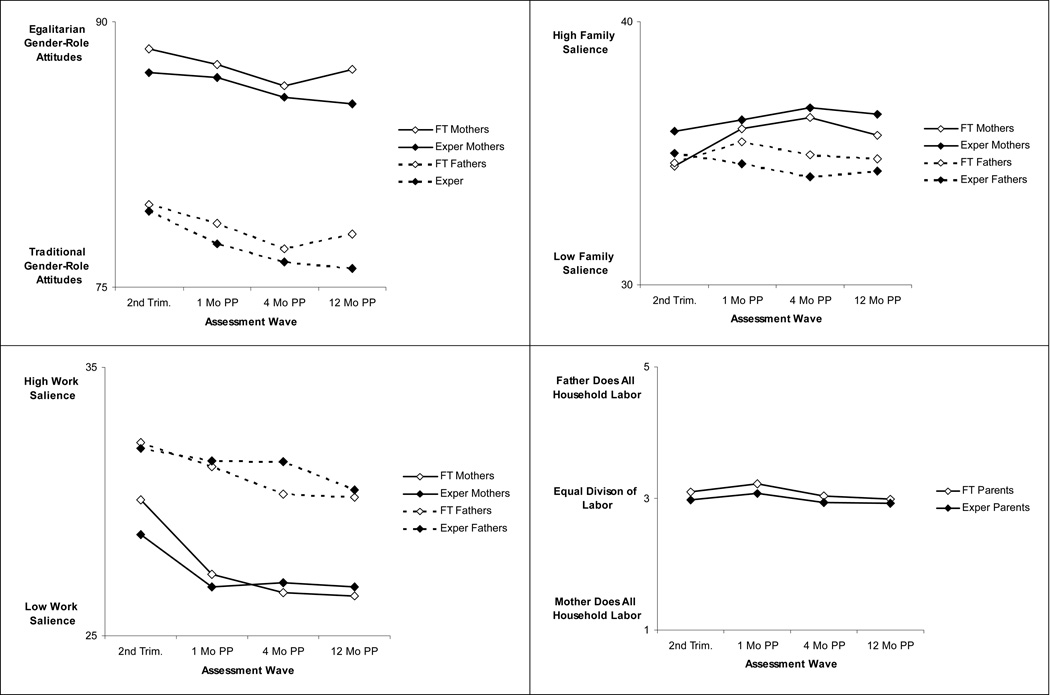
On the basis of social structural theory and identity theory, the current study examined changes in gender-role attitudes and behavior across the first-time transition to parenthood and following the birth of a second child for experienced mothers and fathers. Data were analyzed from the ongoing longitudinal Wisconsin Study of Families and Work. Gender-role attitudes, work and family identity salience, and division of household labor were measured for 205 first-time and 198 experienced mothers and fathers across 4 time points from 5 months pregnant to 12 months postpartum. Multilevel latent growth curve analysis was used to analyze the data. In general, parents became more traditional in their gender-role attitudes and behavior following the birth of a child, women changed more than men, and first-time parents changed more than experienced parents. Findings suggest that changes in gender-role attitudes and behavior following the birth of a child may be attributed to both the process of transitioning to parenthood for the first time and that of negotiating the demands of having a new baby in the family. (PsycINFO Database Record (c) 2009 APA, all rights reserved).
基于社会结构理论和身份理论,本研究考察了经验丰富的母亲和父亲在首次过渡到为人父母和第二个孩子出生后的性别角色态度和行为的变化。数据来自正在进行的纵向威斯康星州家庭和工作研究。在怀孕 5 个月至产后 12 个月的 4 个时间点,对 205 名首次为人父母者和 198 名经验丰富的父母进行了性别角色态度、工作和家庭身份显著性以及家务劳动分工的测量。使用多层次潜在增长曲线分析来分析数据。一般来说,父母在孩子出生后在性别角色态度和行为方面变得更加传统,女性的变化大于男性,首次为人父母者的变化大于经验丰富的为人父母者。研究结果表明,孩子出生后性别角色态度和行为的变化可能归因于首次为人父母的过渡过程和家庭中新婴儿需求的协商。(APA,2009 年,所有权利保留)。