Department of Geography, University of Western Ontario, London, Ontario, N6G 5C2, Canada.
Int J Environ Res Public Health. 2009 Oct;6(10):2655-75. doi: 10.3390/ijerph6102655. Epub 2009 Oct 16.
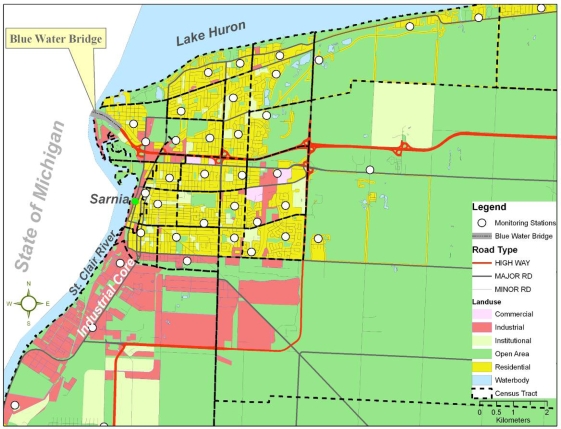
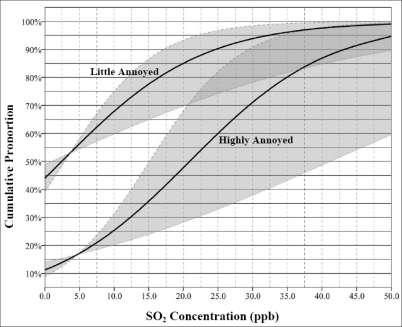
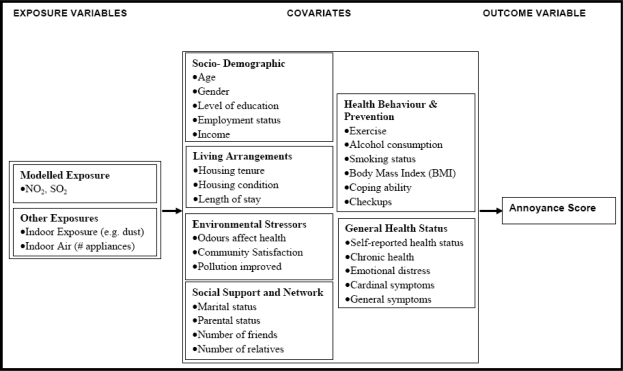
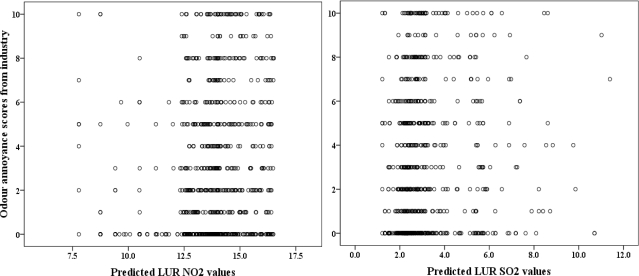
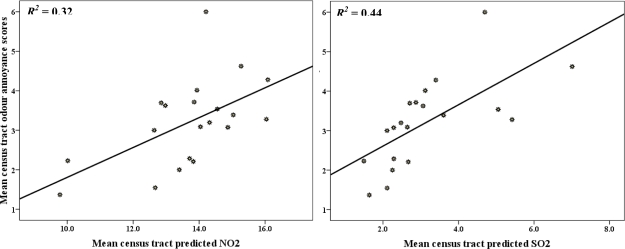
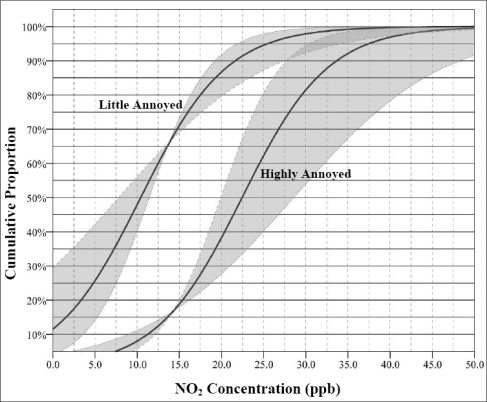
This study aimed at establishing the relationship between annoyance scores and modelled air pollution in "Chemical Valley", Sarnia, Ontario (Canada). Annoyance scores were taken from a community health survey (N = 774); and respondents' exposure to nitrogen dioxide (NO(2)) and sulphur dioxide (SO(2)) were estimated using land use regression (LUR) models. The associations were examined by univariate analysis while multivariate logistic regression was used to examine the determinants of odour annoyance. The results showed that odour annoyance was significantly correlated to modelled pollutants at the individual (NO(2), r = 0.15; SO(2), r = 0.13) and census tract (NO(2), r = 0.56; SO(2), r = 0.67) levels. The exposure-response relationships show that residents of Sarnia react to very low pollution concentrations levels even if they are within the Ontario ambient air quality criteria. The study found that exposure to high NO(2) and SO(2) concentrations, gender, and perception of health effects were significant determinants of individual odour annoyance reporting. The observed association between odour annoyance and modelled ambient pollution suggest that individual and census tract level annoyance scores may serve as proxies for air quality in exposed communities because they capture the within area spatial variability of pollution. However, questionnaire-based odour annoyance scores need to be validated longitudinally and across different scales if they are to be adopted for use at the national level.
本研究旨在建立安大略省萨尼亚“化工谷”(加拿大)烦扰评分与模拟空气污染之间的关系。烦扰评分来自社区健康调查(N=774);并使用土地利用回归(LUR)模型估计了受访者对二氧化氮(NO2)和二氧化硫(SO2)的暴露。单变量分析检查了相关性,而多元逻辑回归用于检查气味烦扰的决定因素。结果表明,气味烦扰与个体(NO2,r=0.15;SO2,r=0.13)和普查区(NO2,r=0.56;SO2,r=0.67)水平的模型污染物显著相关。暴露-反应关系表明,即使萨尼亚的居民处于安大略省环境空气质量标准内,他们也会对非常低的污染浓度水平产生反应。研究发现,暴露于高浓度的 NO2 和 SO2、性别以及对健康影响的认知是个体气味烦扰报告的重要决定因素。观察到的气味烦扰与模拟环境污染物之间的关联表明,个体和普查区水平的烦扰评分可能是暴露社区空气质量的替代指标,因为它们捕捉了污染的区域内空间变异性。然而,如果要在国家层面采用基于问卷的气味烦扰评分,则需要进行纵向和跨不同规模的验证。