Department of Environmental Health Sciences, Mailman School of Public Health, Columbia University, Columbia Center for Children's Environmental Health, New York, New York 10032 , USA.
Environ Health Perspect. 2010 May;118(5):712-9. doi: 10.1289/ehp.0901340. Epub 2010 Jan 4.
Polybrominated diphenyl ethers (PBDEs) are widely used flame retardant compounds that are persistent and bioaccumulative and therefore have become ubiquitous environment contaminants. Animal studies suggest that prenatal PBDE exposure may result in adverse neurodevelopmental effects.
In a longitudinal cohort initiated after 11 September 2001, including 329 mothers who delivered in one of three hospitals in lower Manhattan, New York, we examined prenatal PBDE exposure and neurodevelopment when their children were 12-48 and 72 months of age.
We analyzed 210 cord blood specimens for selected PBDE congeners and assessed neurodevelopmental effects in the children at 12-48 and 72 months of age; 118, 117, 114, 104, and 96 children with available cord PBDE measurements were assessed at 12, 24, 36, 48, and 72 months, respectively. We used multivariate regression analyses to evaluate the associations between concentrations of individual PBDE congeners and neurodevelopmental indices.
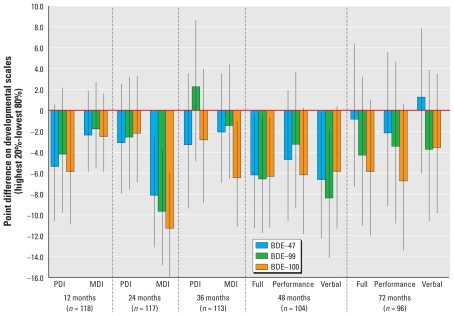
Median cord blood concentrations of PBDE congeners 47, 99, and 100 were 11.2, 3.2, and 1.4 ng/g lipid, respectively. After adjustment for potential confounders, children with higher concentrations of BDEs 47, 99, or 100 scored lower on tests of mental and physical development at 12-48 and 72 months. Associations were significant for 12-month Psychomotor Development Index (BDE-47), 24-month Mental Development Index (MDI) (BDE-47, 99, and 100), 36-month MDI (BDE-100), 48-month full-scale and verbal IQ (BDE-47, 99, and 100) and performance IQ (BDE-100), and 72-month performance IQ (BDE-100).
This epidemiologic study demonstrates neurodevelopmental effects in relation to cord blood PBDE concentrations. Confirmation is needed in other longitudinal studies.
多溴联苯醚(PBDEs)是广泛使用的阻燃剂化合物,具有持久性和生物累积性,因此已成为无处不在的环境污染物。动物研究表明,产前 PBDE 暴露可能导致不良的神经发育影响。
在 2001 年 9 月 11 日之后启动的一个纵向队列中,包括在纽约曼哈顿下城的三家医院之一分娩的 329 名母亲,我们研究了产前 PBDE 暴露与儿童 12-48 个月和 72 个月时的神经发育情况。
我们分析了 210 份脐带血样本中选定的 PBDE 同系物,并在儿童 12-48 个月和 72 个月时评估神经发育效果;分别在 12、24、36、48 和 72 个月时评估了 118、117、114、104 和 96 名具有可用脐带 PBDE 测量值的儿童。我们使用多元回归分析评估了单个 PBDE 同系物浓度与神经发育指数之间的关联。
PBDE 同系物 47、99 和 100 的脐带血浓度中位数分别为 11.2、3.2 和 1.4ng/g 脂质。在调整了潜在混杂因素后,BDEs 47、99 或 100 浓度较高的儿童在 12-48 个月和 72 个月时在精神和身体发育测试中的得分较低。12 个月时的精神运动发育指数(BDE-47)、24 个月时的精神发育指数(MDI)(BDE-47、99 和 100)、36 个月时的 MDI(BDE-100)、48 个月时的全量表和言语智商(BDE-47、99 和 100)和操作智商(BDE-100)以及 72 个月时的操作智商(BDE-100)存在显著关联。
这项流行病学研究表明,脐带血 PBDE 浓度与神经发育效应有关。需要在其他纵向研究中加以证实。