Inorganic Carcinogenesis Section, Laboratory of Comparative Carcinogenesis, National Cancer Institute at the National Institute of Environmental Health Sciences, National Institutes of Health, Department of Health and Human Services, Research Triangle Park, North Carolina 27709, USA.
Environ Health Perspect. 2010 Jan;118(1):108-15. doi: 10.1289/ehp.0901059.
Inorganic arsenic is a ubiquitous environmental carcinogen affecting millions of people worldwide. Evolving theory predicts that normal stem cells (NSCs) are transformed into cancer stem cells (CSCs) that then drive oncogenesis. In humans, arsenic is carcinogenic in the urogenital system (UGS), including the bladder and potentially the prostate, whereas in mice arsenic induces multi-organ UGS cancers, indicating that UGS NSCs may represent targets for carcino-genic initiation. However, proof of emergence of CSCs induced by arsenic in a stem cell population is not available.
We continuously exposed the human prostate epithelial stem/progenitor cell line WPE-stem to an environmentally relevant level of arsenic (5 microM) in vitro and determined the acquired cancer phenotype.
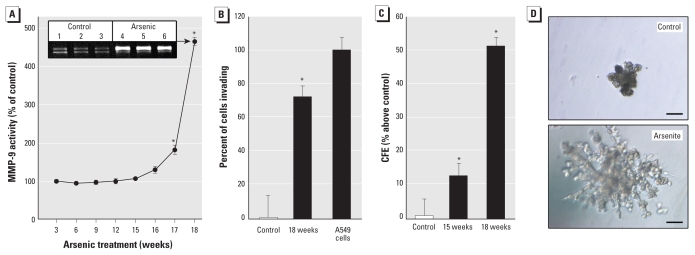
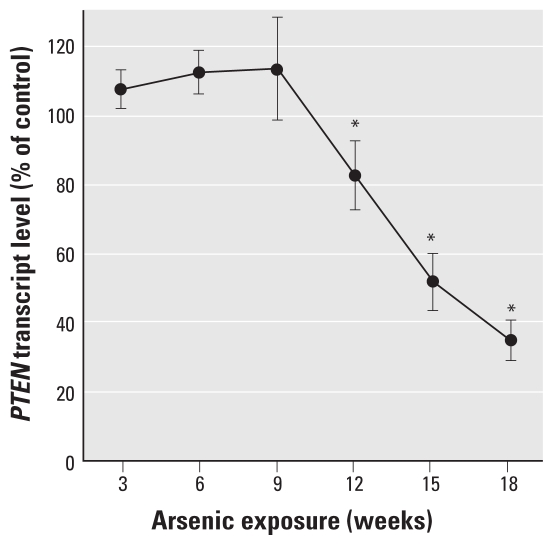
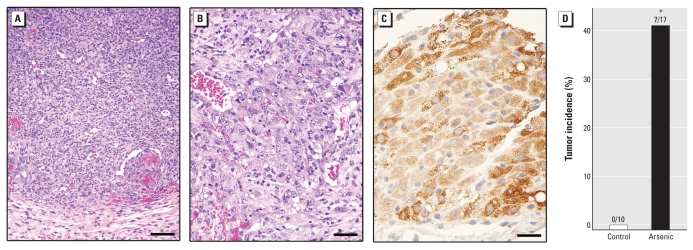
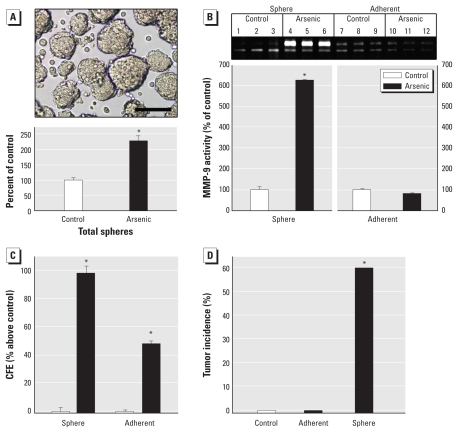
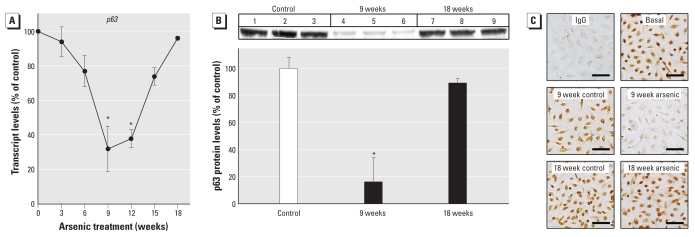
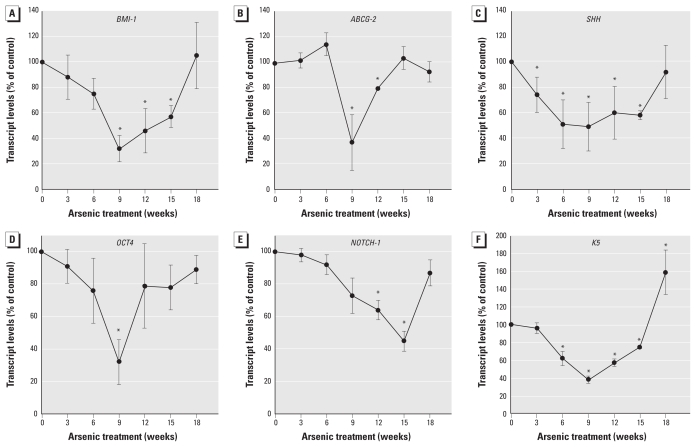
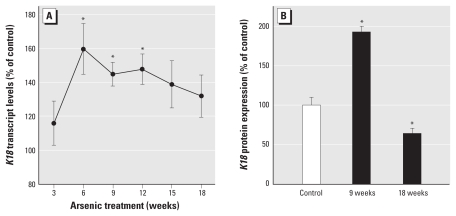
WPE-stem cells rapidly acquired a malignant CSC-like phenotype by 18 weeks of exposure, becoming highly invasive, losing contact inhibition, and hyper-secreting matrix metalloproteinase-9. When hetero-transplanted, these cells (designated As-CSC) formed highly pleomorphic, aggressive tumors with immature epithelial- and mesenchymal-like cells, suggesting a highly pluripotent cell of origin. Consistent with tumor-derived CSCs, As-CSCs formed abundant free-floating spheres enriched in CSC-like cells, as confirmed by molecular analysis and the fact that only these floating cells formed xeno-graft tumors. An early loss of NSC self-renewal gene expression (p63, ABCG2, BMI-1, SHH, OCT-4, NOTCH-1) during arsenite exposure was sub-sequently reversed as the tumor suppressor gene PTEN was progressively suppressed and the CSC-like phenotype acquired.
Arsenite transforms prostate epithelial stem/progenitor cells into CSC-like cells, indicating that it can produce CSCs from a model NSC population.
无机砷是一种普遍存在的环境致癌物质,影响着全球数百万人。不断发展的理论预测,正常干细胞(NSCs)会转化为癌症干细胞(CSCs),从而推动肿瘤发生。在人类中,砷在泌尿系统(UGS)中具有致癌性,包括膀胱,并且可能还包括前列腺,而在小鼠中,砷会导致多器官 UGS 癌症,这表明 UGS NSCs 可能是致癌起始的靶标。但是,砷在干细胞群体中诱导 CSCs 出现的证据尚不可用。
我们在体外连续将人类前列腺上皮干细胞/祖细胞系 WPE-stem 暴露于环境相关水平的砷(5μM),并确定获得的癌症表型。
WPE-stem 细胞在暴露 18 周后迅速获得恶性 CSC 样表型,变得高度侵袭性,失去接触抑制,并过度分泌基质金属蛋白酶-9。当异体移植时,这些细胞(命名为 As-CSC)形成高度多形性、侵袭性的肿瘤,具有不成熟的上皮样和间充质样细胞,提示其起源于高度多能的细胞。与肿瘤衍生的 CSCs 一致,As-CSCs 形成丰富的自由漂浮球体,富含 CSC 样细胞,这通过分子分析得到证实,并且只有这些漂浮细胞形成异种移植肿瘤。在亚砷酸盐暴露期间,NSC 自我更新基因表达(p63、ABCG2、BMI-1、SHH、OCT-4、NOTCH-1)的早期丢失随后被逆转,因为肿瘤抑制基因 PTEN 被逐渐抑制,并且获得了 CSC 样表型。
亚砷酸盐将前列腺上皮干细胞/祖细胞转化为 CSC 样细胞,表明它可以从模型 NSC 群体中产生 CSCs。