Department of Obstetrics, Gynecology and Reproductive Sciences, University of California San Francisco, San Francisco, California, USA.
Environ Health Perspect. 2010 Mar;118(3):400-6. doi: 10.1289/ehp.0901161. Epub 2009 Oct 22.
Bisphenol A (BPA), a chemical used as a plasticizer, is a potent endocrine disruptor that, even in low concentrations, disturbs normal development and functions of reproductive organs in different species.
We investigated whether BPA affects human ovarian granulosa cell function.
We treated KGN granulosa cells and granulosa cells from subjects undergoing in vitro fertilization (IVF) with follicle-stimulating hormone (FSH), BPA, or BPA plus FSH in a dose- and time-dependent manner. We then evaluated expression of insulin-like growth factor 1 (IGF-1), aromatase, and transcription factors known to mediate aromatase induction by FSH [including steroidogenic factor-1 (SF-1), GATA4, cAMP response element binding protein-1 (CREB-1), and peroxisome proliferator-activated receptor-gamma (PPARgamma)], as well as 17beta-estradiol (E2) secretion. KGN cells were transfected with a PPARgamma-containing vector, followed by assessment of aromatase and IGF-I expression.
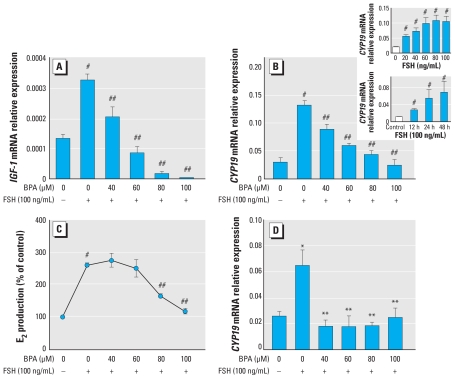
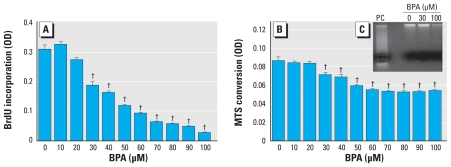
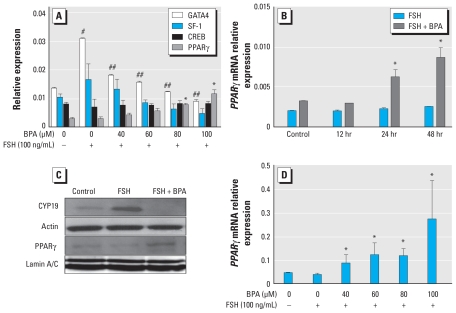
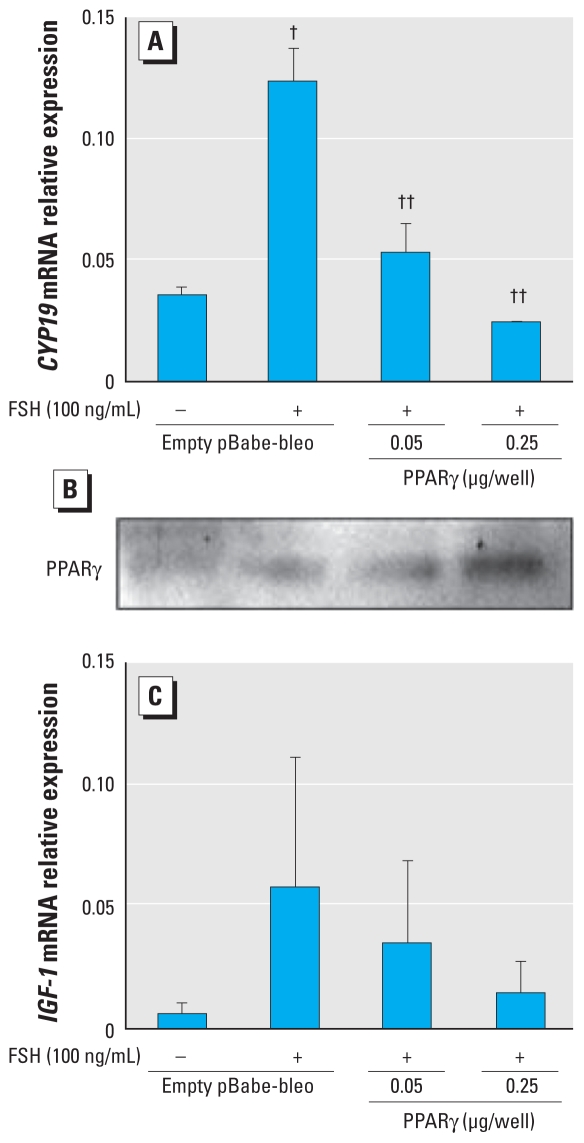
BPA reduced FSH-induced IGF-1 and aromatase expression and E2 secretion in a dose-dependent fashion. Similar effects on aromatase were observed in IVF granulosa cells. SF-1 and GATA4, but not CREB-1, were reduced after BPA treatment, although PPARgamma, an inhibitor of aromatase, was significantly up-regulated by BPA in a dose-dependent manner, with simultaneous decrease of aromatase. Overexpression of PPARgamma in KGN cells reduced FSH-stimulated aromatase and IGF-1 mRNAs, with increasing concentrations of the transfected expression vector, mimicking BPA action. Also, BPA reduced granulosa cell DNA synthesis without changing DNA fragmentation, suggesting that BPA does not induce apoptosis.
Overall, the data demonstrate that BPA induces PPARgamma, which mediates down-regulation of FSH-stimulated IGF-1, SF-1, GATA4, aromatase, and E2 in human granulosa cells. These observations support a potential role of altered steroidogenesis and proliferation within the ovarian follicular compartment due to this endocrine disruptor.
双酚 A(BPA)是一种用作增塑剂的化学物质,是一种强效的内分泌干扰物,即使在低浓度下,也会干扰不同物种生殖器官的正常发育和功能。
我们研究了双酚 A 是否会影响人卵巢颗粒细胞的功能。
我们用卵泡刺激素(FSH)、BPA 或 BPA 加 FSH 以剂量和时间依赖的方式处理 KGN 颗粒细胞和接受体外受精(IVF)的颗粒细胞,然后评估胰岛素样生长因子 1(IGF-1)、芳香化酶的表达以及已知由 FSH 介导芳香化酶诱导的转录因子[包括甾体生成因子-1(SF-1)、GATA4、cAMP 反应元件结合蛋白-1(CREB-1)和过氧化物酶体增殖物激活受体-γ(PPARγ)],以及 17β-雌二醇(E2)的分泌。用含有 PPARγ 的载体转染 KGN 细胞,然后评估芳香化酶和 IGF-I 的表达。
BPA 以剂量依赖性方式降低了 FSH 诱导的 IGF-1 和芳香化酶的表达和 E2 的分泌。在 IVF 颗粒细胞中也观察到类似的芳香化酶作用。BPA 处理后 SF-1 和 GATA4 减少,但 CREB-1 没有减少,尽管 PPARγ是芳香化酶的抑制剂,但它以剂量依赖性方式被显著上调,同时芳香化酶减少。用含有 PPARγ 的载体过表达 KGN 细胞可降低 FSH 刺激的芳香化酶和 IGF-1 mRNA,随着转染表达载体的浓度增加,模拟 BPA 的作用。此外,BPA 降低了颗粒细胞的 DNA 合成而不改变 DNA 片段化,这表明 BPA 不会诱导细胞凋亡。
总的来说,数据表明 BPA 诱导了 PPARγ,它介导了人颗粒细胞中 FSH 刺激的 IGF-1、SF-1、GATA4、芳香化酶和 E2 的下调。这些观察结果支持由于这种内分泌干扰物,卵巢滤泡腔内类固醇生成和增殖发生改变的潜在作用。