MSCE, Children's Hospital of Philadelphia, Division of Infectious Diseases, Room 1526 (North Campus), 34th Street and Civic Center Boulevard, Philadelphia, PA 19104, USA.
Pediatrics. 2010 Feb;125(2):257-64. doi: 10.1542/peds.2009-1181. Epub 2010 Jan 11.
Cerebrospinal fluid (CSF) white blood cell (WBC) counts for neonates and young infants are usually interpreted on the basis of values reported in reference texts or handbooks; however, current reference texts either present normal CSF parameters without citation or cite studies with significant limitations. The objective of this study was to determine accurate, age-specific reference values for CSF WBC counts in a large population of neonates and young infants.
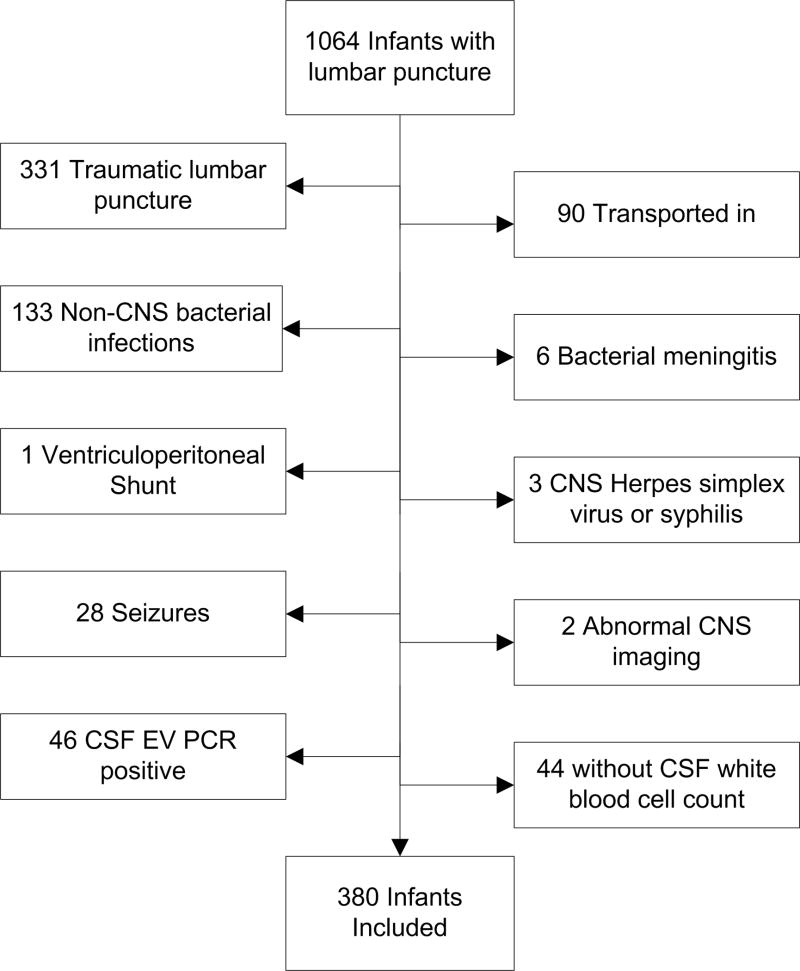
This cross-sectional study included patients who were aged < or =56 days and had a lumbar puncture performed in the emergency department from January 1, 2005, to June 30, 2007. Patients were excluded from analysis for conditions that are suspected to cause CSF pleocytosis, including traumatic lumbar puncture, serious bacterial infection, congenital infection, seizure, and presence of a ventricular shunt. Children who tested positive for enterovirus (EV) in the CSF by polymerase chain reaction were also excluded. Two-sample Wilcoxon rank-sum tests were used to compare median CSF WBC values of those who had negative EV testing with those who did not have EV testing.
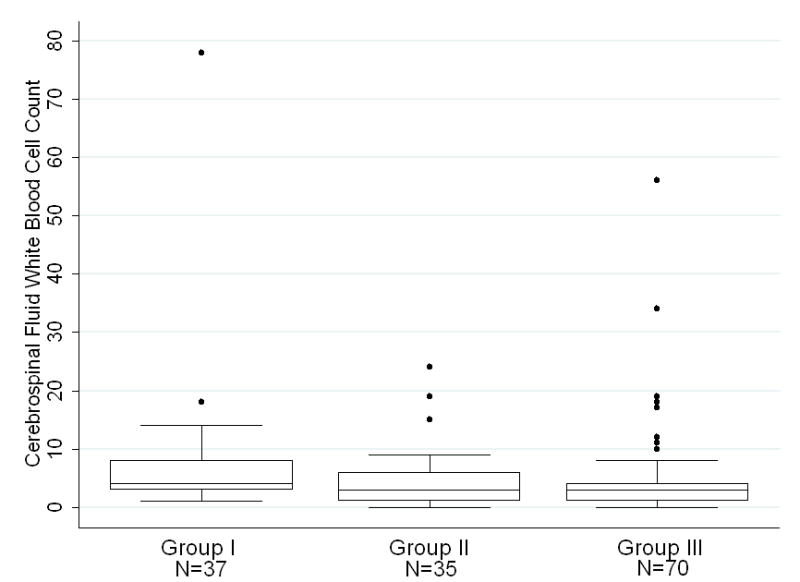
A total of 380 (36%) of 1064 patients met inclusion criteria; 54% were male, 15% were preterm, and 39% presented during EV season. The median CSF WBC count was significantly higher in infants who were aged < or =28 days (3/microL, 95th percentile: 19/microL) than in infants who were aged 29 to 56 days (2/microL, 95th percentile: 9/microL; P < .001). In both age groups, infants with a negative EV PCR had a higher upper bound of the 95% confidence interval of the mean values compared with infants who did not have EV testing performed.
We determined age-specific CSF WBC reference values in a large cohort of neonates and young infants that can be used to interpret accurately the results of lumbar punctures in this population.
脑脊液(CSF)白细胞(WBC)计数在新生儿和婴儿中通常基于参考文本或手册中报告的值进行解释;然而,目前的参考文本要么没有引用就提供了正常的 CSF 参数,要么引用了具有显著局限性的研究。本研究的目的是确定大量新生儿和婴儿中 CSF WBC 计数的准确、年龄特异性参考值。
这项横断面研究纳入了 2005 年 1 月 1 日至 2007 年 6 月 30 日期间在急诊科行腰椎穿刺的年龄≤56 天的患者。有怀疑会引起 CSF 白细胞增多的疾病的患者被排除在分析之外,包括创伤性腰椎穿刺、严重细菌感染、先天性感染、癫痫发作和脑室分流。CSF 通过聚合酶链反应检测出肠道病毒(EV)阳性的儿童也被排除在外。采用两样本 Wilcoxon 秩和检验比较 EV 检测阴性和未进行 EV 检测的患者的 CSF WBC 中位数。
共有 1064 例患者中的 380 例(36%)符合纳入标准;54%为男性,15%为早产儿,39%在 EV 季节就诊。年龄≤28 天的婴儿 CSF WBC 计数中位数明显高于 29-56 天的婴儿(3/微升,95%置信区间:19/微升)(P<.001)。在两个年龄组中,与未进行 EV PCR 检测的婴儿相比,EV PCR 阴性的婴儿的平均值 95%置信区间上限更高。
我们在一个较大的新生儿和婴儿队列中确定了 CSF WBC 的年龄特异性参考值,可以准确解释该人群腰椎穿刺的结果。