Aoyagi Kyota, Ohara-Imaizumi Mica, Nishiwaki Chiyono, Nakamichi Yoko, Nagamatsu Shinya
Department of Biochemistry, Kyorin University School of Medicine, Mitaka, Tokyo 181-8611, Japan.
Exp Diabetes Res. 2009;2009:278762. doi: 10.1155/2009/278762. Epub 2009 Dec 28.
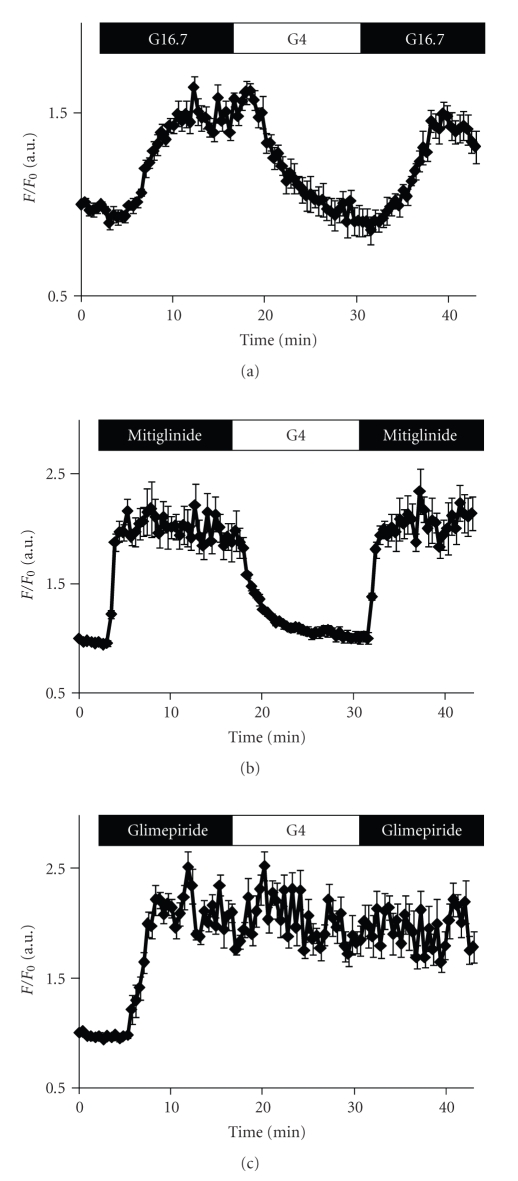
To investigate the different effects between sulfonylurea (SU) and glinide drugs in insulin secretion, pancreatic beta-cells were repeatedly stimulated with SU (glimepiride) or glinide (mitiglinide). Total internal reflection fluorescent (TIRF) microscopy revealed that secondary stimulation with glimepiride, but not glucose and mitiglinide, failed to evoke fusions of insulin granules although primary stimulation with glucose, glimepiride, and mitiglinide induced equivalent numbers of exocytotic responses. Glimepiride, but not glucose and mitiglinide, induced abnormally sustained Ca(2+) elevations and reductions of docked insulin granules on the plasma membrane. Our data suggest that the effect of glinide on insulin secretory mechanisms is similar to that of glucose.
为研究磺脲类(SU)药物和格列奈类药物在胰岛素分泌方面的不同作用,用SU(格列美脲)或格列奈类(米格列奈)反复刺激胰腺β细胞。全内反射荧光(TIRF)显微镜检查显示,尽管葡萄糖、格列美脲和米格列奈的初次刺激诱导了等量的胞吐反应,但格列美脲的二次刺激未能引发胰岛素颗粒融合,而葡萄糖和米格列奈则不会。格列美脲而非葡萄糖和米格列奈诱导了异常持续的细胞内钙离子浓度升高以及质膜上停靠的胰岛素颗粒减少。我们的数据表明,格列奈类对胰岛素分泌机制的作用与葡萄糖相似。