Nucleic Acids Res. 2010 Apr;38(7):e95. doi: 10.1093/nar/gkp1218. Epub 2010 Jan 13.
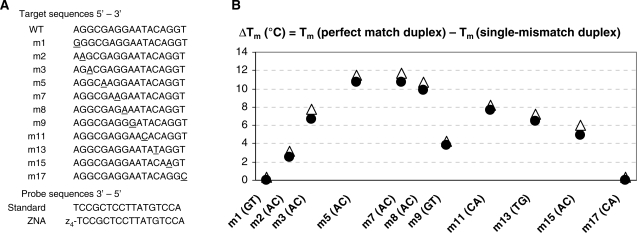
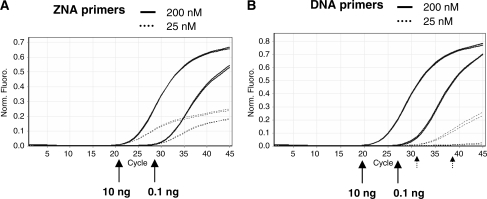
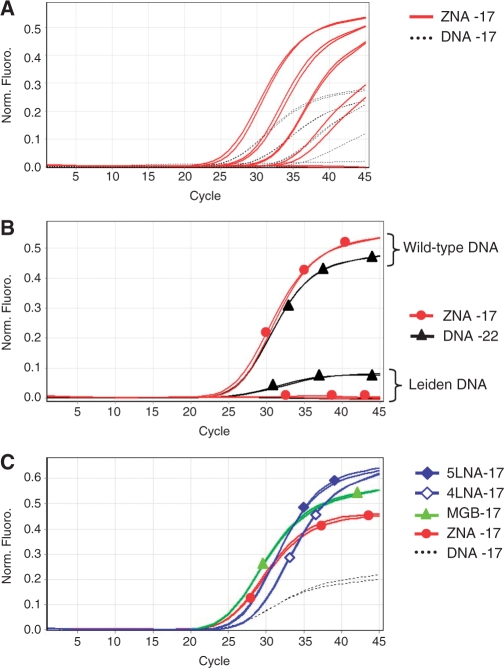
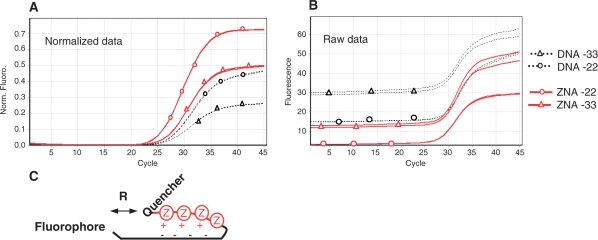
Zip nucleic acids (ZNAs) are oligonucleotides conjugated with cationic spermine units that increase affinity for their target. ZNAs were recently shown to enable specific and sensitive reactions when used as primers for polymerase chain reaction (PCR) and reverse-transcription. Here, we report their use as quantitative PCR hydrolysis probes. Ultraviolet duplex melting data demonstrate that attachment of cationic residues to the 3' end of an oligonucleotide does not alter its ability to discriminate nucleotides nor the destabilization pattern relative to mismatch location in the oligonucleotide sequence. The stability increase provided by the cationic charges allows the use of short dual-labeled probes that significantly improve single-nucleotide polymorphism genotyping. Longer ZNA probes were shown to display reduced background fluorescence, therefore, generating greater sensitivity and signal level as compared to standard probes. ZNA probes thus provide broad flexibility in assay design and also represent an effective alternative to minor groove binder- and locked nucleic-acid-containing probes.
Zip 核酸(ZNAs)是与阳离子精脒单元缀合的寡核苷酸,可增加其与靶标的亲和力。最近的研究表明,ZNAs 可用作聚合酶链反应(PCR)和逆转录的引物,从而实现特异性和灵敏性反应。在这里,我们报告了它们作为定量 PCR 水解探针的用途。紫外双链解链数据表明,在寡核苷酸的 3' 端连接阳离子残基不会改变其区分核苷酸的能力,也不会改变相对于寡核苷酸序列中错配位置的不稳定模式。阳离子电荷提供的稳定性增加允许使用短的双标记探针,这显著改善了单核苷酸多态性基因分型。较长的 ZNA 探针显示出降低的背景荧光,因此与标准探针相比,产生更高的灵敏度和信号水平。因此,ZNA 探针在检测设计中提供了广泛的灵活性,并且也是与小沟结合物和包含锁核酸的探针的有效替代物。