Howard Hughes Medical Institute, Whitehead Institute, and Department of Biology, Massachusetts Institute of Technology, 9 Cambridge Center, Cambridge, Massachusetts 02142, USA.
Nature. 2010 Jan 28;463(7280):536-9. doi: 10.1038/nature08700. Epub 2010 Jan 13.
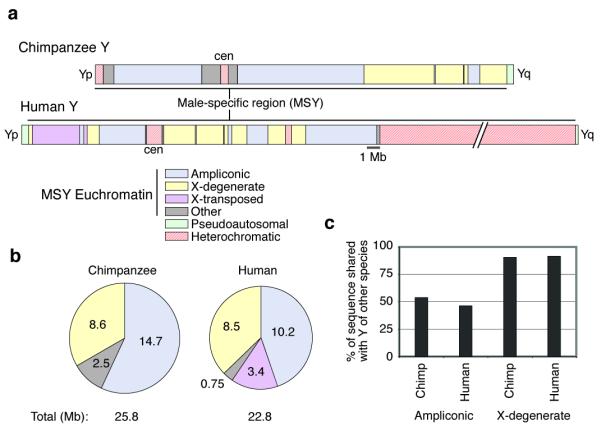
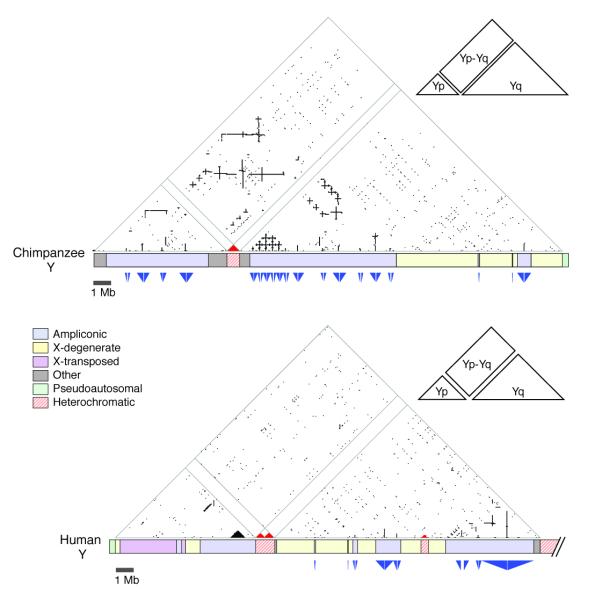
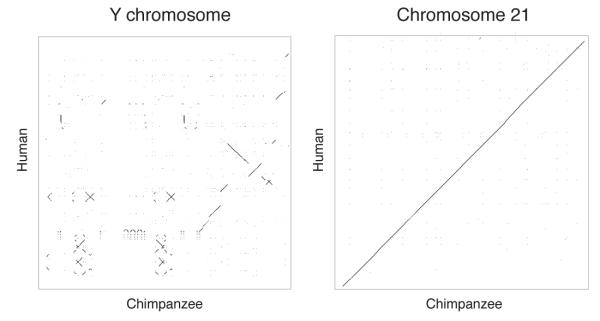
The human Y chromosome began to evolve from an autosome hundreds of millions of years ago, acquiring a sex-determining function and undergoing a series of inversions that suppressed crossing over with the X chromosome. Little is known about the recent evolution of the Y chromosome because only the human Y chromosome has been fully sequenced. Prevailing theories hold that Y chromosomes evolve by gene loss, the pace of which slows over time, eventually leading to a paucity of genes, and stasis. These theories have been buttressed by partial sequence data from newly emergent plant and animal Y chromosomes, but they have not been tested in older, highly evolved Y chromosomes such as that of humans. Here we finished sequencing of the male-specific region of the Y chromosome (MSY) in our closest living relative, the chimpanzee, achieving levels of accuracy and completion previously reached for the human MSY. By comparing the MSYs of the two species we show that they differ radically in sequence structure and gene content, indicating rapid evolution during the past 6 million years. The chimpanzee MSY contains twice as many massive palindromes as the human MSY, yet it has lost large fractions of the MSY protein-coding genes and gene families present in the last common ancestor. We suggest that the extraordinary divergence of the chimpanzee and human MSYs was driven by four synergistic factors: the prominent role of the MSY in sperm production, 'genetic hitchhiking' effects in the absence of meiotic crossing over, frequent ectopic recombination within the MSY, and species differences in mating behaviour. Although genetic decay may be the principal dynamic in the evolution of newly emergent Y chromosomes, wholesale renovation is the paramount theme in the continuing evolution of chimpanzee, human and perhaps other older MSYs.
人类 Y 染色体数亿年前从一条常染色体开始进化,获得了性别决定功能,并经历了一系列抑制与 X 染色体交叉的倒位。由于只有人类 Y 染色体被完全测序,因此人们对 Y 染色体的近期进化知之甚少。目前占主导地位的理论认为,Y 染色体通过基因丢失进化,随着时间的推移,其进化速度会减缓,最终导致基因数量减少和停滞。这些理论得到了来自新出现的植物和动物 Y 染色体的部分序列数据的支持,但尚未在像人类 Y 染色体这样的古老、高度进化的 Y 染色体中进行测试。在这里,我们完成了我们最近的亲缘物种——黑猩猩的 Y 染色体(MSY)的雄性特异性区域的测序,达到了以前在人类 MSY 中达到的准确性和完整性水平。通过比较这两个物种的 MSY,我们表明它们在序列结构和基因含量上有很大的差异,这表明在过去的 600 万年里,它们经历了快速进化。黑猩猩 MSY 中包含的大量回文结构是人类 MSY 的两倍,但它已经失去了在最后共同祖先中存在的大部分 MSY 蛋白编码基因和基因家族。我们认为,黑猩猩和人类 MSY 的巨大差异是由四个协同因素驱动的:MSY 在精子产生中的突出作用、减数分裂交叉缺失时的“遗传搭便车”效应、MSY 内频繁的异位重组,以及物种间交配行为的差异。尽管遗传衰退可能是新出现的 Y 染色体进化的主要动力,但在黑猩猩、人类和可能的其他较老 MSY 的持续进化中,全面革新是首要主题。