Department of Neurology, Eulji General Hospital, Eulji University College of Medicine, Seoul, Korea.
J Clin Neurol. 2009 Dec;5(4):167-72. doi: 10.3988/jcn.2009.5.4.167. Epub 2009 Dec 31.
Hyperglycemia after acute ischemic stroke (AIS) is associated with poor outcomes. However, there is no consensus as to the optimal method for glycemic control. We designed an insulin infusion protocol for aggressive glucose control and investigated its efficacy and safety.
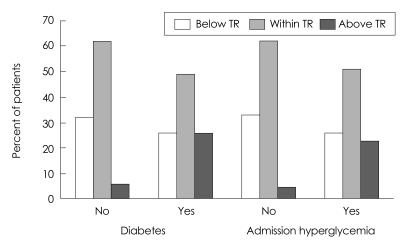
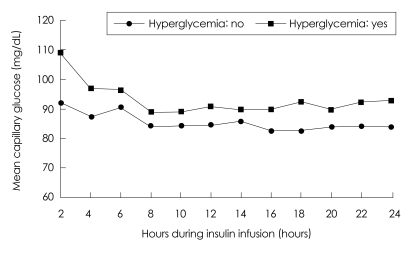
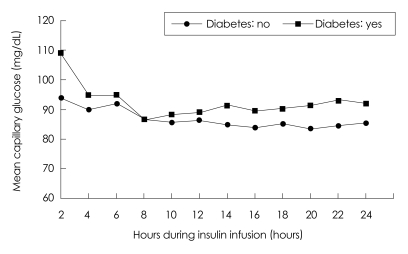
We applied our protocol to patients within 48 hours after AIS or transient ischemic attack (TIA) with an initial capillary glucose level of between 100 and 399 mg/dL (5.6-22.2 mmol/L). An insulin solution comprising 40 or 50 U of human regular insulin in 500 mL of 5% dextrose was administered for 24 hours. Capillary glucose was measured every 2 hours and the infusion rate was adjusted according to a nomogram with a target range of 80-129 mg/dL (4.4-7.2 mmol/L). Changes in glucose and overall glucose levels during insulin infusion were analyzed according to the presence of diabetes or admission hyperglycemia (admission glucose >139 mg/dL or 7.7 mmol/L) by the generalized estimating equation method.
The study cohort comprised 115 consecutive patients. Glucose was significantly lowered from 160+/-57 mg/dL (8.9+/-3.2 mmol/L) at admission to 93+/-28 mg/dL (5.2+/-1.6 mmol/L) during insulin infusion (p<0.05). Laboratory hypoglycemia (capillary glucose <80 mg/dL or 4.4 mmol/L) occurred in 91 (71%) patients, 11 (10%) of whom had symptomatic hypoglycemia. Although glucose levels were significantly lowered and maintained within the target range in all patients, overall glucose levels were significantly higher in patients with diabetes or hyperglycemia (p<0.05).
Our insulin-infusion protocol was effective in glycemic control for patients with AIS or TIA. Further modification is needed to improve the efficacy and safety of this procedure, and tailored intervention should be considered according to glycemic status.
急性缺血性脑卒中(AIS)后高血糖与不良预后相关。然而,对于血糖控制的最佳方法尚无共识。我们设计了一种胰岛素输注方案以进行强化血糖控制,并对其疗效和安全性进行了研究。
我们将该方案应用于 AIS 或短暂性脑缺血发作(TIA)后 48 小时内的患者,初始毛细血管血糖水平为 100-399mg/dL(5.6-22.2mmol/L)。给予 40 或 50U 人普通胰岛素加入 500mL 5%葡萄糖溶液,输注 24 小时。每 2 小时测量一次毛细血管血糖,并根据目标范围为 80-129mg/dL(4.4-7.2mmol/L)的诺模图调整输注率。通过广义估计方程方法,根据是否存在糖尿病或入院高血糖(入院血糖>139mg/dL 或 7.7mmol/L)分析胰岛素输注期间血糖和总体血糖水平的变化。
研究队列包括 115 例连续患者。胰岛素输注期间,血糖从入院时的 160+/-57mg/dL(8.9+/-3.2mmol/L)显著降低至 93+/-28mg/dL(5.2+/-1.6mmol/L)(p<0.05)。91(71%)例患者发生实验室低血糖(毛细血管血糖<80mg/dL 或 4.4mmol/L),其中 11(10%)例出现症状性低血糖。尽管所有患者的血糖水平均显著降低并维持在目标范围内,但糖尿病或高血糖患者的总体血糖水平仍显著升高(p<0.05)。
我们的胰岛素输注方案在 AIS 或 TIA 患者的血糖控制中有效。需要进一步改进该方案以提高其疗效和安全性,并应根据血糖状况考虑个体化干预。