Postgraduate Program in Epidemiology, Federal University of Pelotas, Pelotas, RS 96020-220, Brazil.
Paediatr Perinat Epidemiol. 2010 Jan;24(1):12-23. doi: 10.1111/j.1365-3016.2009.01091.x.
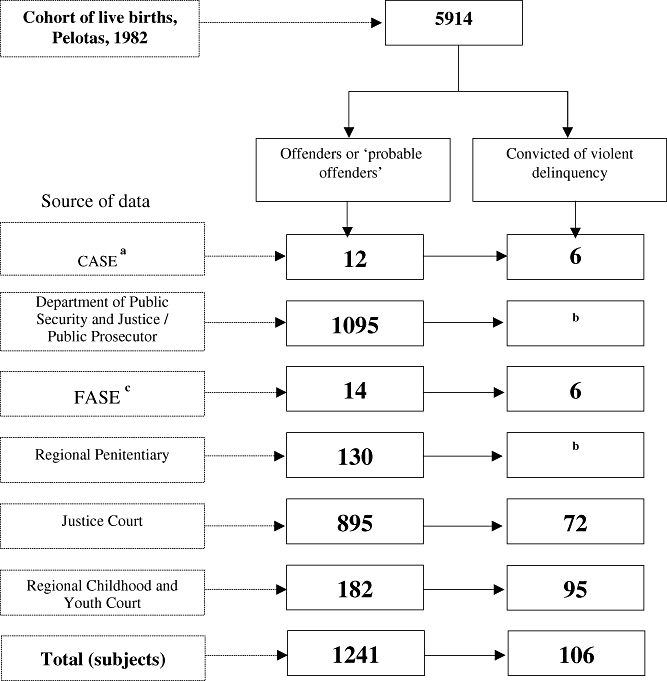
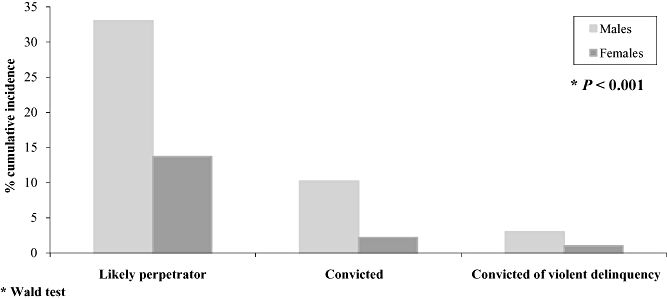
We investigated the association between breast feeding, economic factors and conviction for violent delinquency by age 25 years among subjects of the 1982 Birth Cohort from Pelotas, Southern Brazil. Information on breast-feeding pattern and duration was collected in childhood, during the 1983, 1984 and 1986 follow-ups. Information on socio-economic and family characteristics was also obtained between 1982 and 1996. Of the 5914 livebirths enrolled in the cohort, 5228 had obtained an identification document within the state of Rio Grande do Sul, and could thus be identified in judiciary databases. The outcome studied was conviction due to a violent act between ages 12 and 25 years. A total of 106 young people had been convicted at least once (3.0% of men and 1.0% of women). Subjects born to black or mixed mothers and coming from low-income families were at higher risk of having been convicted. Neither crude nor adjusted analyses showed any association between breast feeding and conviction for violent delinquency. Violent delinquency apparently depends more on social factors than on individual factors such as breast feeding.
我们调查了母乳喂养、经济因素与暴力犯罪定罪之间的关联,研究对象为来自巴西南部佩洛塔斯的 1982 年出生队列的 25 岁以下人群。在儿童时期(1983、1984 和 1986 年随访期间)收集了母乳喂养模式和持续时间的信息。还在 1982 年至 1996 年期间获得了社会经济和家庭特征的信息。在该队列中登记的 5914 例活产儿中,有 5228 例在南里奥格兰德州获得了身份证明文件,因此可以在司法数据库中识别。研究的结果是 12 至 25 岁之间因暴力行为被定罪的情况。共有 106 名年轻人至少被判过一次罪(男性 3.0%,女性 1.0%)。出生时母亲为黑人或混血儿且来自低收入家庭的受试者被判有罪的风险更高。无论是原始分析还是调整分析都没有显示母乳喂养与暴力犯罪定罪之间存在任何关联。暴力犯罪显然更多地取决于社会因素,而不是母乳喂养等个人因素。