Department of Molecular Biology, Massachusetts General Hospital, Boston, MA 02114, USA.
Cell. 2010 Jan 8;140(1):99-110. doi: 10.1016/j.cell.2009.12.022.
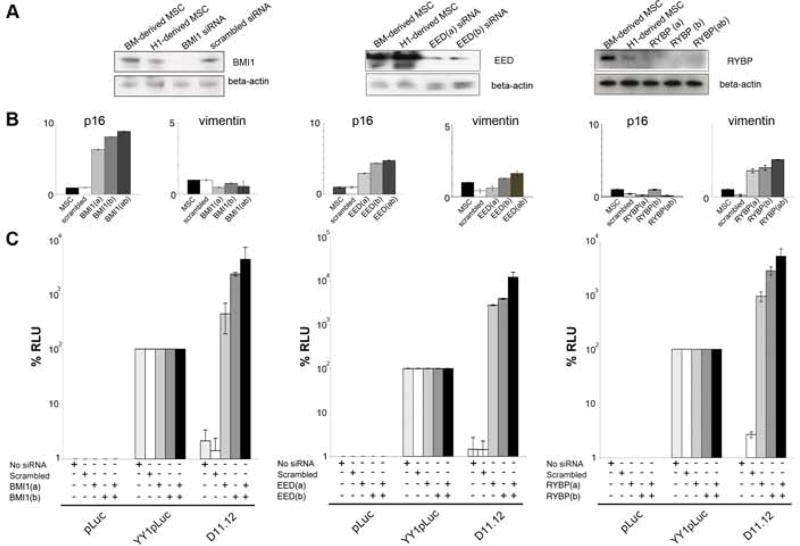
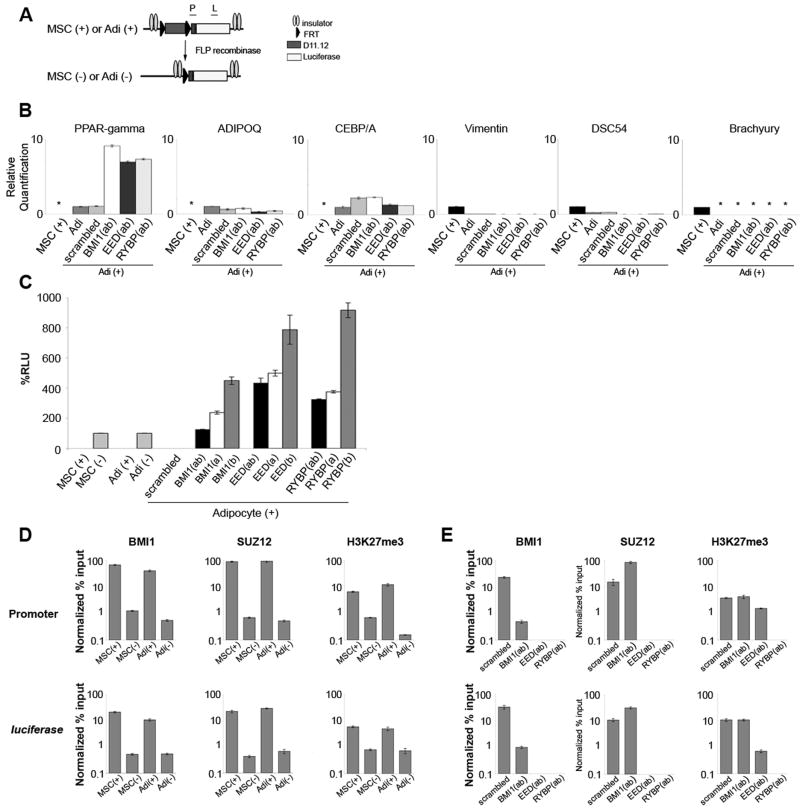
Polycomb group (PcG) proteins are essential for accurate axial body patterning during embryonic development. PcG-mediated repression is conserved in metazoans and is targeted in Drosophila by Polycomb response elements (PREs). However, targeting sequences in humans have not been described. While analyzing chromatin architecture in the context of human embryonic stem cell (hESC) differentiation, we discovered a 1.8kb region between HOXD11 and HOXD12 (D11.12) that is associated with PcG proteins, becomes nuclease hypersensitive, and then shows alteration in nuclease sensitivity as hESCs differentiate. The D11.12 element repressed luciferase expression from a reporter construct and full repression required a highly conserved region and YY1 binding sites. Furthermore, repression was dependent on the PcG proteins BMI1 and EED and a YY1-interacting partner, RYBP. We conclude that D11.12 is a Polycomb-dependent regulatory region with similarities to Drosophila PREs, indicating conservation in the mechanisms that target PcG function in mammals and flies.
多梳组(PcG)蛋白对于胚胎发育过程中准确的轴向体模式形成至关重要。PcG 介导的抑制作用在后生动物中是保守的,并在果蝇中由多梳反应元件(PREs)靶向。然而,人类的靶向序列尚未被描述。在分析人类胚胎干细胞(hESC)分化过程中的染色质结构时,我们发现了 HOXD11 和 HOXD12(D11.12)之间的一个 1.8kb 区域,该区域与 PcG 蛋白相关,变得对核酸酶敏感,然后在 hESC 分化时显示核酸酶敏感性的改变。D11.12 元件抑制了报告基因构建体的荧光素酶表达,完全抑制需要高度保守的区域和 YY1 结合位点。此外,抑制作用依赖于 PcG 蛋白 BMI1 和 EED 以及一个与 YY1 相互作用的伙伴 RYBP。我们得出结论,D11.12 是一个依赖于多梳的调节区域,与果蝇 PREs 具有相似性,表明在靶向 PcG 功能的机制在哺乳动物和果蝇中是保守的。