AgResearch, Grasslands Research Centre, Palmerston North, New Zealand.
PLoS One. 2010 Jan 14;5(1):e8698. doi: 10.1371/journal.pone.0008698.
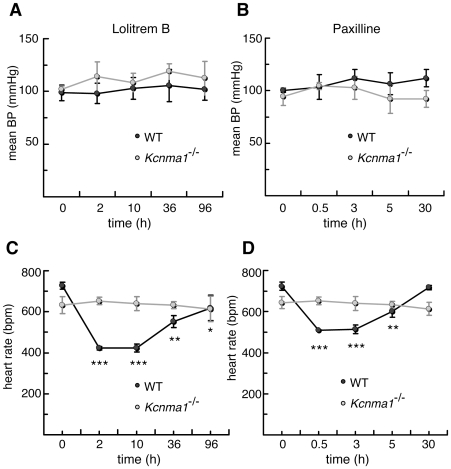
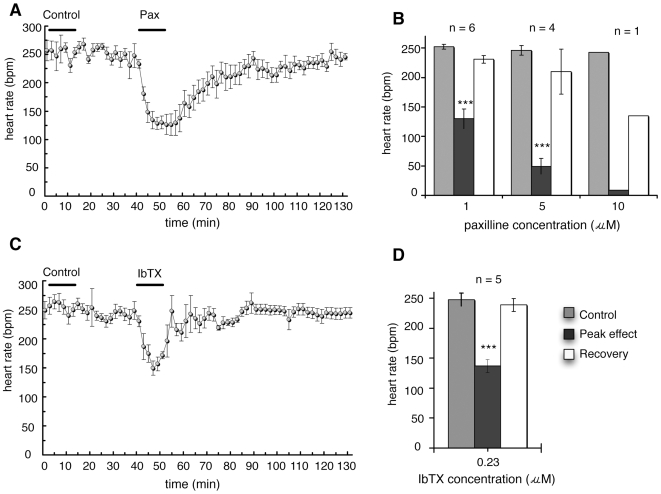
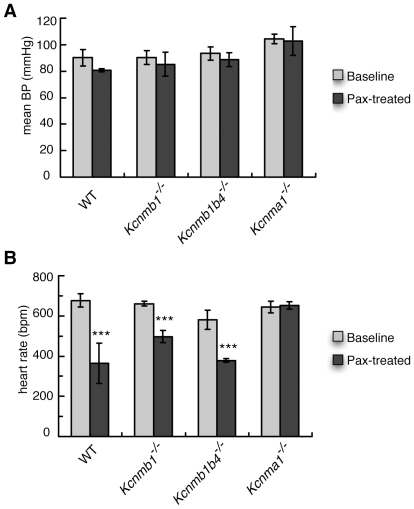
The heart generates and propagates action potentials through synchronized activation of ion channels allowing inward Na(+) and Ca(2+) and outward K(+) currents. There are a number of K(+) channel types expressed in the heart that play key roles in regulating the cardiac cycle. Large conductance calcium-activated potassium (BK) ion channels are not thought to be directly involved in heart function. Here we present evidence that heart rate can be significantly reduced by inhibiting the activity of BK channels. Agents that specifically inhibit BK channel activity, including paxilline and lolitrem B, slowed heart rate in conscious wild-type mice by 30% and 42%, respectively. Heart rate of BK channel knock-out mice (Kcnma1(-/-)) was not affected by these BK channel inhibitors, suggesting that the changes to heart rate were specifically mediated through BK channels. The possibility that these effects were mediated through BK channels peripheral to the heart was ruled out with experiments using isolated, perfused rat hearts, which showed a significant reduction in heart rate when treated with the BK channel inhibitors paxilline (1 microM), lolitrem B (1 microM), and iberiotoxin (0.23 microM), of 34%, 60%, and 42%, respectively. Furthermore, paxilline was shown to decrease heart rate in a dose-dependent manner. These results implicate BK channels located in the heart to be directly involved in the regulation of heart rate.
心脏通过离子通道的同步激活产生并传播动作电位,允许内向的 Na(+)和 Ca(2+)以及外向的 K(+)电流通过。心脏中表达了许多 K(+)通道类型,它们在调节心脏周期中起着关键作用。大电导钙激活钾 (BK) 离子通道被认为不直接参与心脏功能。在这里,我们提供的证据表明,抑制 BK 通道的活性可以显著降低心率。专门抑制 BK 通道活性的药物,包括 paxilline 和 lolitrem B,分别使清醒的野生型小鼠的心率降低了 30%和 42%。BK 通道敲除小鼠 (Kcnma1(-/-)) 的心率不受这些 BK 通道抑制剂的影响,这表明心率的变化是通过 BK 通道特异性介导的。通过使用分离的灌注大鼠心脏进行的实验排除了这些作用是通过心脏以外的 BK 通道介导的可能性,当用 BK 通道抑制剂 paxilline (1 microM)、lolitrem B (1 microM) 和 iberiotoxin (0.23 microM) 处理时,这些抑制剂分别使心率显著降低了 34%、60%和 42%。此外,paxilline 被证明以剂量依赖的方式降低心率。这些结果表明,位于心脏中的 BK 通道直接参与了心率的调节。