Essawy Hisham, Tauer Klaus
Colloid Polym Sci. 2010 Feb;288(3):317-331. doi: 10.1007/s00396-009-2175-0. Epub 2010 Jan 6.
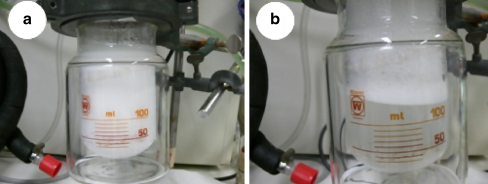
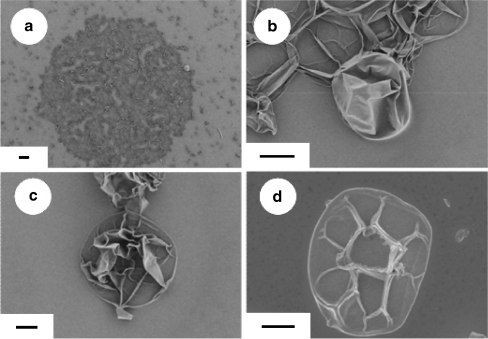
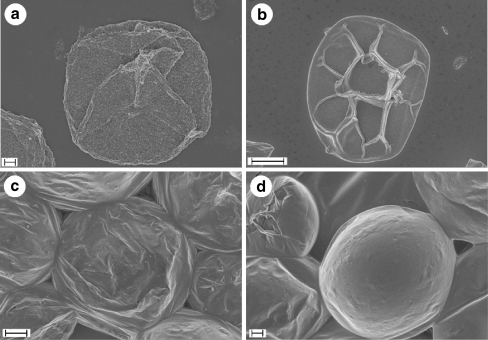
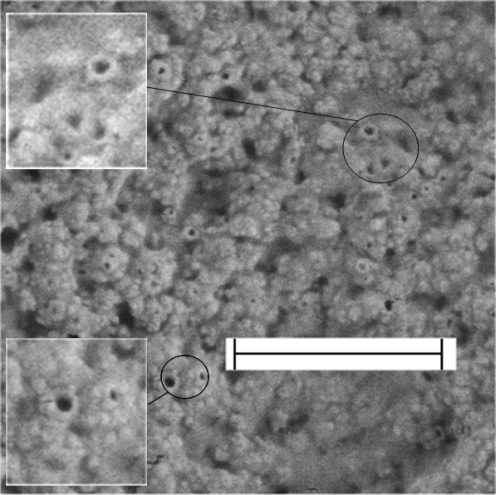
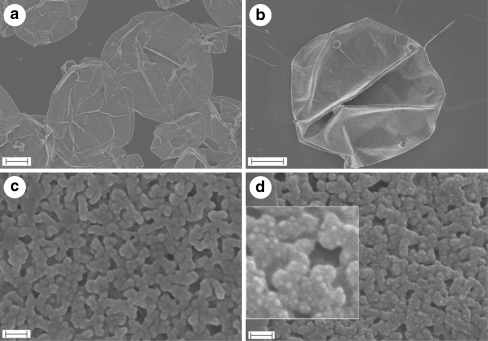
Poly(terephthalamide) microcapsules can be reproducibly and easily prepared by interfacial polycondensation around emulsion droplets in water. Oil drops of cyclohexane/chloroform mixture stabilized with poly(vinyl alcohol) containing terephthaloylchloride serve as soft template. The interfacial polycondensation starts immediately after addition of an amine mixture (hexamethylenediamine/diethylenetriamine). Light and scanning electron microscopy prove the formation of capsules with size distribution in the range from a few up to 100 microm depending on particular composition of the reaction mixture. The morphology of the capsule wall is characterized by precipitated particles. If instead of pure organic solvents a reactive oil phase is used as template, the capsules can serve in subsequent reactions as templates for the synthesis of composite particles. In this way, styrene can be radically polymerized inside the capsule leading to composite capsules. The capsule morphology is determined by the partition of all components between all phases.
聚对苯二甲酰胺微胶囊可通过水相中乳液滴周围的界面缩聚反应可重复且轻松地制备。用含有对苯二甲酰氯的聚乙烯醇稳定的环己烷/氯仿混合物油滴用作软模板。在加入胺混合物(六亚甲基二胺/二亚乙基三胺)后,界面缩聚反应立即开始。光学显微镜和扫描电子显微镜证明形成了尺寸分布在几微米到100微米范围内的胶囊,这取决于反应混合物的特定组成。胶囊壁的形态以沉淀颗粒为特征。如果使用反应性油相代替纯有机溶剂作为模板,这些胶囊可在后续反应中用作合成复合颗粒的模板。通过这种方式,苯乙烯可在胶囊内部进行自由基聚合,从而得到复合胶囊。胶囊的形态由所有组分在各相之间的分配决定。