Institute of Anatomy, Medical Faculty Carl Gustav Carus, Dresden University of Technology, Dresden, Germany.
PLoS One. 2010 Jan 19;5(1):e8762. doi: 10.1371/journal.pone.0008762.
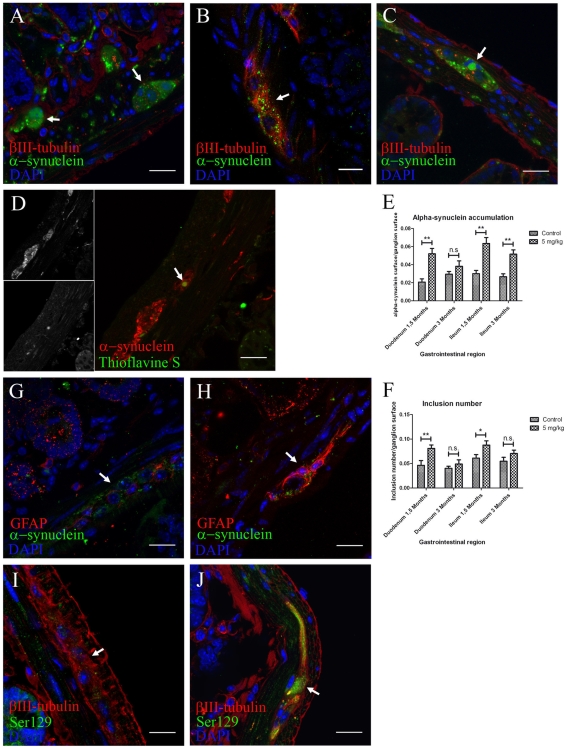
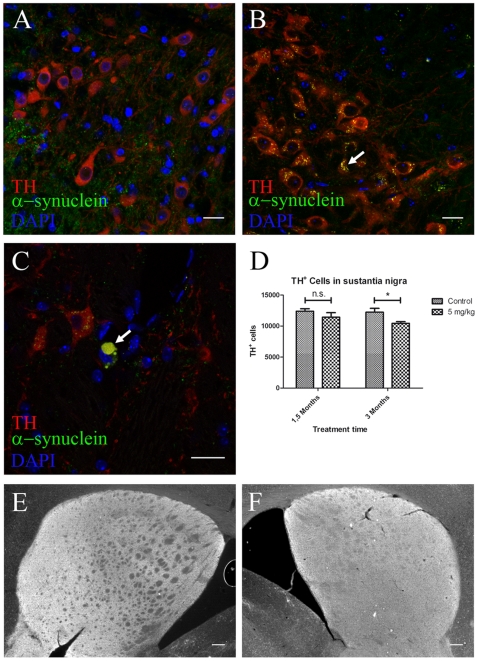
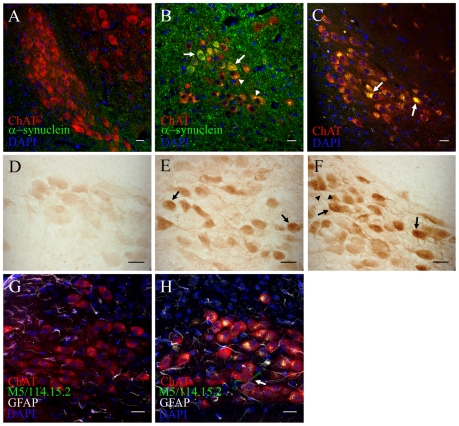
In patients with Parkinson's disease (PD), the associated pathology follows a characteristic pattern involving inter alia the enteric nervous system (ENS), the dorsal motor nucleus of the vagus (DMV), the intermediolateral nucleus of the spinal cord and the substantia nigra, providing the basis for the neuropathological staging of the disease. Here we report that intragastrically administered rotenone, a commonly used pesticide that inhibits Complex I of the mitochondrial respiratory chain, is able to reproduce PD pathological staging as found in patients. Our results show that low doses of chronically and intragastrically administered rotenone induce alpha-synuclein accumulation in all the above-mentioned nervous system structures of wild-type mice. Moreover, we also observed inflammation and alpha-synuclein phosphorylation in the ENS and DMV. HPLC analysis showed no rotenone levels in the systemic blood or the central nervous system (detection limit [rotenone]<20 nM) and mitochondrial Complex I measurements showed no systemic Complex I inhibition after 1.5 months of treatment. These alterations are sequential, appearing only in synaptically connected nervous structures, treatment time-dependent and accompanied by inflammatory signs and motor dysfunctions. These results strongly suggest that the local effect of pesticides on the ENS might be sufficient to induce PD-like progression and to reproduce the neuroanatomical and neurochemical features of PD staging. It provides new insight into how environmental factors could trigger PD and suggests a transsynaptic mechanism by which PD might spread throughout the central nervous system.
在帕金森病(PD)患者中,相关的病理学遵循一种特征性模式,涉及肠神经系统(ENS)、迷走神经背核(DMV)、脊髓中间外侧核和黑质等,为疾病的神经病理学分期提供了基础。在这里,我们报告胃内给予鱼藤酮,一种常用于抑制线粒体呼吸链复合物 I 的杀虫剂,能够复制患者中发现的 PD 病理分期。我们的结果表明,慢性和胃内给予低剂量的鱼藤酮会导致野生型小鼠所有上述神经系统结构中α-突触核蛋白的积累。此外,我们还观察到 ENS 和 DMV 中的炎症和α-突触核蛋白磷酸化。HPLC 分析显示系统血液或中枢神经系统(检测限[鱼藤酮] <20 nM)中没有鱼藤酮水平,并且在 1.5 个月的治疗后线粒体复合物 I 测量没有显示系统复合物 I 抑制。这些改变是顺序发生的,仅出现在突触连接的神经结构中,与炎症迹象和运动功能障碍有关,且与治疗时间有关。这些结果强烈表明,杀虫剂对 ENS 的局部作用足以诱导 PD 样进展,并复制 PD 分期的神经解剖和神经化学特征。它为环境因素如何引发 PD 提供了新的见解,并提示了 PD 可能通过突触传递机制在中枢神经系统中传播的机制。