Finding Species, Takoma Park, Maryland, United States of America.
PLoS One. 2010 Jan 19;5(1):e8767. doi: 10.1371/journal.pone.0008767.
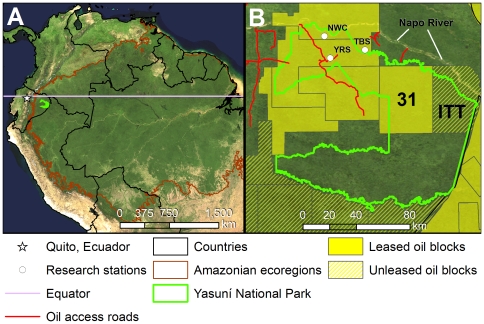
The threats facing Ecuador's Yasuní National Park are emblematic of those confronting the greater western Amazon, one of the world's last high-biodiversity wilderness areas. Notably, the country's second largest untapped oil reserves--called "ITT"--lie beneath an intact, remote section of the park. The conservation significance of Yasuní may weigh heavily in upcoming state-level and international decisions, including whether to develop the oil or invest in alternatives.
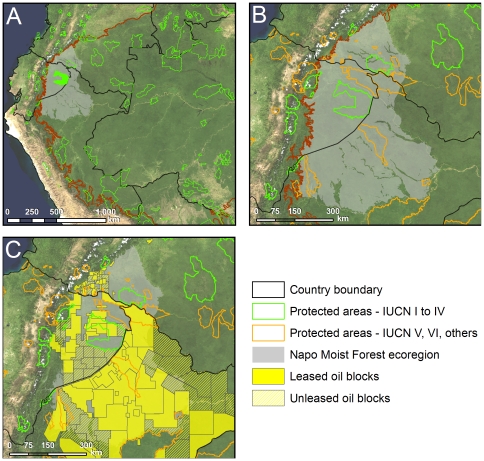
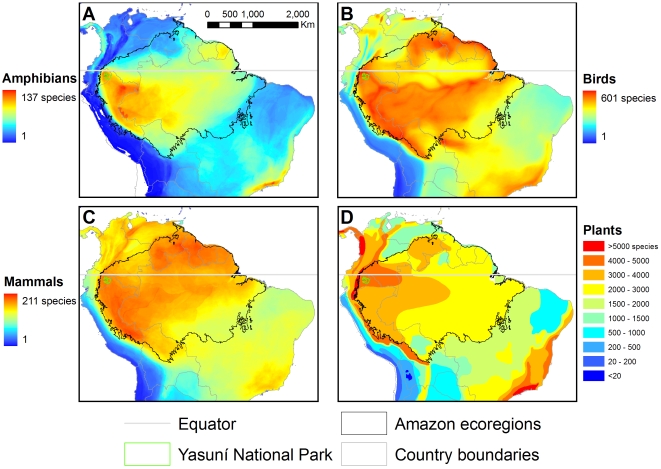
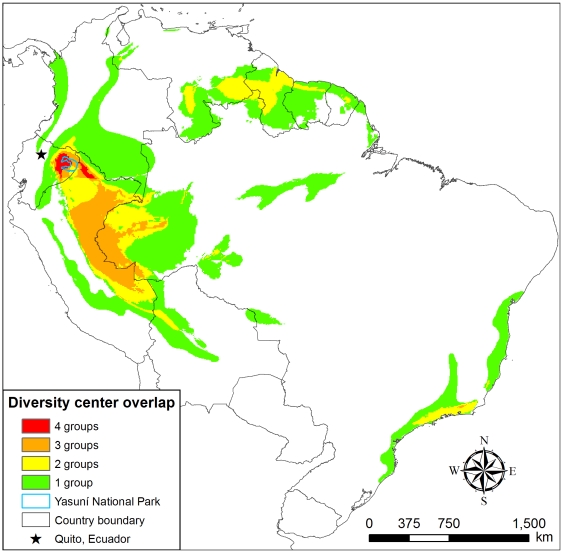
METHODOLOGY/PRINCIPAL FINDINGS: We conducted the first comprehensive synthesis of biodiversity data for Yasuní. Mapping amphibian, bird, mammal, and plant distributions, we found eastern Ecuador and northern Peru to be the only regions in South America where species richness centers for all four taxonomic groups overlap. This quadruple richness center has only one viable strict protected area (IUCN levels I-IV): Yasuní. The park covers just 14% of the quadruple richness center's area, whereas active or proposed oil concessions cover 79%. Using field inventory data, we compared Yasuní's local (alpha) and landscape (gamma) diversity to other sites, in the western Amazon and globally. These analyses further suggest that Yasuní is among the most biodiverse places on Earth, with apparent world richness records for amphibians, reptiles, bats, and trees. Yasuní also protects a considerable number of threatened species and regional endemics.
CONCLUSIONS/SIGNIFICANCE: Yasuní has outstanding global conservation significance due to its extraordinary biodiversity and potential to sustain this biodiversity in the long term because of its 1) large size and wilderness character, 2) intact large-vertebrate assemblage, 3) IUCN level-II protection status in a region lacking other strict protected areas, and 4) likelihood of maintaining wet, rainforest conditions while anticipated climate change-induced drought intensifies in the eastern Amazon. However, further oil development in Yasuní jeopardizes its conservation values. These findings form the scientific basis for policy recommendations, including stopping any new oil activities and road construction in Yasuní and creating areas off-limits to large-scale development in adjacent northern Peru.
厄瓜多尔亚苏尼国家公园所面临的威胁是整个西亚马逊地区所面临威胁的缩影,而后者是世界上最后几个高生物多样性的荒野地区之一。值得注意的是,该国第二大未开发的石油储备——被称为“ITT”——位于该公园一个完整的偏远地区之下。亚苏尼的保护意义可能会在即将到来的国家和国际决策中产生重大影响,包括是开发石油还是投资于替代方案。
方法/主要发现:我们对亚苏尼的生物多样性数据进行了首次全面综合分析。通过绘制两栖动物、鸟类、哺乳动物和植物的分布地图,我们发现厄瓜多尔东部和秘鲁北部是南美洲唯一一个四个分类群的物种丰富度中心重叠的地区。这个四重丰富度中心只有一个可行的严格保护区(IUCN 级别 I-IV):亚苏尼。该公园仅覆盖四重丰富度中心面积的 14%,而活跃或提议的石油特许权则覆盖 79%。我们使用实地调查数据,将亚苏尼的本地(α)和景观(γ)多样性与西亚马逊和全球其他地区的其他地点进行了比较。这些分析进一步表明,亚苏尼是地球上生物多样性最丰富的地方之一,其两栖动物、爬行动物、蝙蝠和树木的物种丰富度可能创世界纪录。亚苏尼还保护着大量受威胁的物种和区域性特有物种。
结论/意义:由于其非凡的生物多样性和长期维持生物多样性的潜力,亚苏尼具有突出的全球保护意义,这主要是由于其 1)面积大且原始,2)完整的大型脊椎动物组合,3)在一个缺乏其他严格保护区的地区具有 IUCN 二级保护地位,以及 4)在预期的亚马逊东部干旱加剧的情况下,有维持湿润雨林条件的可能性。然而,在亚苏尼进一步开发石油会危及它的保护价值。这些发现为政策建议提供了科学依据,包括停止在亚苏尼进行任何新的石油活动和道路建设,并在相邻的秘鲁北部划定禁止大规模开发的区域。