Pettit Syril, des Etages Shelley Ann, Mylecraine Louis, Snyder Ronald, Fostel Jennifer, Dunn Robert T, Haymes Kenneth, Duval Manuel, Stevens James, Afshari Cynthia, Vickers Alison
ILSI Health and Environmental Sciences Institute, Washington, DC 20005, USA.
Environ Health Perspect. 2010 Jul;118(7):992-7. doi: 10.1289/ehp.0901501. Epub 2010 Jan 25.
In spite of the application of toxicogenomic (TGx) data to the field of toxicology for the past 10 years, the broad implementation and full impact of TGx for chemical and drug evaluation to improve decision making within organizations and by policy makers has not been achieved.
The goal of the Health and Environmental Sciences Institute (HESI) Committee on the Application of Genomics to Mechanism-based Risk Assessment was to construct and summarize a multisector survey, addressing key issues and perspectives on the current and future practical uses and challenges of implementing TGx data to facilitate discussions for decision making within organizations and by policy makers.
An online survey to probe the current status and future challenges facing the field of TGx for drug and chemical evaluation in experimental and nonclinical models was taken by scientists and scientific decision/policy makers actively engaged in the field of TGx within industrial, academic, and regulatory sectors of the United States, Europe, and Japan. For this survey, TGx refers specifically to the analysis of gene expression responses to evaluate xenobiotic exposure in experimental and preclinical models.
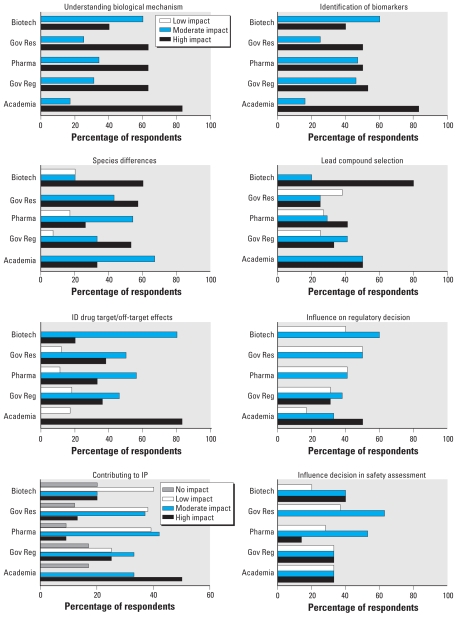
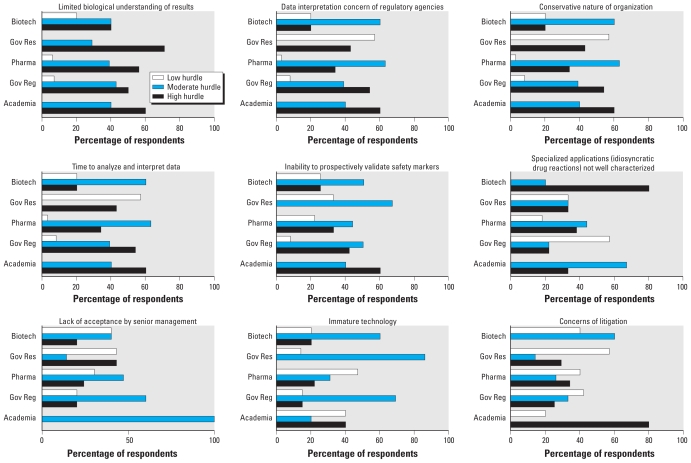
The survey results are summarized from questions covering broad areas including technology used, organizational capacity and resource allocation, experimental approaches, data storage and exchange, perceptions of benefits and hurdles, and future expectations.
The survey findings provide valuable information on the current state of the science of TGx applications and identify key areas in which TGx will have an impact as well as the key hurdles in applying TGx data to address issues. The findings serve as a public resource to facilitate discussions on the focus of future TGx efforts to ensure that a maximal benefit can be obtained from toxicogenomic studies.
尽管在过去十年中毒理基因组学(TGx)数据已应用于毒理学领域,但在化学和药物评估中广泛实施TGx并充分发挥其对组织内决策以及政策制定者决策的影响尚未实现。
健康与环境科学研究所(HESI)基因组学应用于基于机制的风险评估委员会的目标是构建并总结一项多部门调查,探讨有关实施TGx数据当前和未来实际用途及挑战的关键问题和观点,以促进组织内和政策制定者的决策讨论。
美国、欧洲和日本工业、学术和监管部门中积极从事TGx领域工作的科学家以及科学决策/政策制定者参与了一项在线调查,以探究TGx在实验和非临床模型中用于药物和化学评估领域所面临的现状和未来挑战。对于本次调查,TGx具体指分析基因表达反应以评估实验和临床前模型中的异源物质暴露。
调查结果是对涵盖广泛领域问题的总结,这些领域包括所使用的技术、组织能力和资源分配、实验方法、数据存储和交换、对益处和障碍的看法以及未来期望。
调查结果提供了关于TGx应用科学现状的宝贵信息,确定了TGx将产生影响的关键领域以及应用TGx数据解决问题的关键障碍。这些结果作为一种公共资源,有助于促进关于未来TGx工作重点的讨论,以确保从毒理基因组学研究中获得最大益处。