Metcalfe Kelly A, Ghadirian Parviz, Rosen Barry, Foulkes William, Kim-Sing Charmaine, Eisen Andrea, Ainsworth Peter, Horsman Doug, Maugard Christine, Provencher Diane, Robideaux André, Gilchrist Dawna, Chudley Albert, Lemire Edmond G, Armel Susan, Finch Amy, Sun Ping, Narod Steven A
Open Med. 2007 Aug 13;1(2):e92-8.
Women with a BRCA1 or BRCA2 genetic mutation have several options for cancer prevention, including prophylactic surgery, chemoprevention and screening. In this study we report on preventive practices used by women with and without breast cancer and examine differences in their selection of preventive practices according to geographic area in Canada.
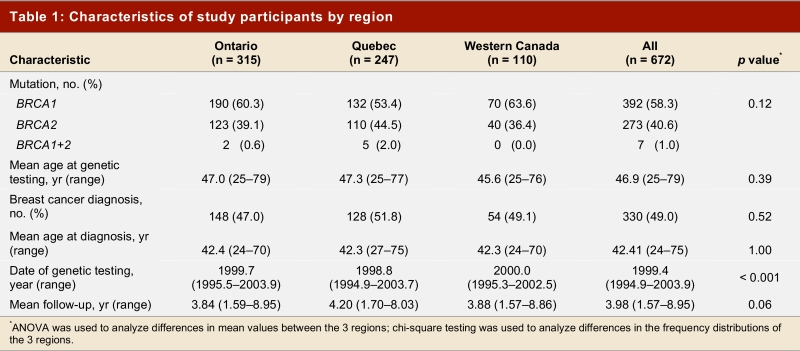
Canadian women with a BRCA1 or BRCA2 mutation were followed after genetic testing and questioned about their preventive practices. Women reported on uptake of prophylactic mastectomy, prophylactic oophorectomy, tamoxifen or raloxifene usage and screening practices. We analyzed the uptake of each preventive option and completed a subanalysis according to the geographic area in Canada where genetic testing was provided.
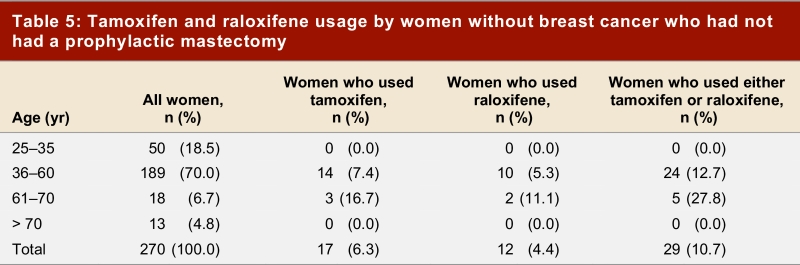
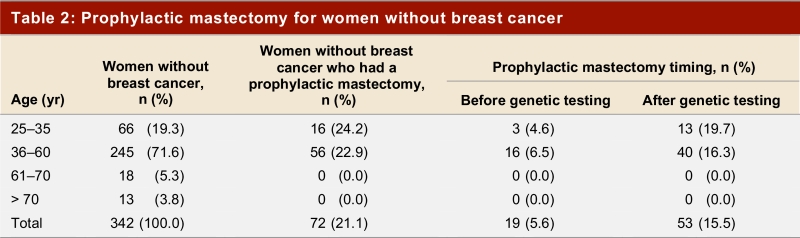
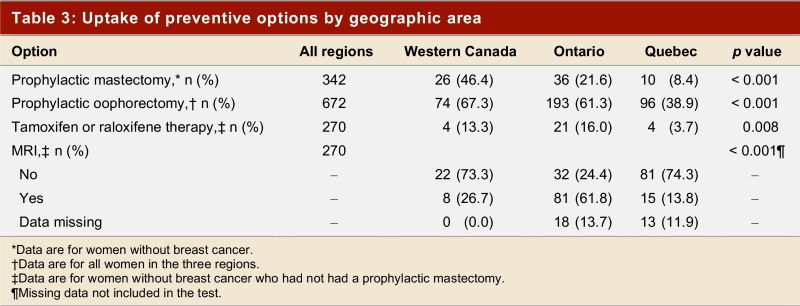
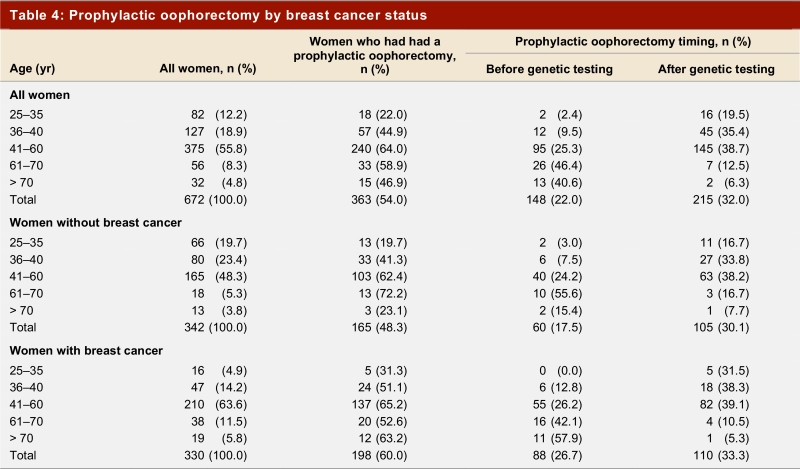
The study included 672 women. Follow-up questionnaires were completed after a mean of 4.0 years (range 1.6-9.1 years). Of the 342 women without breast cancer, 72 (21%) had had a prophylactic bilateral mastectomy. Three hundred and sixty-three women (54%) had had a bilateral prophylactic oophorectomy. Seventeen (6%) of the 270 women without breast cancer who had not had a prophylactic mastectomy took tamoxifen, and 12 (4%) reported taking raloxifene. Of the 342 women without breast cancer, 157 (46%) had not undertaken any cancer prevention option (mastectomy, oophorectomy or treatment with tamoxifen or raloxifene). Sixty-five (39%) of the 167 women from Ontario, 19 (34%) of the 56 women from Western Canada and 73 (62%) of the 119 women from Quebec had not undertaken any preventive procedure.
Significant differences in the uptake of preventive options by women with a BRCA1 or BRCA2 mutation were observed across 3 regions of Canada. Future research is needed to explain why these differences exist.
携带BRCA1或BRCA2基因突变的女性有多种癌症预防选择,包括预防性手术、化学预防和筛查。在本研究中,我们报告了患有和未患乳腺癌的女性所采用的预防措施,并根据加拿大的地理区域研究她们在预防措施选择上的差异。
对接受基因检测后的加拿大BRCA1或BRCA2基因突变女性进行随访,并询问她们的预防措施。女性报告了预防性乳房切除术、预防性卵巢切除术、他莫昔芬或雷洛昔芬的使用情况以及筛查措施。我们分析了每种预防措施的采用情况,并根据提供基因检测的加拿大地理区域进行了亚组分析。
该研究纳入了672名女性。平均4.0年(范围1.6 - 9.1年)后完成了随访问卷调查。在342名未患乳腺癌的女性中,72名(21%)进行了双侧预防性乳房切除术。363名女性(54%)进行了双侧预防性卵巢切除术。在270名未进行预防性乳房切除术的未患乳腺癌女性中,17名(6%)服用了他莫昔芬,12名(4%)报告服用了雷洛昔芬。在342名未患乳腺癌的女性中,157名(46%)未采取任何癌症预防措施(乳房切除术、卵巢切除术或他莫昔芬或雷洛昔芬治疗)。安大略省167名女性中的65名(39%)、加拿大西部56名女性中的19名(34%)以及魁北克省119名女性中的73名(62%)未采取任何预防措施。
在加拿大的三个地区,观察到携带BRCA1或BRCA2基因突变的女性在预防措施采用方面存在显著差异。需要进一步的研究来解释这些差异存在的原因。