Larry Hillblom Islet Research Center, University of California, Los Angeles, David Geffen School of Medicine, Los Angeles, California, USA.
Diabetes. 2010 Apr;59(4):987-96. doi: 10.2337/db09-0838. Epub 2010 Jan 26.
A major determinant of the progression from insulin resistance to the development of overt type 2 diabetes is a failure to mount an appropriate compensatory beta-cell hyperplastic response to maintain normoglycemia. We undertook the present study to directly explore the significance of the cell cycle protein cyclin D2 in the expansion of beta-cell mass in two different models of insulin resistance.
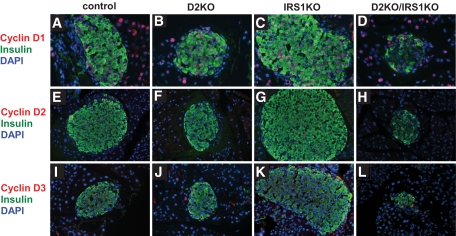
We created compound knockouts by crossing mice deficient in cyclin D2 (D2KO) with either the insulin receptor substrate 1 knockout (IRS1KO) mice or the insulin receptor liver-specific knockout mice (LIRKO), neither of which develops overt diabetes on its own because of robust compensatory beta-cell hyperplasia. We phenotyped the double knockouts and used RT-qPCR and immunohistochemistry to examine beta-cell mass.
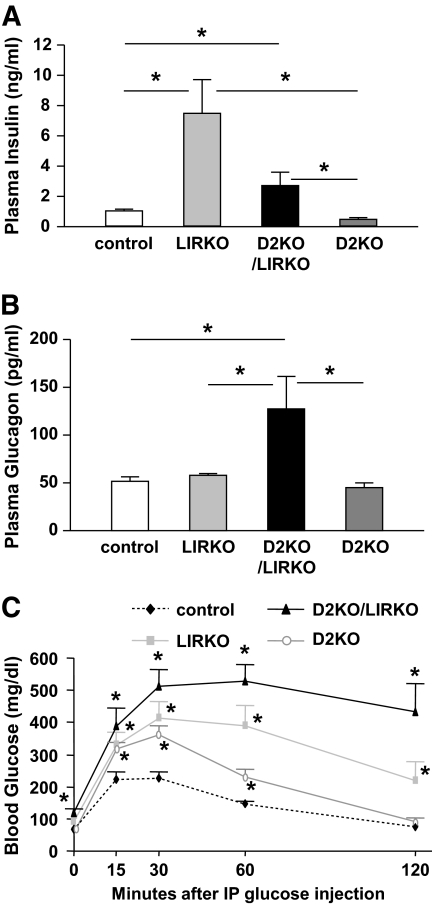
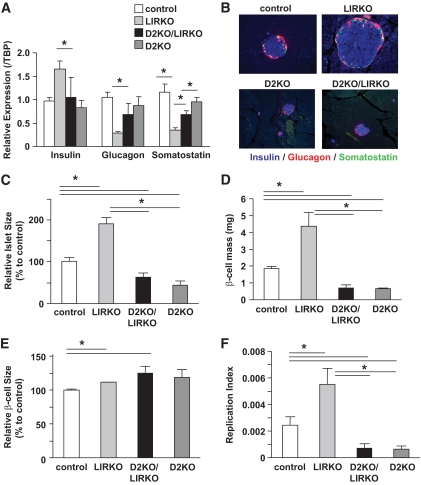
Both compound knockouts, D2KO/LIRKO and D2KO/IRS1KO, exhibited insulin resistance and hyperinsulinemia and an absence of compensatory beta-cell hyperplasia. However, the diabetic D2KO/LIRKO group rapidly succumbed early compared with a relatively normal lifespan in the glucose-intolerant D2KO/IRS1KO mice.
This study provides direct genetic evidence that cyclin D2 is essential for the expansion of beta-cell mass in response to a spectrum of insulin resistance and points to the cell-cycle protein as a potential therapeutic target that can be harnessed for preventing and curing type 2 diabetes.
从胰岛素抵抗发展为显性 2 型糖尿病的一个主要决定因素是β细胞无法对维持正常血糖水平的适当代偿性增生反应。我们进行了本研究,以直接探讨细胞周期蛋白 D2 在两种不同胰岛素抵抗模型中β细胞质量扩张中的意义。
我们通过将缺乏细胞周期蛋白 D2(D2KO)的小鼠与胰岛素受体底物 1 敲除(IRS1KO)小鼠或胰岛素受体肝特异性敲除(LIRKO)小鼠杂交,创建了复合敲除小鼠,后者本身不会因强大的代偿性β细胞增生而发展为显性糖尿病。我们对双敲除小鼠进行表型分析,并使用 RT-qPCR 和免疫组织化学检查β细胞质量。
两种复合敲除小鼠,D2KO/LIRKO 和 D2KO/IRS1KO,均表现出胰岛素抵抗和高胰岛素血症,以及缺乏代偿性β细胞增生。然而,与葡萄糖耐量不良的 D2KO/IRS1KO 小鼠相比,糖尿病的 D2KO/LIRKO 组早期迅速死亡。
这项研究提供了直接的遗传证据,表明细胞周期蛋白 D2 是β细胞质量对胰岛素抵抗谱扩张所必需的,并指出细胞周期蛋白作为一种潜在的治疗靶点,可以用于预防和治疗 2 型糖尿病。