Jacob Eufemia, Hockenberry Marilyn, Mueller Brigitta U, Coates Thomas D, Zeltzer Lonnie
TUCLA School of Nursing, Los Angeles, California.
J Pain Manag. 2008;2(1):179-190.
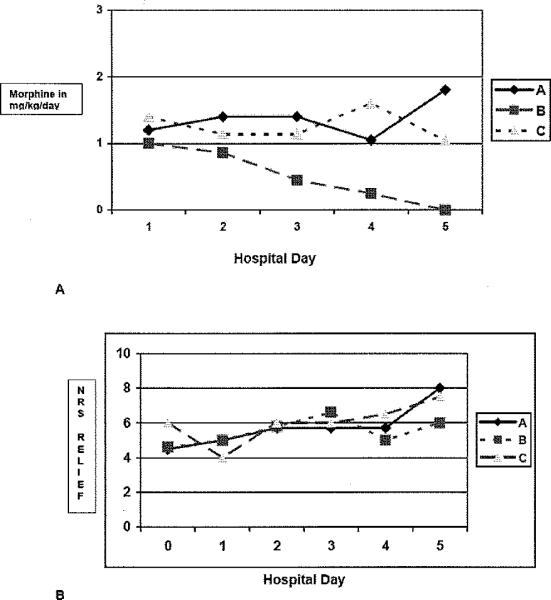
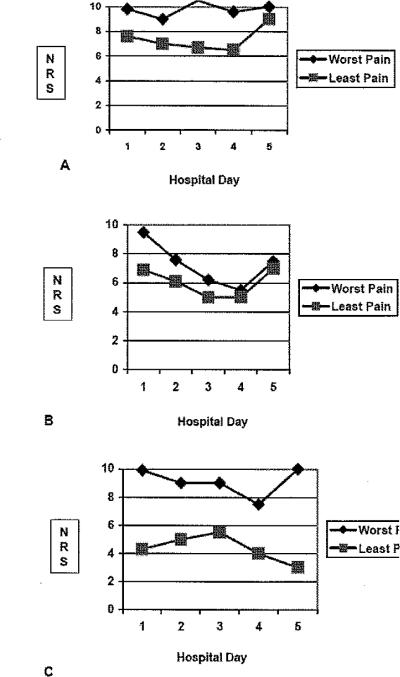
Morphine given by Patient Controlled Analgesia (PCA) is widely used in hospital settings to manage severe pain during acute painful episodes. Wide variations in prescription patterns occur and some patients are often self-administering sub- or low- therapeutic doses. In this preliminary study, a descriptive design with repeated measures was used to examine the effects of different PCA morphine regimens on the intensity, location and quality of pain as well as on the perceived amount of relief and side effects in patients with sickle cell disease (N=13; mean age 13.7 years; eight males; five females). The preliminary data showed that a regimen with a high background infusion rate and low intermittent push dose (Regimen B) may provide better response to PCA morphine. The difference in trends between the worst and least pain intensity ratings were narrower in this regimen, suggesting that pain peaks and troughs were not occurring as in a regimen with an around the clock nurse administered dosing schedule (Regimen C). The amount of morphine that was administered per day was not significantly different (p > 0.05) among the three morphine regimens. The combination of a high background infusion rate and low intermittent push dose (as in Regimen B) within the first 24 hours of admission, may provide improved response and possibly shorter recovery from the painful episode than the regimen that would routinely be prescribed with lower background infusion rate and high intermittent push dose (as in regimen A).
患者自控镇痛(PCA)给予的吗啡在医院环境中广泛用于管理急性疼痛发作期间的重度疼痛。处方模式存在很大差异,一些患者经常自行给予低于或低于治疗剂量的药物。在这项初步研究中,采用具有重复测量的描述性设计,以检查不同PCA吗啡方案对镰状细胞病患者(N = 13;平均年龄13.7岁;8名男性;5名女性)疼痛的强度、部位和性质以及对缓解程度和副作用的影响。初步数据表明,具有高背景输注速率和低间歇性推注剂量的方案(方案B)可能对PCA吗啡有更好的反应。在该方案中,最严重和最轻疼痛强度评分之间的趋势差异较小,这表明疼痛高峰和低谷不像采用全天候护士给药时间表的方案(方案C)那样出现。三种吗啡方案之间每天给予的吗啡量没有显著差异(p>0.05)。与常规采用较低背景输注速率和高间歇性推注剂量(如方案A)的方案相比,入院后24小时内采用高背景输注速率和低间歇性推注剂量(如方案B)的组合可能会提供更好的反应,并可能缩短疼痛发作后的恢复时间。