Center for Regenerative Medicine and Department of Neurosurgery, Massachusetts General Hospital, Harvard Medical School, Boston, MA, USA.
Department of Stem Cell and Regenerative Biology and Harvard Stem Cell Institute, Harvard University, Cambridge, MA, USA.
Bioessays. 2010 Mar;32(3):197-206. doi: 10.1002/bies.200900114.
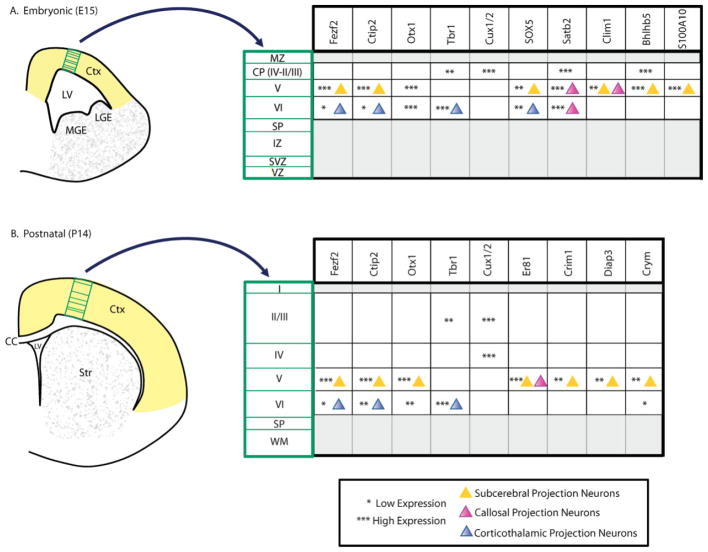
The mature cerebral cortex contains a staggering variety of projection neuron subtypes, and a number of complementary studies have recently begun to define their identity and embryonic origin. Among the different types of cortical projection neurons, subcerebral projection neurons, including corticospinal motor neurons (CSMN), have been extensively studied and some of the molecular controls over their differentiation have been elucidated. Here, we first provide an overview of the approaches used to purify and molecularly profile neuronal populations of the neocortex and, more broadly, of the central nervous system (CNS). Next, we specifically review recent progress in understanding the genes that define and control development of the CSMN population. Finally, we briefly discuss the relevance of this work to current questions regarding the mechanisms of the establishment of projection neuron subtype identity in the neocortex and its implications to direct the differentiation of CSMN for therapeutic benefit.
成熟的大脑皮层包含了令人惊讶的多种投射神经元亚型,最近有一些补充研究开始定义它们的身份和胚胎起源。在不同类型的皮质投射神经元中,包括皮质脊髓运动神经元(CSMN)在内的皮质下投射神经元已经得到了广泛的研究,并且已经阐明了一些控制其分化的分子机制。在这里,我们首先概述了用于纯化和分子分析新皮层以及更广泛的中枢神经系统(CNS)神经元群体的方法。接下来,我们特别回顾了最近在理解定义和控制 CSMN 群体发育的基因方面的进展。最后,我们简要讨论了这项工作与目前关于在新皮层中建立投射神经元亚型身份的机制的问题以及其对指导 CSMN 分化以获得治疗益处的相关性。