Department of Biochemistry and Molecular Biology, New York Medical College, Valhalla, New York 10595, USA.
Biochemistry. 2010 Mar 9;49(9):1822-32. doi: 10.1021/bi901974a.
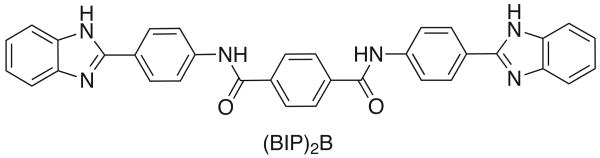
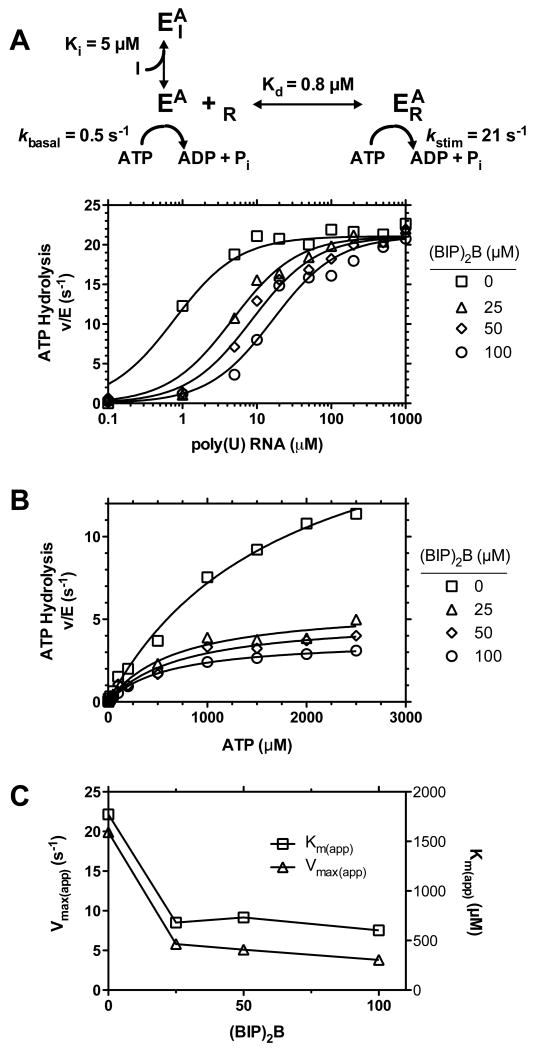
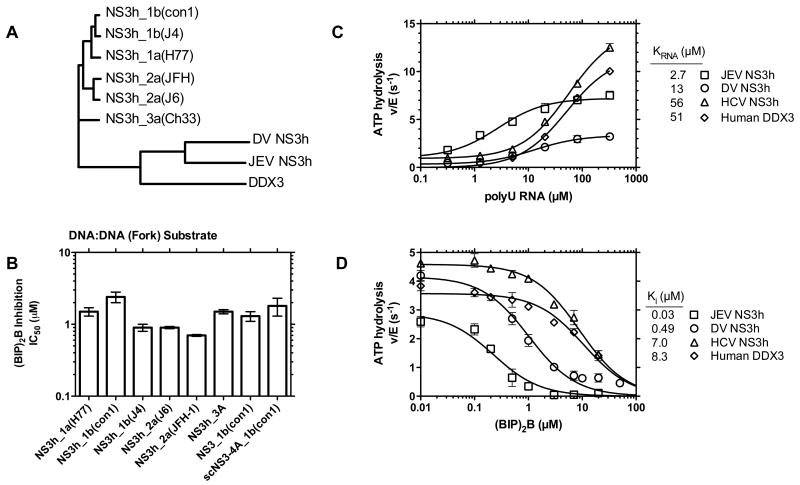
This study examines the effects of 1-N,4-N-bis[4-(1H-benzimidazol-2-yl)phenyl]benzene-1,4-dicarboxamide ((BIP)(2)B) on the NS3 helicase encoded by the hepatitis C virus (HCV). Molecular beacon-based helicase assays were used to show that (BIP)(2)B inhibits the ability of HCV helicase to separate a variety of RNA and DNA duplexes with half-maximal inhibitory concentrations ranging from 0.7 to 5 microM, depending on the nature of the substrate. In single turnover assays, (BIP)(2)B only inhibited unwinding reactions when it was preincubated with the helicase-nucleic acid complex. (BIP)(2)B quenched NS3 intrinsic protein fluorescence with an apparent dissociation constant of 5 microM, and in the presence of (BIP)(2)B, HCV helicase did not appear to interact with a fluorescent DNA oligonucleotide. In assays monitoring HCV helicase-catalyzed ATP hydrolysis, (BIP)(2)B only inhibited helicase-catalyzed ATP hydrolysis in the presence of intermediate concentrations of RNA, suggesting RNA and (BIP)(2)B compete for the same binding site. HCV helicases isolated from various HCV genotypes were similarly sensitive to (BIP)(2)B, with half-maximal inhibitory concentrations ranging from 0.7 to 2.4 microM. (BIP)(2)B also inhibited ATP hydrolysis catalyzed by related helicases from Dengue virus, Japanese encephalitis virus, and humans. (BIP)(2)B appeared to bind the HCV and human proteins with similar affinity (K(i) = 7 and 8 microM, respectively), but it bound the flavivirus proteins up to 270 times more tightly. Results are discussed in light of a molecular model of a (BIP)(2)B-HCV helicase complex, which is unable to bind nucleic acid, thus preventing the enzyme from separating double-stranded nucleic acid.
本研究考察了 1-N,4-N-双[4-(1H-苯并咪唑-2-基)苯基]苯-1,4-二羧酸酰胺((BIP)(2)B)对丙型肝炎病毒(HCV)编码的 NS3 解旋酶的影响。基于分子信标的解旋酶测定表明,(BIP)(2)B 抑制 HCV 解旋酶分离各种 RNA 和 DNA 双链的能力,其半抑制浓度范围为 0.7 至 5μM,取决于底物的性质。在单轮实验中,(BIP)(2)B 仅在与解旋酶-核酸复合物预孵育时才抑制解旋反应。(BIP)(2)B 猝灭 NS3 内在蛋白荧光的表观解离常数为 5μM,并且在(BIP)(2)B 的存在下,HCV 解旋酶似乎不与荧光 DNA 寡核苷酸相互作用。在监测 HCV 解旋酶催化的 ATP 水解的实验中,(BIP)(2)B 仅在存在中间浓度 RNA 的情况下抑制解旋酶催化的 ATP 水解,这表明 RNA 和(BIP)(2)B 竞争相同的结合位点。从各种 HCV 基因型中分离的 HCV 解旋酶对(BIP)(2)B 同样敏感,其半抑制浓度范围为 0.7 至 2.4μM。(BIP)(2)B 还抑制登革热病毒、日本脑炎病毒和人类相关解旋酶催化的 ATP 水解。(BIP)(2)B 似乎以相似的亲和力结合 HCV 和人蛋白(K(i)分别为 7 和 8μM),但与黄病毒蛋白的结合亲和力高达 270 倍。结果讨论了一种(BIP)(2)B-HCV 解旋酶复合物的分子模型,该模型无法结合核酸,从而阻止酶分离双链核酸。