Institute for Clinical Evaluative Sciences, Toronto, Ontario M4N 3M5, Canada.
BMJ. 2010 Jan 28;340:b5526. doi: 10.1136/bmj.b5526.
To determine the association of non-invasive cardiac stress testing before elective intermediate to high risk non-cardiac surgery with survival and hospital stay.
Population based retrospective cohort study.
Acute care hospitals in Ontario, Canada, between 1 April 1994 and 31 March 2004.
Patients aged 40 years or older who underwent specific elective intermediate to high risk non-cardiac surgical procedures.
Non-invasive cardiac stress testing performed within six months before surgery.
Postoperative one year survival and length of stay in hospital.
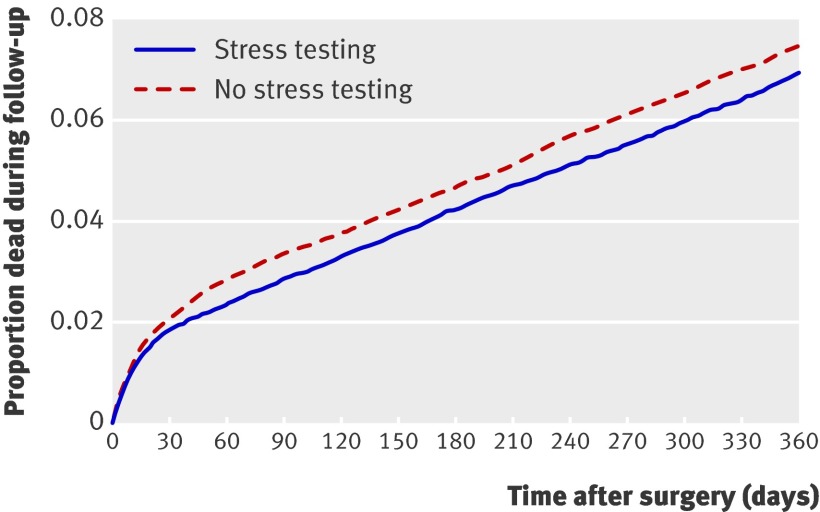
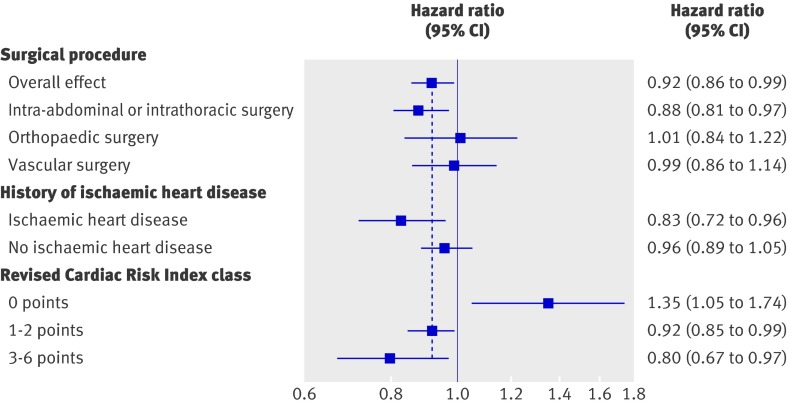
Of the 271 082 patients in the entire cohort, 23 991 (8.9%) underwent stress testing. After propensity score methods were used to reduce important differences between patients who did or did not undergo preoperative stress testing and assemble a matched cohort (n=46 120), testing was associated with improved one year survival (hazard ratio (HR) 0.92, 95% CI 0.86 to 0.99; P=0.03) and reduced mean hospital stay (difference -0.24 days, 95% CI -0.07 to -0.43; P<0.001). In an analysis of subgroups defined by Revised Cardiac Risk Index (RCRI) class, testing was associated with harm in low risk patients (RCRI 0 points: HR 1.35, 95% CI 1.05 to 1.74), but with benefit in patients who were at intermediate risk (RCRI 1-2 points: 0.92, 95% CI 0.85 to 0.99) or high risk (RCRI 3-6 points: 0.80, 95% CI 0.67 to 0.97).
Preoperative non-invasive cardiac stress testing is associated with improved one year survival and length of hospital stay in patients undergoing elective intermediate to high risk non-cardiac surgery. These benefits principally apply to patients with risk factors for perioperative cardiac complications.
确定择期中高危非心脏手术前非侵入性心脏应激试验与生存和住院时间的关系。
基于人群的回顾性队列研究。
加拿大安大略省的急症护理医院,时间为 1994 年 4 月 1 日至 2004 年 3 月 31 日。
年龄 40 岁或以上,接受特定择期中高危非心脏手术的患者。
手术前 6 个月内进行非侵入性心脏应激试验。
术后一年生存率和住院时间。
在整个队列的 271082 名患者中,有 23991 名(8.9%)接受了应激测试。在使用倾向评分方法减少接受术前应激测试和未接受术前应激测试的患者之间的重要差异,并组建匹配队列(n=46120)后,测试与改善一年生存率相关(风险比(HR)0.92,95%CI 0.86 至 0.99;P=0.03),并降低了平均住院时间(差异-0.24 天,95%CI-0.07 至-0.43;P<0.001)。在按修订后的心脏风险指数(RCRI)分类定义的亚组分析中,测试与低危患者(RCRI 0 分:HR 1.35,95%CI 1.05 至 1.74)的危害相关,但与中危患者(RCRI 1-2 分:0.92,95%CI 0.85 至 0.99)或高危患者(RCRI 3-6 分:0.80,95%CI 0.67 至 0.97)的获益相关。
择期中高危非心脏手术前非侵入性心脏应激试验与患者的一年生存率和住院时间的改善相关。这些益处主要适用于围手术期心脏并发症风险因素的患者。