Department of Biochemistry & Molecular Biology, Tongji Medical College, Huazhong University of Science & Technology, Wuhan, The People's Republic of China.
PLoS One. 2010 Jan 27;5(1):e8922. doi: 10.1371/journal.pone.0008922.
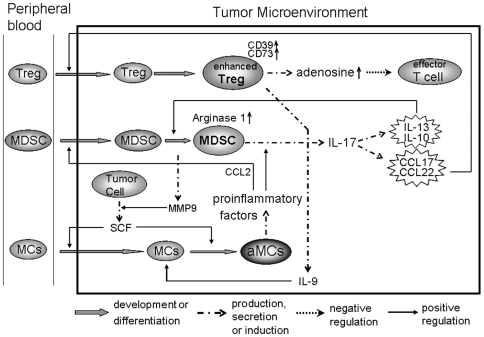
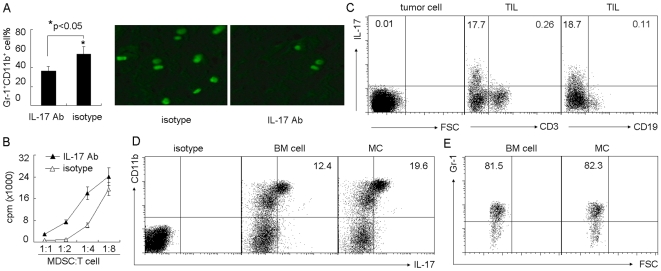
Tumor immunosuppression is commonly braided with chronic inflammation during tumor development. However, the relationship between immunosuppression and inflammation in tumor microenvironment is still unclear. We have demonstrated that mast cells are accumulated and exacerbate the inflammation and immunosuppression in tumor microenvironment via SCF/c-kit signaling pathway. Here, we further elucidate the underlying mechanism, which involves both myeloid-derived suppressor cells (MDSCs) and regulatory T (Treg) cells. Our data showed that mast cells mobilized the infiltration of MDSCs to tumor and induced the production of IL-17 by MDSCs; MDSCs-derived IL-17 indirectly attracted Treg cells, enhanced their suppressor function, and induced the IL-9 production by Treg cells; in turn, IL-9 strengthened the survival and protumor effect of mast cells in tumor microenvironment. Our findings disclose a closed loop among mast cells, MDSCs and Treg cells in tumor microenvironment, which provides a new insight into the paralleled developments of inflammation and immunosuppression in tumor microenvironment. Based on these findings, we propose that targeting tumor inflammation might be a potential strategy to reverse the immunosuppression of tumor microenvironment, thus facilitating cancer immunotherapy.
肿瘤的免疫抑制通常与肿瘤发展过程中的慢性炎症交织在一起。然而,肿瘤微环境中免疫抑制与炎症之间的关系仍不清楚。我们已经证明,肥大细胞通过 SCF/c-kit 信号通路在肿瘤微环境中积累并加剧炎症和免疫抑制。在这里,我们进一步阐明了这一潜在机制,该机制涉及髓系来源的抑制细胞(MDSCs)和调节性 T 细胞(Treg 细胞)。我们的数据表明,肥大细胞动员 MDSC 浸润肿瘤,并诱导 MDSC 产生白细胞介素-17;MDSC 衍生的白细胞介素-17 间接吸引 Treg 细胞,增强其抑制功能,并诱导 Treg 细胞产生白细胞介素-9;反过来,白细胞介素-9 增强了肿瘤微环境中肥大细胞的存活和促肿瘤作用。我们的研究结果揭示了肿瘤微环境中肥大细胞、MDSC 和 Treg 细胞之间的闭环,为肿瘤微环境中炎症和免疫抑制的平行发展提供了新的见解。基于这些发现,我们提出靶向肿瘤炎症可能是逆转肿瘤微环境免疫抑制、从而促进癌症免疫治疗的一种潜在策略。