Li Ying, Xiang Shuai, Pan Wenjun, Wang Jing, Zhan Hanxiang, Liu Shanglong
Department of Blood Transfusion, the Affiliated Hospital of Qingdao University, Qingdao, China.
Department of Gastrointestinal Surgery, the Affiliated Hospital of Qingdao University, Qingdao, China.
Front Oncol. 2023 Mar 29;13:1166860. doi: 10.3389/fonc.2023.1166860. eCollection 2023.
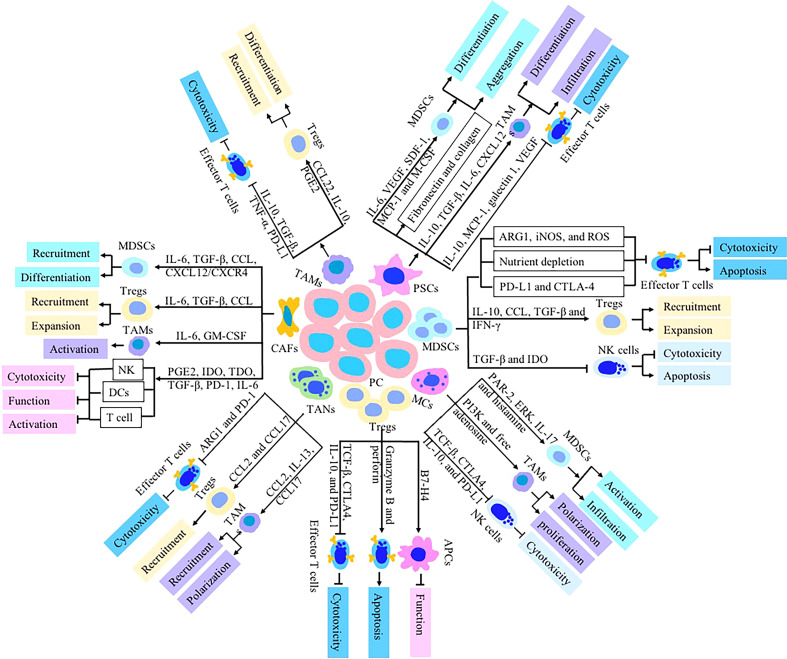
Pancreatic cancer is one of the most malignant tumors with increased incidence rate. The effect of surgery combined with chemoradiotherapy on survival of patients is unsatisfactory. New treatment strategy such as immunotherapy need to be investigated. The accumulation of desmoplastic stroma, infiltration of immunosuppressive cells including myeloid derived suppressor cells (MDSCs), tumor associated macrophages (TAMs), cancer-associated fibroblasts (CAFs), and regulatory T cells (Tregs), as well as tumor associated cytokine such as TGF-β, IL-10, IL-35, CCL5 and CXCL12 construct an immunosuppressive microenvironment of pancreatic cancer, which presents challenges for immunotherapy. In this review article, we explore the roles and mechanism of immunosuppressive cells and lymphocytes in establishing an immunosuppressive tumor microenvironment in pancreatic cancer. In addition, immunotherapy strategies for pancreatic cancer based on tumor microenvironment including immune checkpoint inhibitors, targeting extracellular matrix (ECM), interfering with stromal cells or cytokines in TME, cancer vaccines and extracellular vesicles (EVs) are also discussed. It is necessary to identify an approach of immunotherapy in combination with other modalities to produce a synergistic effect with increased response rates in pancreatic cancer therapy.
胰腺癌是发病率不断上升的最恶性肿瘤之一。手术联合放化疗对患者生存的影响并不理想。需要研究免疫疗法等新的治疗策略。促纤维增生性基质的积累、免疫抑制细胞的浸润,包括髓源性抑制细胞(MDSCs)、肿瘤相关巨噬细胞(TAMs)、癌症相关成纤维细胞(CAFs)和调节性T细胞(Tregs),以及肿瘤相关细胞因子如转化生长因子-β(TGF-β)、白细胞介素-10(IL-10)、白细胞介素-35(IL-35)、趋化因子配体5(CCL5)和CXC趋化因子配体12(CXCL12),共同构建了胰腺癌的免疫抑制微环境,这给免疫治疗带来了挑战。在这篇综述文章中,我们探讨了免疫抑制细胞和淋巴细胞在胰腺癌免疫抑制肿瘤微环境形成中的作用及机制。此外,还讨论了基于肿瘤微环境的胰腺癌免疫治疗策略,包括免疫检查点抑制剂、靶向细胞外基质(ECM)、干扰肿瘤微环境中的基质细胞或细胞因子、癌症疫苗和细胞外囊泡(EVs)。有必要确定一种将免疫治疗与其他方式相结合的方法,以在胰腺癌治疗中产生协同效应并提高反应率。