Department of Psychiatry, Mount Sinai School of Medicine, New York, New York, USA.
Biol Psychiatry. 2010 Mar 15;67(6):535-42. doi: 10.1016/j.biopsych.2009.11.028. Epub 2010 Feb 8.
Prior promising results have been reported with deep brain stimulation (DBS) of the anterior limb of the internal capsule in cases with severe obsessive compulsive disorder (OCD) who had exhausted conventional therapies.
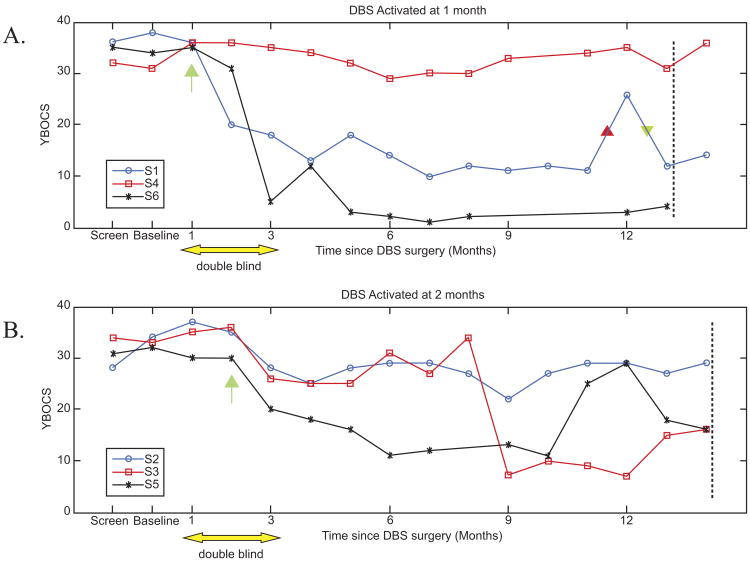
In this pilot study, six adult patients (2 male; 4 female) meeting stringent criteria for severe (minimum Yale-Brown Obsessive Compulsive Scale [Y-BOCS] of 28) and treatment-refractory OCD had DBS electrode arrays placed bilaterally in an area spanning the ventral anterior limb of the internal capsule and adjacent ventral striatum referred to as the ventral capsule/ventral striatum. Using a randomized, staggered-onset design, patients were stimulated at either 30 or 60 days following surgery under blinded conditions.
After 12 months of stimulation, four (66.7%) of six patients met a stringent criterion as "responders" (> or =35% improvement in the Y-BOCS and end point Y-BOCS severity < or =16). Patients did not improve during sham stimulation. Depressive symptoms improved significantly in the group as a whole; global functioning improved in the four responders. Adverse events associated with chronic DBS were generally mild and modifiable with setting changes. Stimulation interruption led to rapid but reversible induction of depressive symptoms in two cases.
This pilot study suggests that DBS of the ventral capsule/ventral striatum region is a promising therapy of last resort for carefully selected cases of severe and intractable OCD. Future research should attend to subject selection, lead location, DBS programming, and mechanisms underpinning therapeutic benefits.
深部脑刺激(DBS)在前内囊肢治疗重度强迫症(OCD)患者中取得了令人鼓舞的结果,这些患者已经用尽了常规治疗方法。
在这项初步研究中,6 名符合严格标准的成年患者(2 名男性;4 名女性),患有严重(最低耶鲁-布朗强迫症量表[Y-BOCS]为 28 分)和治疗抵抗性 OCD,双侧在前内囊肢和相邻腹侧纹状体区域植入 DBS 电极阵列,该区域被称为腹侧胶囊/腹侧纹状体。使用随机、交错起始设计,在术后 30 或 60 天,在盲法条件下对患者进行刺激。
在 12 个月的刺激后,6 名患者中的 4 名(66.7%)符合严格标准,被认为是“应答者”(Y-BOCS 改善>35%,终点 Y-BOCS 严重度<16)。假刺激时患者没有改善。抑郁症状在整个组中显著改善;4 名应答者的总体功能改善。与慢性 DBS 相关的不良事件通常是轻微的,可以通过改变设置来纠正。在两个病例中,刺激中断导致抑郁症状迅速但可逆地出现。
这项初步研究表明,腹侧胶囊/腹侧纹状体区域的 DBS 是一种有前途的、最后手段的疗法,适用于精心挑选的重度、难治性 OCD 患者。未来的研究应关注于受试者选择、导联位置、DBS 编程以及治疗效果的潜在机制。