Ripmeester Erwin A P, Kok Jet S, van Rijssel Jacco C, Slabbekoorn Hans
Sylvius Laboratory, Behavioural Biology, IBL, Leiden University, P.O. Box 9505, 2300 RA Leiden, The Netherlands.
Behav Ecol Sociobiol. 2010 Jan;64(3):409-418. doi: 10.1007/s00265-009-0857-8. Epub 2009 Sep 30.
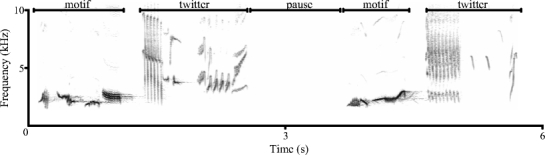
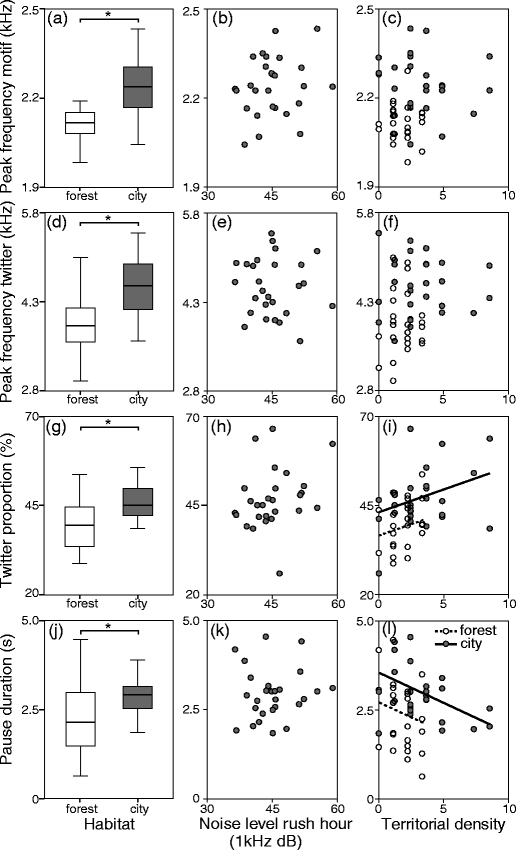
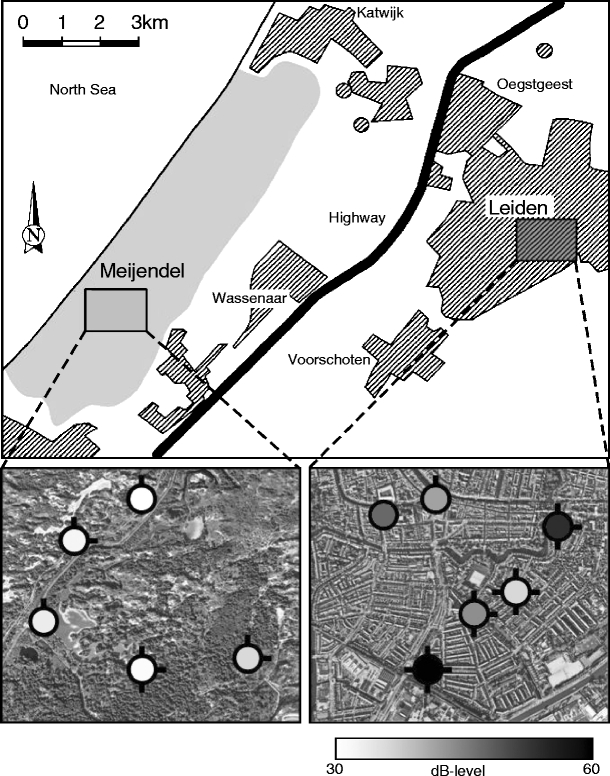
Song plays an important role in avian communication and acoustic variation is important at both the individual and population level. Habitat-related variation between populations in particular can reflect adaptations to the environment accumulated over generations, but this may not always be the case. In this study, we test whether variation between individuals matches local conditions with respect to noise level and territory density to examine whether short-term flexibility could contribute to song divergence at the population level. We conducted a case study on an urban and forest population of the European blackbird and show divergence at the population level (i.e. across habitats) in blackbird song, anthropogenic noise level and territory density. Unlike in several other species, we found a lack of any correlation at the individual level (i.e. across individuals) between song features and ambient noise. This suggests species-specific causal explanations for noise-dependent song differentiation which are likely associated with variation in song-copying behaviour or feedback constraints related to variable singing styles. On the other hand, we found that at the level of individual territories, temporal features, but not spectral ones, are correlated to territory density and seasonality. This suggests that short-term individual variation can indeed contribute to habitat-dependent divergence at the population level. As this may undermine the potential role for song as a population marker, we conclude that more investigations on individual song flexibility are required for a better understanding of the impact of population-level song divergence on hybridisation and speciation.
鸣叫在鸟类交流中起着重要作用,声学变化在个体和种群层面都很重要。特别是种群间与栖息地相关的变化能够反映历经几代积累下来的对环境的适应性,但情况可能并非总是如此。在本研究中,我们测试个体间的变化在噪声水平和领地密度方面是否与当地条件相匹配,以检验短期灵活性是否会导致种群层面的鸣叫差异。我们对欧洲乌鸫的城市和森林种群进行了一项案例研究,结果表明乌鸫鸣叫、人为噪声水平和领地密度在种群层面(即跨栖息地)存在差异。与其他几个物种不同的是,我们发现在个体层面(即跨个体)鸣叫特征与环境噪声之间不存在任何相关性。这表明对于依赖噪声的鸣叫分化存在物种特异性的因果解释,这可能与鸣叫模仿行为的变化或与可变鸣叫风格相关的反馈限制有关。另一方面,我们发现在个体领地层面,时间特征而非频谱特征与领地密度和季节性相关。这表明短期个体变化确实会导致种群层面与栖息地相关的差异。由于这可能会削弱鸣叫作为种群标志物的潜在作用,我们得出结论,需要对个体鸣叫灵活性进行更多研究,以便更好地理解种群层面鸣叫差异对杂交和物种形成的影响。