Dutton Steven J, Schauer James J, Vedal Sverre, Hannigan Michael P
Department of Civil, Environmental and Architectural Engineering, College of Engineering and Applied Science, University of Colorado, Boulder, CO 80309, USA.
Atmos Environ (1994). 2009 Feb 1;43(5):1136-1146. doi: 10.1016/j.atmosenv.2008.10.003.
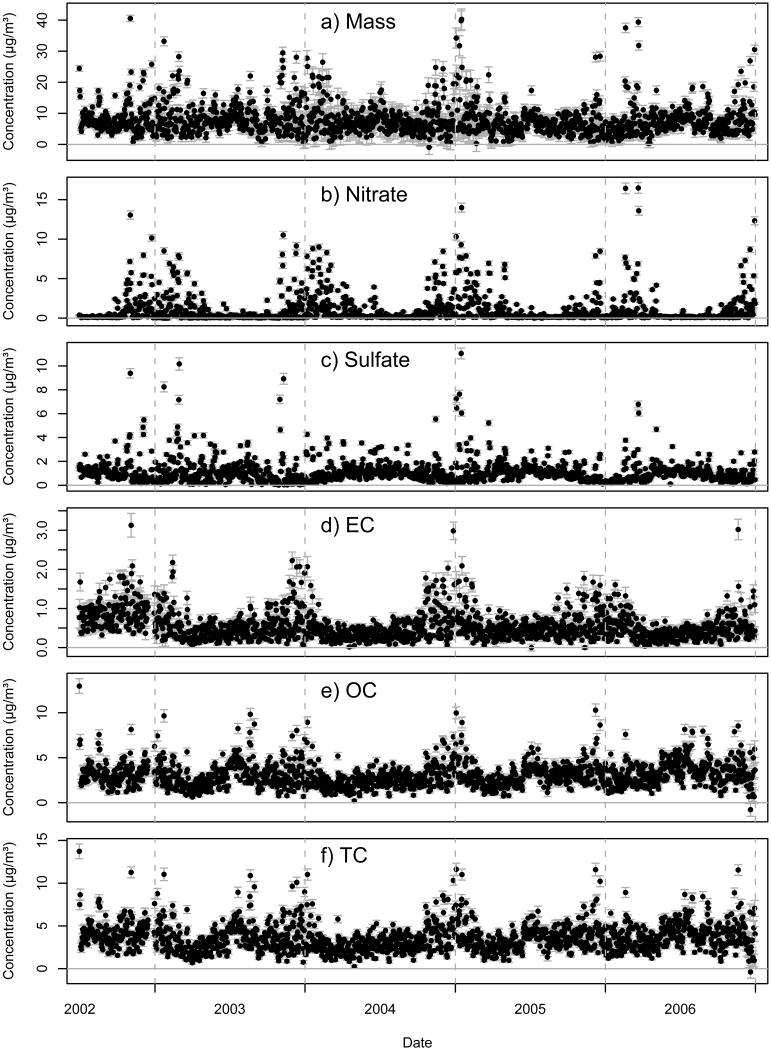
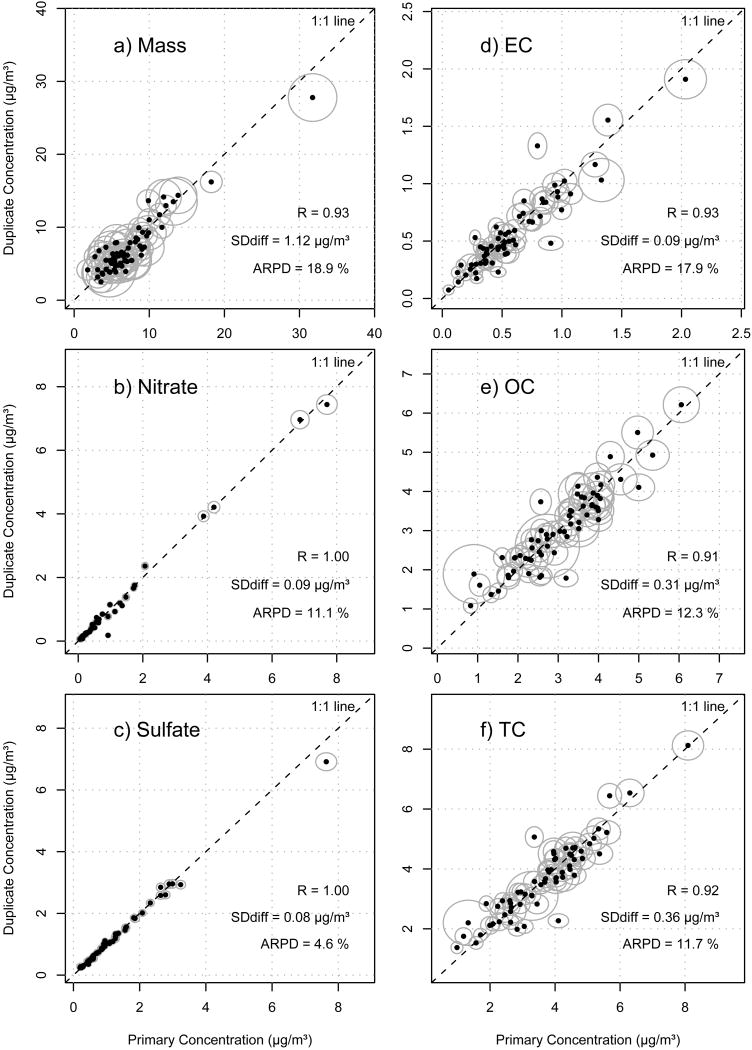
Many studies have identified associations between adverse health effects and short-term exposure to particulate matter less than 2.5 microns in diameter (PM(2.5)). These effects, however, are not consistent across geographical regions. This may be due in part to variations in the chemical make-up of PM(2.5) resulting from unique combinations of sources, both primary and secondary, in different regions. The Denver Aerosol Sources and Health (DASH) study is a multi-year time series study designed to characterize the daily chemical composition of PM(2.5) in Denver, identify the major contributing sources, and investigate associations between sources and a broad array of adverse health outcomes.Measurement methodology, field blank correction, pointwise uncertainty estimation and detection limit consideration are discussed in the context of bulk speciation for the DASH study. Results are presented for the first 4.5 years of mass, inorganic ion and bulk carbon speciation. The derived measurement uncertainties were propagated using the root sum of squares method and show good agreement with precision estimates derived from bi-weekly duplicate samples collected on collocated samplers. Gravimetric mass has the most uncertainty of any measurement and reconstructed mass generated from the sum of the individual species shows less uncertainty than measured mass on average. The methods discussed provide a good framework for PM(2.5) speciation measurements and are generalizable to analysis of other environmental measures.
许多研究已确定了不良健康影响与短期接触直径小于2.5微米的颗粒物(PM2.5)之间的关联。然而,这些影响在不同地理区域并不一致。这可能部分归因于不同区域主要和次要来源的独特组合导致的PM2.5化学组成差异。丹佛气溶胶来源与健康(DASH)研究是一项多年期时间序列研究,旨在描述丹佛PM2.5的每日化学成分,确定主要贡献来源,并调查来源与一系列广泛不良健康结果之间的关联。在DASH研究的总量形态分析背景下,讨论了测量方法、现场空白校正、逐点不确定度估计和检测限考虑因素。给出了前4.5年质量、无机离子和总量碳形态分析的结果。使用平方和根方法传播推导的测量不确定度,结果与从并置采样器收集的双周重复样品得出的精密度估计值吻合良好。重量法质量在所有测量中不确定性最大,由各个物种总和生成的重构质量平均而言比测量质量的不确定性小。所讨论的方法为PM2.5形态分析测量提供了一个良好框架,并且可推广到其他环境测量的分析中。