Department of Human Molecular Genetics, Max Planck Institute for Molecular Genetics, Berlin, Germany.
PLoS One. 2010 Jan 29;5(1):e8956. doi: 10.1371/journal.pone.0008956.
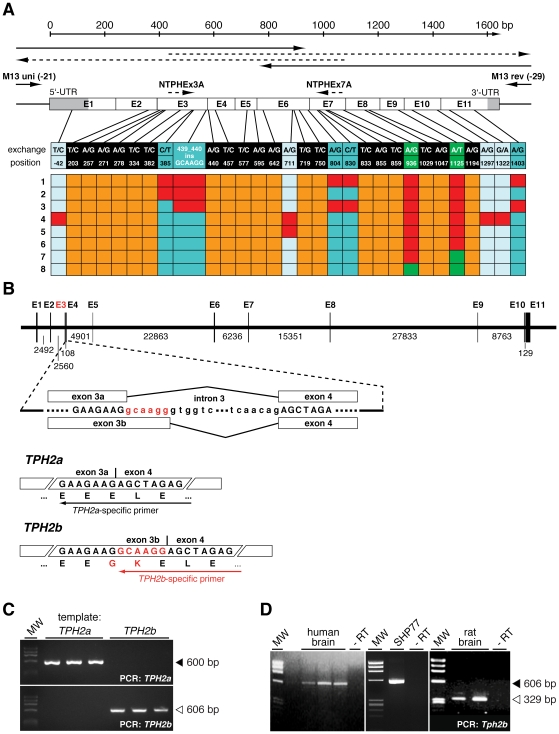
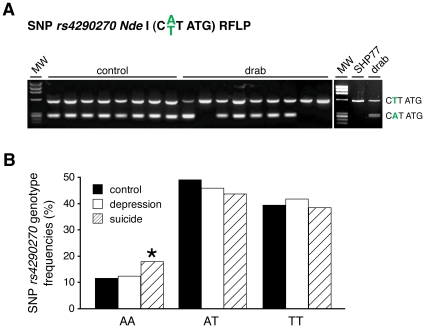
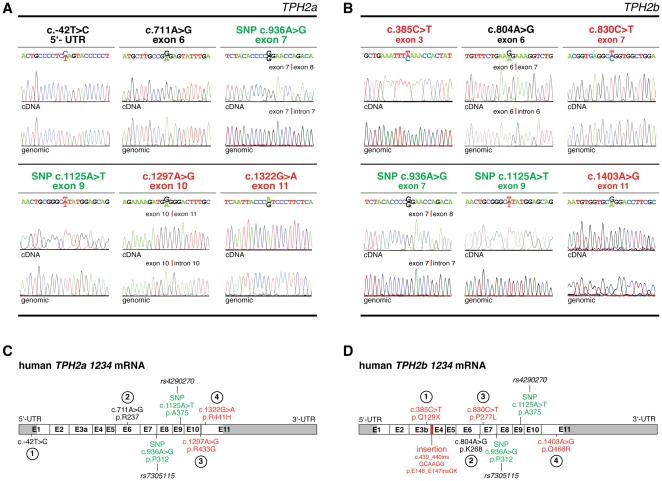
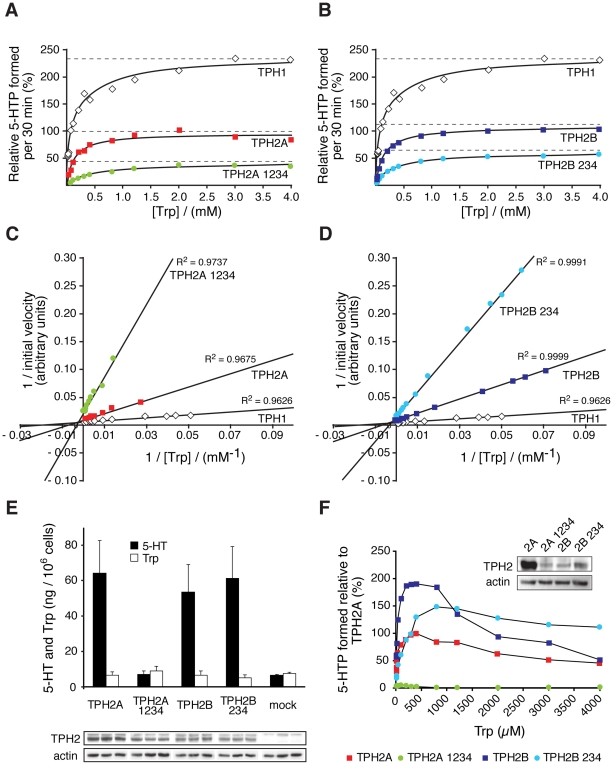
Brain serotonin (5-HT) neurotransmission plays a key role in the regulation of mood and has been implicated in a variety of neuropsychiatric conditions. Tryptophan hydroxylase (TPH) is the rate-limiting enzyme in the biosynthesis of 5-HT. Recently, we discovered a second TPH isoform (TPH2) in vertebrates, including man, which is predominantly expressed in brain, while the previously known TPH isoform (TPH1) is primarly a non-neuronal enzyme. Overwhelming evidence now points to TPH2 as a candidate gene for 5-HT-related psychiatric disorders. To assess the role of TPH2 gene variability in the etiology of psychiatric diseases we performed cDNA sequence analysis of TPH2 transcripts from human post mortem amygdala samples obtained from individuals with psychiatric disorders (drug abuse, schizophrenia, suicide) and controls. Here we show that TPH2 exists in two alternatively spliced variants in the coding region, denoted TPH2a and TPH2b. Moreover, we found evidence that the pre-mRNAs of both splice variants are dynamically RNA-edited in a mutually exclusive manner. Kinetic studies with cell lines expressing recombinant TPH2 variants revealed a higher activity of the novel TPH2B protein compared with the previously known TPH2A, whereas RNA editing was shown to inhibit the enzymatic activity of both TPH2 splice variants. Therefore, our results strongly suggest a complex fine-tuning of central nervous system 5-HT biosynthesis by TPH2 alternative splicing and RNA editing. Finally, we present molecular and large-scale linkage data evidencing that deregulated alternative splicing and RNA editing is involved in the etiology of psychiatric diseases, such as suicidal behaviour.
脑内 5-羟色胺(5-HT)神经传递在调节情绪方面起着关键作用,并与多种神经精神疾病有关。色氨酸羟化酶(TPH)是 5-HT 生物合成的限速酶。最近,我们在脊椎动物(包括人类)中发现了第二种 TPH 同工酶(TPH2),它主要在脑中表达,而以前已知的 TPH 同工酶(TPH1)主要是非神经元酶。现在大量证据表明 TPH2 是与 5-HT 相关的精神疾病的候选基因。为了评估 TPH2 基因变异在精神疾病发病机制中的作用,我们对来自有精神疾病(药物滥用、精神分裂症、自杀)和对照个体死后杏仁核样本的 TPH2 转录物进行了 cDNA 序列分析。在这里,我们表明 TPH2 在编码区存在两种选择性剪接变异体,分别称为 TPH2a 和 TPH2b。此外,我们发现证据表明两种剪接变体的前体 mRNA 以相互排斥的方式进行动态 RNA 编辑。用表达重组 TPH2 变体的细胞系进行的动力学研究表明,新型 TPH2B 蛋白的活性高于以前已知的 TPH2A,而 RNA 编辑被证明抑制了两种 TPH2 剪接变体的酶活性。因此,我们的结果强烈表明 TPH2 选择性剪接和 RNA 编辑对中枢神经系统 5-HT 生物合成进行了复杂的精细调节。最后,我们提出了分子和大规模连锁数据,证明了异常的选择性剪接和 RNA 编辑参与了精神疾病的发病机制,如自杀行为。