Department of Dermatology, University of Münster, Münster, Germany.
PLoS One. 2010 Feb 1;5(2):e8958. doi: 10.1371/journal.pone.0008958.
The neuropeptide alpha-melanocyte-stimulating hormone is well known as a mediator of skin pigmentation. More recently, it has been shown that alpha-melanocyte-stimulating hormone also plays pivotal roles in energy homeostasis, sexual function, and inflammation or immunomodulation. Alpha-melanocyte-stimulating hormone exerts its antiinflammatory and immunomodulatory effects by binding to the melanocortin-1 receptor, and since T cells are important effectors during immune responses, we investigated the effects of alpha-melanocyte-stimulating hormone on T cell function.
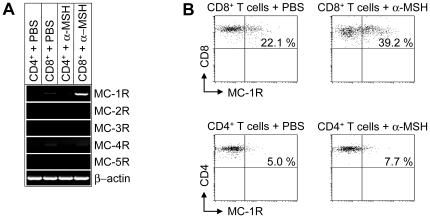
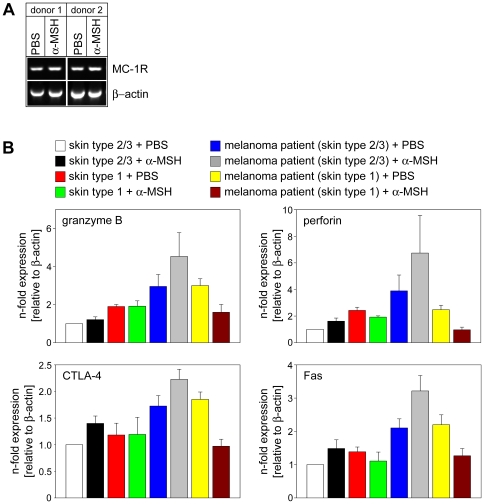
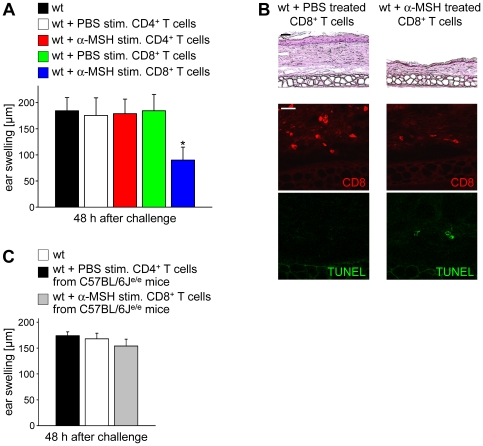
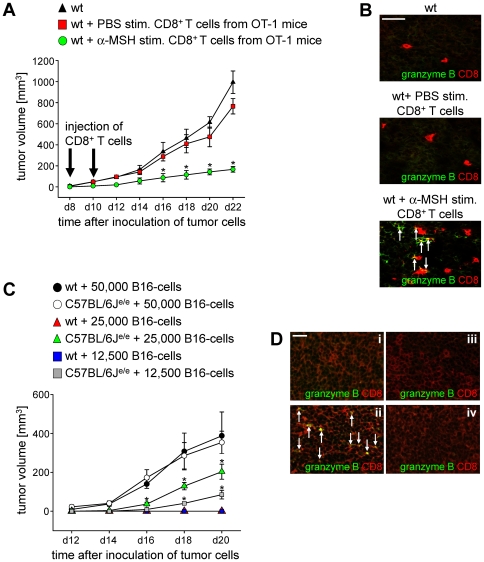
METHODOLOGY/PRINCIPAL FINDINGS: T cells were treated with alpha-melanocyte-stimulating hormone, and subsequently, their phenotype and function was analyzed in a contact allergy as well as a melanoma model. Furthermore, the relevance of alpha-melanocyte-stimulating hormone-mediated signaling for the induction of cytotoxicity was assessed in CD8(+) T cells from melanoma patients with functional and nonfunctional melanocortin-1 receptors. Here we demonstrate that the melanocortin-1 receptor is expressed by murine as well as human CD8(+) T cells, and we furthermore show that alpha-melanocyte-stimulating hormone/melanocortin-1 receptor-mediated signaling is critical for the induction of cytotoxicity in human and murine CD8(+) T cells. Upon adoptive transfer, alpha-melanocyte-stimulating hormone-treated murine CD8(+) T cells significantly reduced contact allergy responses in recipient mice. Additionally, the presented data indicate that alpha-melanocyte-stimulating hormone via signaling through a functional melanocortin-1 receptor augmented antitumoral immunity by up-regulating the expression of cytotoxic genes and enhancing the cytolytic activity in tumor-specific CD8(+) T cells.
CONCLUSIONS/SIGNIFICANCE: Together, these results point to an important role of alpha-melanocyte-stimulating hormone in MHC class I-restricted cytotoxicity. Therefore, treatment of contact allergies or skin cancer with alpha-melanocyte-stimulating hormone or other more stable agonists of melanocortin-1 receptor might ameliorate disease or improve antitumoral immune responses.
神经肽α-黑色素细胞刺激素是众所周知的皮肤色素沉着的介质。最近,它已被证明,α-黑色素细胞刺激素也在能量平衡、性功能、炎症或免疫调节中发挥关键作用。α-黑色素细胞刺激素通过与黑素皮质素-1 受体结合发挥其抗炎和免疫调节作用,由于 T 细胞是免疫反应中的重要效应器,我们研究了α-黑色素细胞刺激素对 T 细胞功能的影响。
方法/主要发现:用α-黑色素细胞刺激素处理 T 细胞,然后在接触过敏和黑色素瘤模型中分析其表型和功能。此外,还评估了黑色素皮质素-1 受体介导的信号转导对功能性和非功能性黑素皮质素-1 受体黑色素瘤患者 CD8(+)T 细胞细胞毒性诱导的相关性。在这里,我们证明了黑素皮质素-1 受体在鼠和人 CD8(+)T 细胞中表达,并且我们还表明α-黑色素细胞刺激素/黑素皮质素-1 受体介导的信号转导对于诱导人和鼠 CD8(+)T 细胞的细胞毒性至关重要。在过继转移后,α-黑色素细胞刺激素处理的鼠 CD8(+)T 细胞显著降低了受体小鼠的接触过敏反应。此外,所呈现的数据表明,α-黑色素细胞刺激素通过功能性黑素皮质素-1 受体信号转导增强了抗肿瘤免疫,上调了细胞毒性基因的表达,并增强了肿瘤特异性 CD8(+)T 细胞的细胞溶解活性。
结论/意义:总的来说,这些结果表明α-黑色素细胞刺激素在 MHC Ⅰ类限制的细胞毒性中起着重要作用。因此,用α-黑色素细胞刺激素或其他更稳定的黑素皮质素-1 受体激动剂治疗接触过敏或皮肤癌可能会改善疾病或改善抗肿瘤免疫反应。