Arce Fritzie, Novick Itai, Vaadia Eilon
Department of Medical Neurobiology, The Institute for Medical Research Israel-Canada, Hadassah Medical School, Hebrew University Jerusalem, Israel.
Front Hum Neurosci. 2010 Jan 4;3:65. doi: 10.3389/neuro.09.065.2009. eCollection 2010.
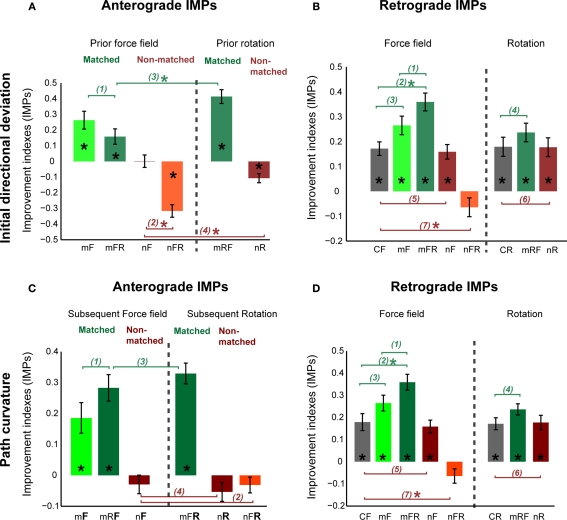
Motor control and adaptation are multi-determinate processes with complex interactions. This is reflected for example in the ambiguous nature of interactions during sequential adaptation of reaching under kinematics and dynamics perturbations. It has been suggested that perturbations based on the same kinematic parameter interfere. Others posited that opposing motor adjustments underlie interference. Here, we examined the influence of discordances in task and in motor adjustments on sequential adaptations to visuomotor rotation and viscous force field perturbations. These two factors - perturbation direction and task discordance - have been examined separately by previous studies, thus the inherent difficulty to identify the roots of interference. Forty-eight human subjects adapted sequentially to one or two types of perturbations, of matched or conflicting directions. We found a gradient of interaction effects based on perturbation direction and task discordance. Perturbations of matched directions showed facilitation while perturbations of opposite directions, which required opposing motor adjustments, interfered with each other. Further, interaction effects increased with greater task discordance. We also found that force field and visuomotor rotation had mutual anterograde and retrograde effects. However, we found independence between anterograde and retrograde interferences between similar tasks. The results suggest that the newly acquired internal models of kinematic and dynamic perturbations are not independent but they share common neuronal resources and interact between them. Such overlap does not necessarily imply competition of resources. Rather, our results point to an additional principle of sensorimotor adaptation allowing the system to tap or harness common features across diverse sensory inputs and task contexts whenever available.
运动控制与适应是具有复杂相互作用的多决定因素过程。这例如体现在运动学和动力学扰动下伸手动作的顺序适应过程中相互作用的模糊性质上。有人提出基于相同运动学参数的扰动会相互干扰。其他人则认为干扰的基础是相反的运动调整。在此,我们研究了任务和运动调整中的不一致对视觉运动旋转和粘性力场扰动顺序适应的影响。先前的研究分别考察了这两个因素——扰动方向和任务不一致性,因此难以确定干扰的根源。48名人类受试者依次适应一种或两种类型的扰动,其方向匹配或冲突。我们发现了基于扰动方向和任务不一致性的相互作用效应梯度。方向匹配的扰动表现出促进作用,而方向相反的扰动需要相反的运动调整,它们会相互干扰。此外,相互作用效应随着任务不一致性的增加而增强。我们还发现力场和视觉运动旋转具有相互的顺行和逆行效应。然而,我们发现相似任务之间的顺行和逆行干扰是相互独立的。结果表明,新获得的运动学和动力学扰动的内部模型并非相互独立,而是共享共同的神经元资源并相互作用。这种重叠不一定意味着资源竞争。相反,我们的结果指出了感觉运动适应的另一个原则,即允许系统在任何可用时利用或利用不同感觉输入和任务背景中的共同特征。