Panda Manjubala, Hutin Yvan J, Ramachandran Vidya, Murhekar Manoj
Field Epidemiology Training Programme, National Institute of Epidemiology (NIE), Indian Council of Medical Research, Chennai, Tamil Nadu 600077, India.
J Toxicol. 2009;2009:692496. doi: 10.1155/2009/692496. Epub 2009 Jul 1.
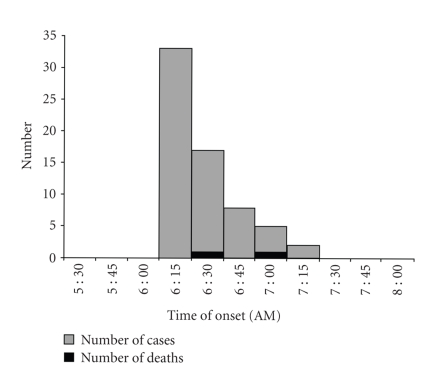
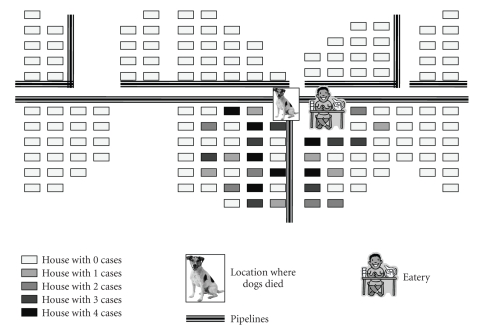
Introduction. We investigated a cluster of pesticide poisoning in Orissa. Methods. We searched the village for cases of vomiting and sweating on 2 February 2008. We described the outbreak by time, place, and person. We compared cases with controls. Results. We identified 65 cases (two deaths; attack rate: 12 per 1000; case fatality: 3%). The epidemic curve suggested a point source outbreak, and cases clustered close to a roadside eatery. Consumption of water from a specific source (odds ratio [OR]: 35, confidence interval [CI]: 13-93) and eating in the eatery (OR: 2.3, CI: 1.1-4.7) was associated with illness. On 31 January 2008, villagers had used pesticides to kill street dogs and had discarded leftovers in the drains. Damaged pipelines located beneath and supplying water may have aspirated the pesticide during the nocturnal negative pressure phase and rinsed it off the next morning in the water supply. Conclusions. Innapropriate use of pesticides contaminated the water supply and caused this outbreak. Education programs and regulations need to be combined to ensure a safer use of pesticides in India.
引言。我们对奥里萨邦的一起农药中毒聚集性事件进行了调查。方法。2008年2月2日,我们在该村庄搜索呕吐和出汗病例。我们按时间、地点和人物描述了此次疫情。我们将病例与对照进行了比较。结果。我们确定了65例病例(2例死亡;发病率:每1000人中有12例;病死率:3%)。流行曲线显示为点源暴发,病例集中在一家路边餐馆附近。饮用特定水源的水(比值比[OR]:35,置信区间[CI]:13 - 93)和在该餐馆就餐(OR:2.3,CI:1.1 - 4.7)与发病有关。2008年1月31日,村民用农药捕杀流浪狗,并将剩余农药丢弃在排水沟中。位于下方并供水的受损管道可能在夜间负压阶段吸入了农药,并在次日早晨随供水将其冲洗出来。结论。农药使用不当污染了供水并导致了此次疫情暴发。需要将教育项目和法规相结合,以确保印度更安全地使用农药。