Marine Science Institute, University of California, Santa Barbara, CA 93106, USA.
Proc Biol Sci. 2010 Jun 7;277(1688):1685-94. doi: 10.1098/rspb.2009.2214. Epub 2010 Feb 4.
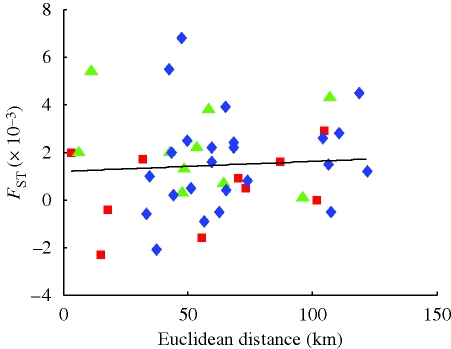
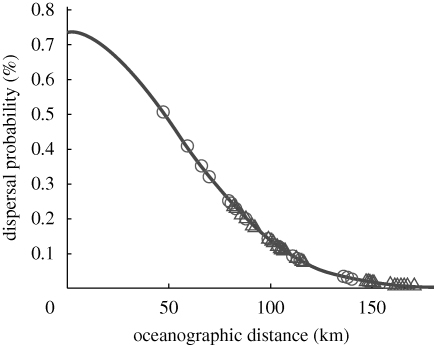
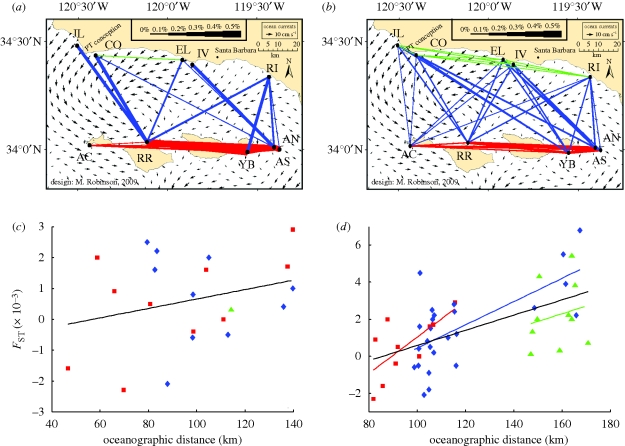
Management and conservation can be greatly informed by considering explicitly how environmental factors influence population genetic structure. Using simulated larval dispersal estimates based on ocean current observations, we demonstrate how explicit consideration of frequency of exchange of larvae among sites via ocean advection can fundamentally change the interpretation of empirical population genetic structuring as compared with conventional spatial genetic analyses. Both frequency of larval exchange and empirical genetic difference were uncorrelated with Euclidean distance between sites. When transformed into relative oceanographic distances and integrated into a genetic isolation-by-distance framework, however, the frequency of larval exchange explained nearly 50 per cent of the variance in empirical genetic differences among sites over scales of tens of kilometres. Explanatory power was strongest when we considered effects of multiple generations of larval dispersal via intermediary locations on the long-term probability of exchange between sites. Our results uncover meaningful spatial patterning to population genetic structuring that corresponds with ocean circulation. This study advances our ability to interpret population structure from complex genetic data characteristic of high gene flow species, validates recent advances in oceanographic approaches for assessing larval dispersal and represents a novel approach to characterize population connectivity at small spatial scales germane to conservation and fisheries management.
通过明确考虑环境因素如何影响种群遗传结构,管理和保护可以得到极大的启发。利用基于海洋观测的模拟幼虫扩散估计,我们展示了如何通过海洋平流明确考虑幼虫在站点之间交换的频率,这与传统的空间遗传分析相比,可以从根本上改变对经验种群遗传结构的解释。幼虫交换的频率和经验遗传差异都与站点之间的欧几里得距离无关。然而,当将其转换为相对海洋学距离,并整合到遗传隔离距离框架中时,幼虫交换的频率解释了站点之间经验遗传差异的近 50%的方差,范围在数十公里之间。当我们考虑通过中间地点进行多代幼虫扩散的影响时,解释力最强,这增加了长期站点之间交换的可能性。我们的研究结果揭示了与海洋环流相对应的种群遗传结构的有意义的空间模式。这项研究提高了我们从具有高基因流物种特征的复杂遗传数据中解释种群结构的能力,验证了海洋学方法在评估幼虫扩散方面的最新进展,并代表了一种在与保护和渔业管理相关的小空间尺度上表征种群连通性的新方法。