Department of Biochemistry and Molecular Biology, College of Basic Medical Sciences, Third Military Medical University, Chongqing 400038, China.
Lipids Health Dis. 2010 Feb 6;9:16. doi: 10.1186/1476-511X-9-16.
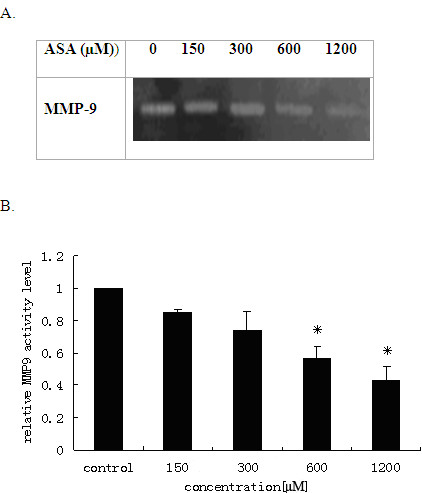
Although its role to prevent secondary cardiovascular complications has been well established, how acetyl salicylic acid (ASA, aspirin) regulates certain key molecules in the atherogenesis is still not known. Considering the role of matrix metalloproteinase-9 (MMP-9) to destabilize the atherosclerotic plaques, the roles of the scavenger receptor class BI (SR-BI) and ATP-binding cassette transporter A1 (ABCA1) to promote cholesterol efflux in the foam cells at the plaques, and the role of NF-kappaB in the overall inflammation related to the atherosclerosis, we addressed whether these molecules are all related to a common mechanism that may be regulated by acetyl salicylic acid. We investigated the effect of ASA to regulate the expressions and activities of these molecules in THP-1 macrophages. Our results showed that ASA inhibited MMP-9 mRNA expression, and caused the decrease in the MMP-9 activities from the cell culture supernatants. In addition, it inhibited the nuclear translocation of NF-kappaB p65 subunit, thus the activity of this inflammatory molecule. On the contrary, acetyl salicylic acid induced the expressions of ABCA1 and SR-BI, two molecules known to reduce the progression of atherosclerosis, at both mRNA and protein levels. It also stimulated the cholesterol efflux out of macrophages. These data suggest that acetyl salicylic acid may alleviate symptoms of atherosclerosis by two potential mechanisms: maintaining the plaque stability via inhibiting activities of inflammatory molecules MMP-9 and NF-kappaB, and increasing the cholesterol efflux through inducing expressions of ABCA1 and SR-BI.
虽然乙酰水杨酸(ASA,阿司匹林)在预防心血管二级并发症方面的作用已得到充分证实,但它如何调节动脉粥样硬化形成过程中的某些关键分子仍不清楚。鉴于基质金属蛋白酶-9(MMP-9)在破坏动脉粥样硬化斑块稳定性方面的作用,清道夫受体 B 类 I(SR-BI)和三磷酸腺苷结合盒转运蛋白 A1(ABCA1)在泡沫细胞中促进胆固醇外流的作用,以及 NF-κB 在与动脉粥样硬化相关的整体炎症中的作用,我们探讨了这些分子是否都与可能受乙酰水杨酸调节的共同机制有关。我们研究了 ASA 调节 THP-1 巨噬细胞中这些分子表达和活性的作用。我们的结果表明,ASA 抑制 MMP-9 mRNA 表达,并导致细胞培养上清液中 MMP-9 活性降低。此外,它抑制了 NF-κB p65 亚基的核转位,从而抑制了这种炎症分子的活性。相反,乙酰水杨酸诱导 ABCA1 和 SR-BI 的表达,这两种分子已知可减缓动脉粥样硬化的进展,在 mRNA 和蛋白质水平上均有上调。它还刺激了巨噬细胞内胆固醇的外流。这些数据表明,乙酰水杨酸可能通过两种潜在机制缓解动脉粥样硬化症状:通过抑制炎症分子 MMP-9 和 NF-κB 的活性来维持斑块稳定性,以及通过诱导 ABCA1 和 SR-BI 的表达来增加胆固醇外流。