Department of Genetics and Development, Columbia University Medical Center, New York, New York, USA.
Nat Med. 2010 Mar;16(3):308-12. doi: 10.1038/nm.2098. Epub 2010 Feb 7.
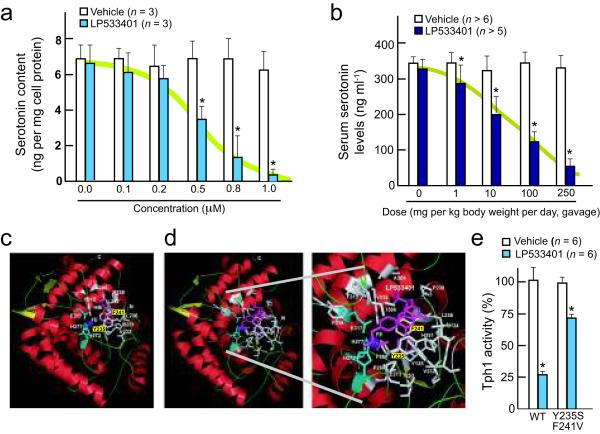
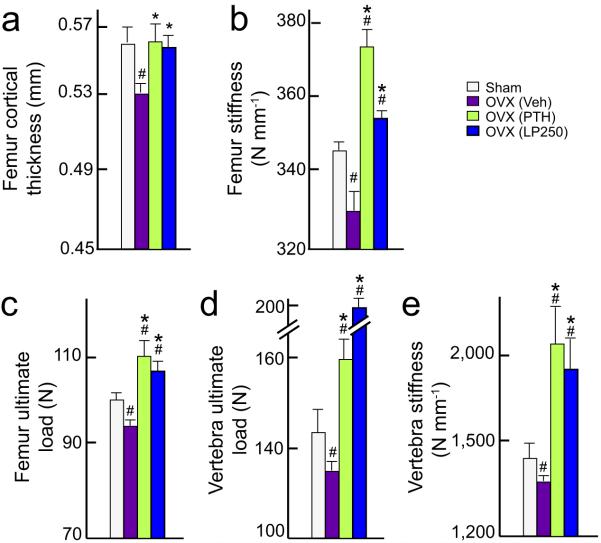
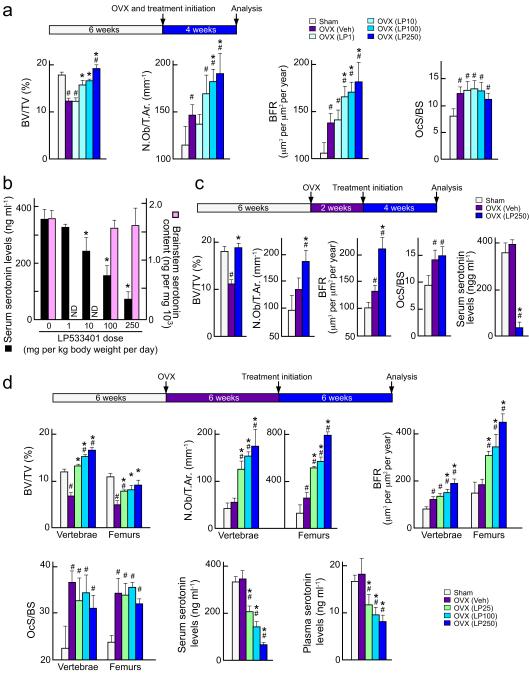
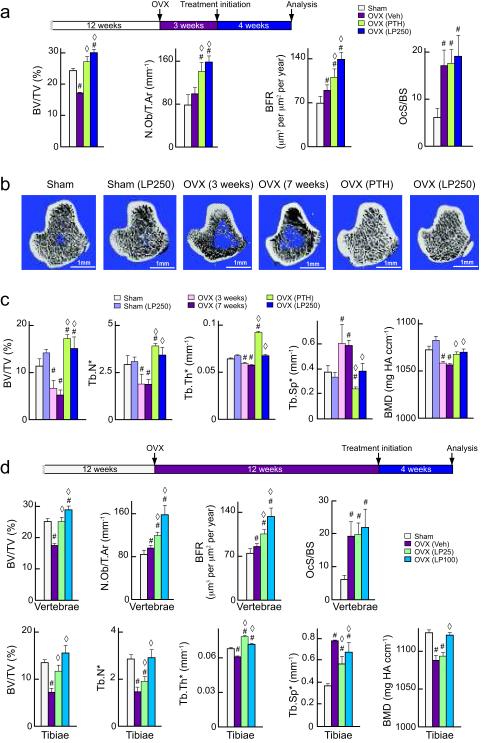
Osteoporosis is a disease of low bone mass most often caused by an increase in bone resorption that is not sufficiently compensated for by a corresponding increase in bone formation. As gut-derived serotonin (GDS) inhibits bone formation, we asked whether hampering its biosynthesis could treat osteoporosis through an anabolic mechanism (that is, by increasing bone formation). We synthesized and used LP533401, a small molecule inhibitor of tryptophan hydroxylase-1 (Tph-1), the initial enzyme in GDS biosynthesis. Oral administration of this small molecule once daily for up to six weeks acts prophylactically or therapeutically, in a dose-dependent manner, to treat osteoporosis in ovariectomized rodents because of an isolated increase in bone formation. These results provide a proof of principle that inhibiting GDS biosynthesis could become a new anabolic treatment for osteoporosis.
骨质疏松症是一种低骨量疾病,通常由骨吸收增加引起,而骨形成不能与之相应地增加来代偿。由于肠源性血清素(GDS)抑制骨形成,我们想知道,通过促进合成代谢机制(即增加骨形成)来阻碍其生物合成是否可以治疗骨质疏松症。我们合成并使用了 LP533401,它是一种色氨酸羟化酶-1(Tph-1)的小分子抑制剂,Tph-1 是 GDS 生物合成的初始酶。这种小分子每天口服一次,最多持续六周,可以起到预防或治疗作用,以剂量依赖性方式治疗去卵巢啮齿动物的骨质疏松症,因为骨形成单独增加。这些结果提供了一个原理性的证明,即抑制 GDS 生物合成可能成为骨质疏松症的一种新的合成代谢治疗方法。