Liang Tong-Zhou, Jin Zhe-Yu, Lin Yue-Jun, Chen Zi-Yi, Li Ye, Xu Jian-Kun, Yang Fan, Qin Ling
Musculoskeletal Research Laboratory of Department of Orthopaedics & Traumatology and Innovative Orthopaedic Biomaterial and Drug Translational Research Laboratory, Li Ka Shing Institute of Health, the Chinese University of Hong Kong, Sha Tin, 999077, Hong Kong, China.
Innovative Orthopedic Biomaterial and Drug Translational Research Laboratory, Li Ka Shing Institute of Health Sciences, Prince of Wales Hospital, the Chinese University of Hong Kong, Sha Tin, 999077, Hong Kong, China.
Mil Med Res. 2025 Mar 20;12(1):13. doi: 10.1186/s40779-025-00600-8.
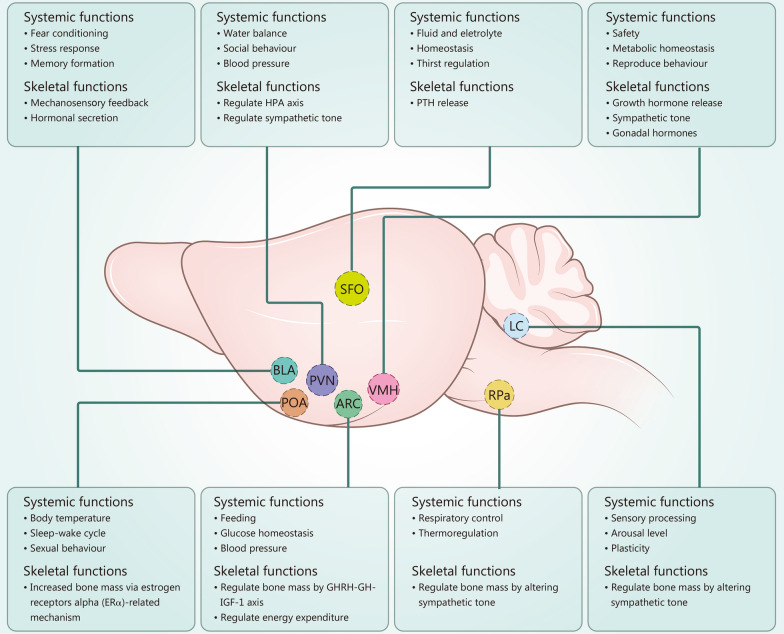
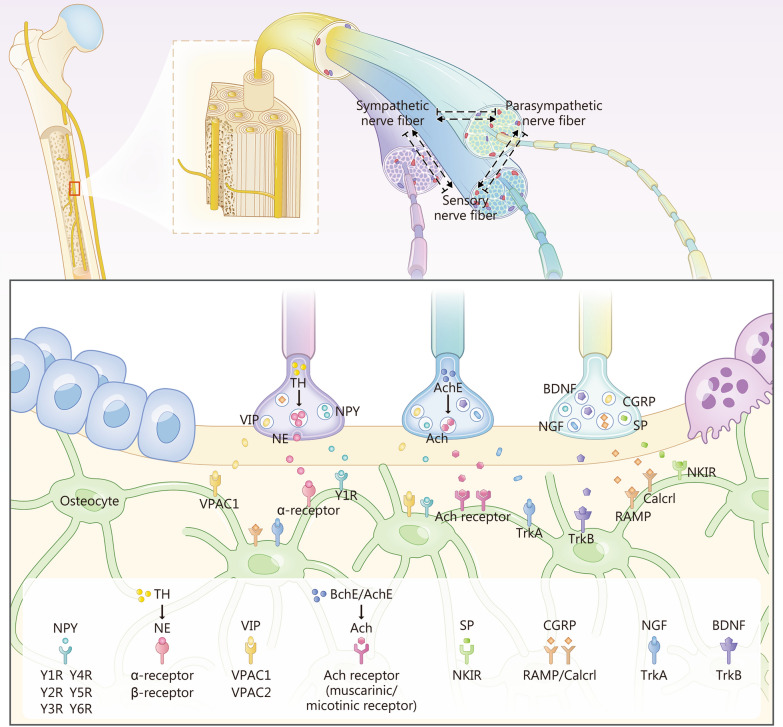
The skeleton is innervated by different types of nerves and receives signaling from the nervous system to maintain homeostasis and facilitate regeneration or repair. Although the role of peripheral nerves and signals in regulating bone homeostasis has been extensively investigated, the intimate relationship between the central nervous system and bone remains less understood, yet it has emerged as a hot topic in the bone field. In this review, we discussed clinical observations and animal studies that elucidate the connection between the nervous system and bone metabolism, either intact or after injury. First, we explored mechanistic studies linking specific brain nuclei with bone homeostasis, including the ventromedial hypothalamus, arcuate nucleus, paraventricular hypothalamic nucleus, amygdala, and locus coeruleus. We then focused on the characteristics of bone innervation and nerve subtypes, such as sensory, sympathetic, and parasympathetic nerves. Moreover, we summarized the molecular features and regulatory functions of these nerves. Finally, we included available translational approaches that utilize nerve function to improve bone homeostasis and promote bone regeneration. Therefore, considering the nervous system within the context of neuromusculoskeletal interactions can deepen our understanding of skeletal homeostasis and repair process, ultimately benefiting future clinical translation.
骨骼由不同类型的神经支配,并接收来自神经系统的信号以维持体内平衡,促进再生或修复。尽管外周神经及其信号在调节骨稳态中的作用已得到广泛研究,但中枢神经系统与骨骼之间的密切关系仍鲜为人知,不过它已成为骨领域的一个热门话题。在这篇综述中,我们讨论了阐明完整或损伤后神经系统与骨代谢之间联系的临床观察和动物研究。首先,我们探讨了将特定脑核与骨稳态联系起来的机制研究,包括腹内侧下丘脑、弓状核、室旁下丘脑核、杏仁核和蓝斑。然后,我们重点关注了骨神经支配和神经亚型的特征,如感觉神经、交感神经和副交感神经。此外,我们总结了这些神经的分子特征和调节功能。最后,我们纳入了利用神经功能改善骨稳态和促进骨再生的现有转化方法。因此,在神经肌肉骨骼相互作用的背景下考虑神经系统,可以加深我们对骨骼稳态和修复过程的理解,最终有益于未来的临床转化。