Gál Viktor, Kóbor István, Bankó Eva M, Kozák Lajos R, Serences John T, Vidnyánszky Zoltán
Neurobionics Research Group, Hungarian Academy of Sciences - Péter Pázmány Catholic University - Semmelweis University Budapest, Hungary.
Front Hum Neurosci. 2010 Jan 6;3:69. doi: 10.3389/neuro.09.069.2009. eCollection 2010.
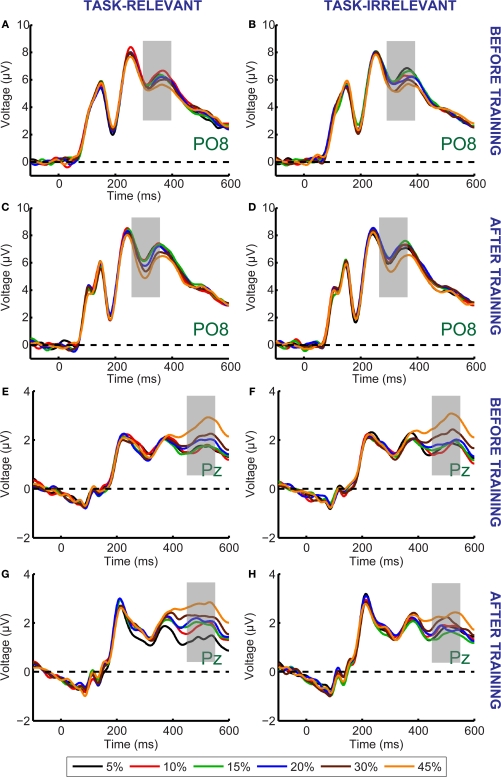
Training on a visual task leads to increased perceptual and neural responses to visual features that were attended during training as well as decreased responses to neglected distractor features. However, the time course of these attention-based modulations of neural sensitivity for visual features has not been investigated before. Here we measured event related potentials (ERP) in response to motion stimuli with different coherence levels before and after training on a speed discrimination task requiring object-based attentional selection of one of the two competing motion stimuli. We found that two peaks on the ERP waveform were modulated by the strength of the coherent motion signal; the response amplitude associated with motion directions that were neglected during training was smaller than the response amplitude associated with motion directions that were attended during training. The first peak of motion coherence-dependent modulation of the ERP responses was at 300 ms after stimulus onset and it was most pronounced over the occipitotemporal cortex. The second peak was around 500 ms and was focused over the parietal cortex. A control experiment suggests that the earlier motion coherence-related response modulation reflects the extraction of the coherent motion signal whereas the later peak might index accumulation and readout of motion signals by parietal decision mechanisms. These findings suggest that attention-based learning affects neural responses both at the sensory and decision processing stages.
在视觉任务上的训练会导致对训练期间所关注的视觉特征的感知和神经反应增强,同时对被忽视的干扰特征的反应减弱。然而,此前尚未研究过基于注意力的视觉特征神经敏感性调制的时间进程。在此,我们在一项速度辨别任务的训练前后,测量了对具有不同连贯水平的运动刺激做出反应的事件相关电位(ERP),该任务需要基于对象对两个相互竞争的运动刺激之一进行注意力选择。我们发现,ERP波形上的两个峰值受到连贯运动信号强度的调制;与训练期间被忽视的运动方向相关的反应幅度小于与训练期间被关注的运动方向相关的反应幅度。ERP反应的运动连贯性依赖性调制的第一个峰值出现在刺激开始后300毫秒,在枕颞叶皮层最为明显。第二个峰值在500毫秒左右,集中在顶叶皮层。一项对照实验表明,较早的与运动连贯性相关的反应调制反映了连贯运动信号的提取,而较晚的峰值可能指示顶叶决策机制对运动信号的积累和读出。这些发现表明,基于注意力的学习在感觉和决策处理阶段都会影响神经反应。