Zhejiang Respiratory Drugs Research Laboratory of State Food and Drug Administration of China, Medical Science College of Zhejiang University, Hangzhou, China.
J Neuroinflammation. 2010 Feb 11;7:12. doi: 10.1186/1742-2094-7-12.
Despite intensive studies focused on the pathophysiology of asthmatic inflammation, little is known about how cross-talk between neuroendocrine and immune systems regulates the inflammatory response during an asthmatic attack. We recently showed corresponding changes of cytokines and leukotriene B4 (LTB4) in brain and lung tissues of antigen-challenged asthmatic rats. Here, we investigated how LTB4 interacts with the neuroendocrine-immune system in regulating antigen-induced asthmatic responses in sensitized guinea pigs.
Ovalbumin-sensitized guinea pigs were challenged by inhalation of antigen. Vehicle, LTB4 or U75302 (a selective LTB4 BLT1 receptor inhibitor) was given via intracerebroventricular injection (i.c.v.) 30 min before challenge. Airway contraction response was evaluated using Penh values before and after antigen challenge. The inflammatory response in lung tissue was evaluated 24 h after challenge. The LTB4 content of lung and brain homogenate preparations was detected by reversed phase high-performance liquid chromatography (RP-HPLC). Plasma levels of adrenocorticotropic hormone (ACTH) and corticosterone (CORT) were measured using ELISA kits.
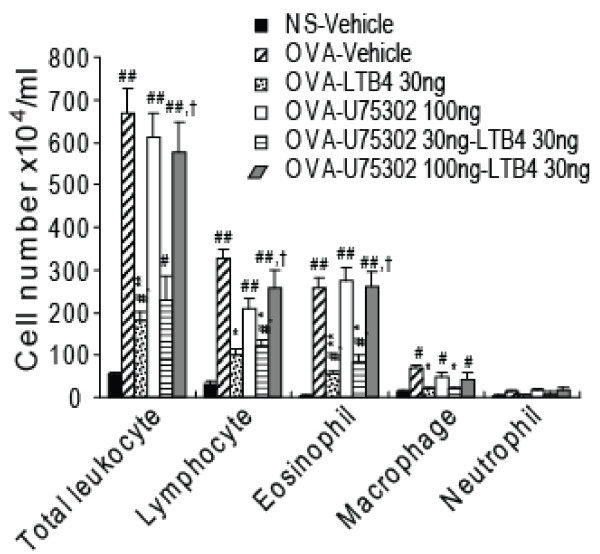
Antigen challenge impaired pulmonary function and increased inflammatory cell infiltration in lung tissue. These responses could be significantly suppressed by LTB4, 30 ng i.c.v., in ovalbumin-sensitized guinea pigs. LTB4 content of lung and brain homogenates from antigen-challenged guinea pigs was significantly increased. In addition, administration of LTB4 via i.c.v. markedly increased CORT and ACTH level in plasma before antigen challenge, and there were further increases in CORT and ACTH levels in plasma after antigen challenge. U75302, 100 ng i.c.v., completely blocked the effects of LTB4. In addition, U75302, 100 ng via i.c.v. injection, markedly decreased LTB4 content in lung homogenates, but not in brain homogenates.
Increased LTB4 levels in brain during asthmatic attacks down-regulates airway contraction response and inflammation through the BLT1 receptor. Stimulation of the hypothalamic-pituitary-adrenal axis by LTB4 may result in an increase in systemic glucocorticoids which, in turn, would feed back to suppress the asthmatic response.
尽管针对哮喘炎症的病理生理学进行了深入研究,但对于神经内分泌和免疫系统之间的相互作用如何调节哮喘发作时的炎症反应,我们知之甚少。我们最近在抗原攻击的哮喘大鼠的脑组织和肺组织中观察到细胞因子和白三烯 B4(LTB4)相应的变化。在这里,我们研究了 LTB4 如何与神经内分泌-免疫系统相互作用,以调节致敏豚鼠的抗原诱导的哮喘反应。
卵清蛋白致敏的豚鼠通过吸入抗原进行挑战。在挑战前 30 分钟,通过脑室内注射(i.c.v.)给予载体、LTB4 或 U75302(一种选择性 LTB4 BLT1 受体抑制剂)。使用 Penh 值在抗原挑战前后评估气道收缩反应。在挑战后 24 小时评估肺组织中的炎症反应。通过反相高效液相色谱法(RP-HPLC)检测肺和脑匀浆制剂中的 LTB4 含量。使用 ELISA 试剂盒测量血浆中促肾上腺皮质激素(ACTH)和皮质酮(CORT)的水平。
抗原挑战会损害肺功能并增加肺组织中的炎症细胞浸润。在卵清蛋白致敏的豚鼠中,LTB4(30ng i.c.v.)可显著抑制这些反应。来自抗原攻击的豚鼠的肺和脑匀浆中的 LTB4 含量显着增加。此外,LTB4 通过 i.c.v. 给药可显着增加抗原前的血浆中 CORT 和 ACTH 水平,并且在抗原后进一步增加血浆中的 CORT 和 ACTH 水平。100ng i.c.v. 的 U75302 完全阻断了 LTB4 的作用。此外,100ng i.c.v. 注射 U75302 可显着降低肺匀浆中的 LTB4 含量,但不影响脑匀浆中的 LTB4 含量。
哮喘发作时大脑中 LTB4 水平升高,通过 BLT1 受体下调气道收缩反应和炎症。LTB4 对下丘脑-垂体-肾上腺轴的刺激可能导致全身糖皮质激素增加,反过来又会反馈抑制哮喘反应。