Schneider Uwe, Besserer Jürgen, Mack Andreas
Radiotherapy Hirslanden AG, Institute for Radiotherapy, Rain 34, Aarau, Switzerland.
Theor Biol Med Model. 2010 Feb 11;7:4. doi: 10.1186/1742-4682-7-4.
A model for carcinoma and sarcoma induction was used to study the dependence of carcinogenesis after radiotherapy on fractionation.
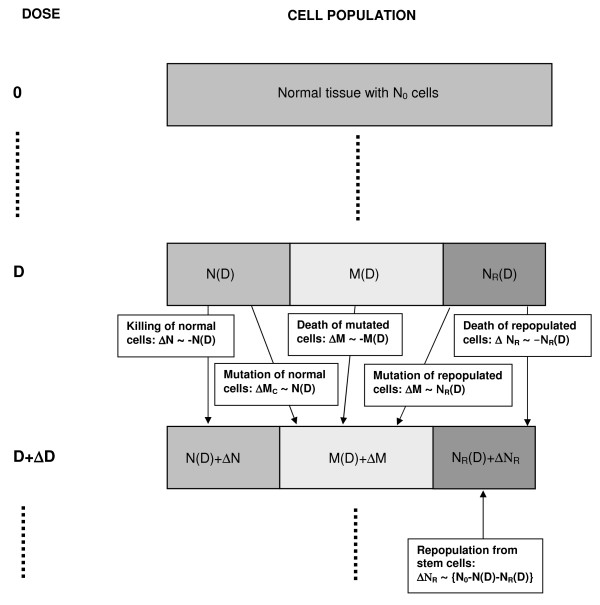
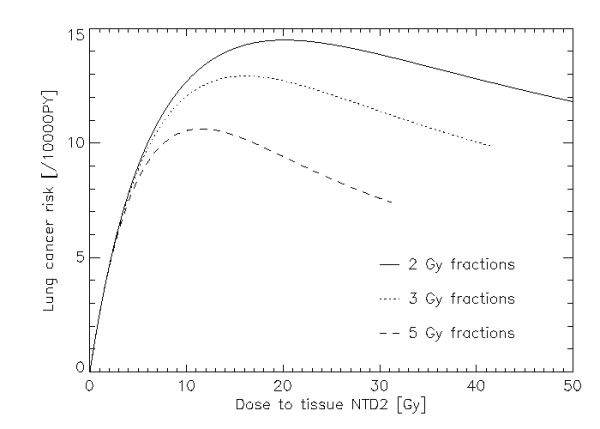
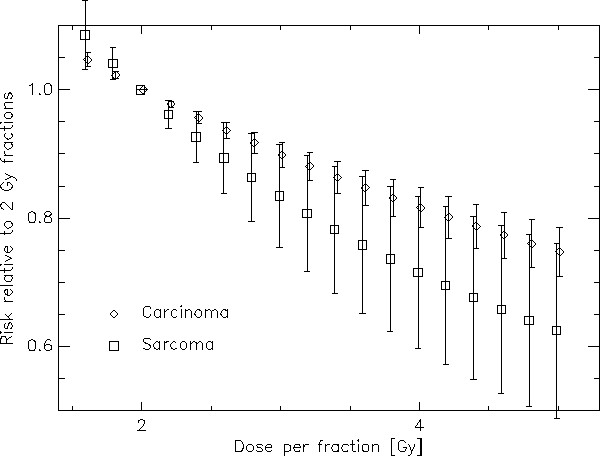
A cancer induction model for radiotherapy doses including fractionation was used to model carcinoma and sarcoma induction after a radiation treatment. For different fractionation schemes the dose response relationships were obtained. Tumor induction was studied as a function of dose per fraction.
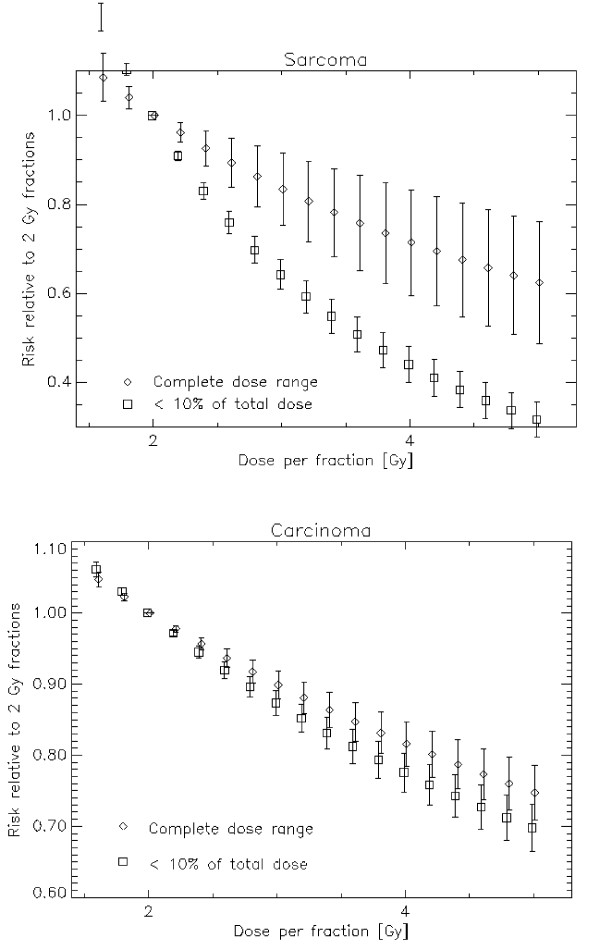
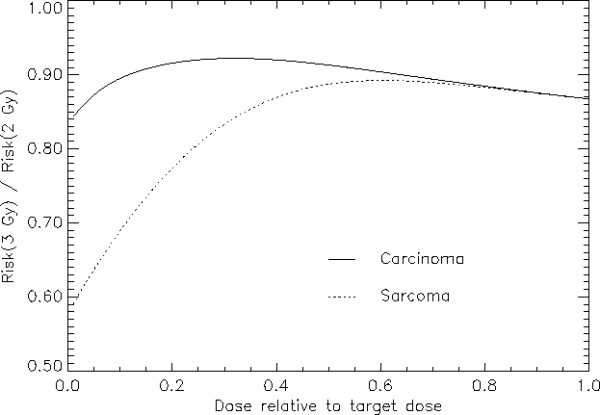
If it is assumed that the tumor is treated up to the same biologically equivalent dose it was found that large dose fractions could decrease second cancer induction. The risk decreases approximately linear with increasing fraction size and is more pronounced for sarcoma induction. Carcinoma induction decreases by around 10% per 1 Gy increase in fraction dose. Sarcoma risk is decreased by about 15% per 1 Gy increase in fractionation. It is also found that tissue which is irradiated using large dose fractions to dose levels lower than 10% of the target dose potentially develop less sarcomas when compared to tissues irradiated to all dose levels. This is not observed for carcinoma induction.
It was found that carcinoma as well as sarcoma risk decreases with increasing fractionation dose. The reduction of sarcoma risk is even more pronounced than carcinoma risk. Hypofractionation is potentially beneficial with regard to second cancer induction.
采用癌和肉瘤诱发模型研究放疗后致癌作用对分次照射的依赖性。
使用包含分次照射的放疗剂量致癌诱发模型来模拟放射治疗后癌和肉瘤的诱发情况。针对不同的分次照射方案,得出剂量反应关系。将肿瘤诱发作为每分次剂量的函数进行研究。
如果假设肿瘤接受相同生物等效剂量的治疗,发现大剂量分次照射可降低二次癌症的诱发。风险随分次剂量增加大致呈线性降低,且在肉瘤诱发中更为明显。每分次剂量每增加1 Gy,癌诱发降低约10%。每分次照射增加1 Gy,肉瘤风险降低约15%。还发现,与照射至所有剂量水平的组织相比,使用大剂量分次照射至低于靶剂量10%剂量水平的组织潜在发生的肉瘤较少。癌诱发未观察到这种情况。
发现癌和肉瘤风险均随分次剂量增加而降低。肉瘤风险的降低比癌风险更为明显。在二次癌症诱发方面,大分割放疗可能有益。