Institute of Biomechanics/ School of Bioscience and Bioengineering, South China University of Technology, Guangzhou 510006, China.
Int J Biol Sci. 2010 Feb 3;6(1):89-95. doi: 10.7150/ijbs.6.89.
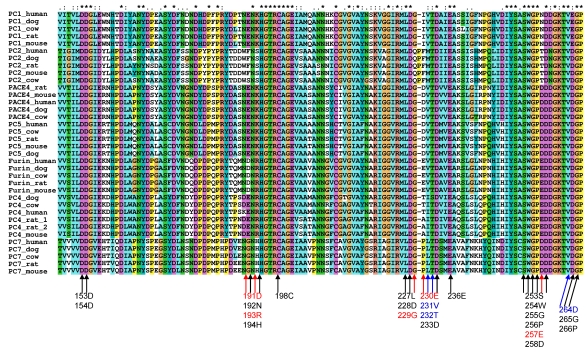
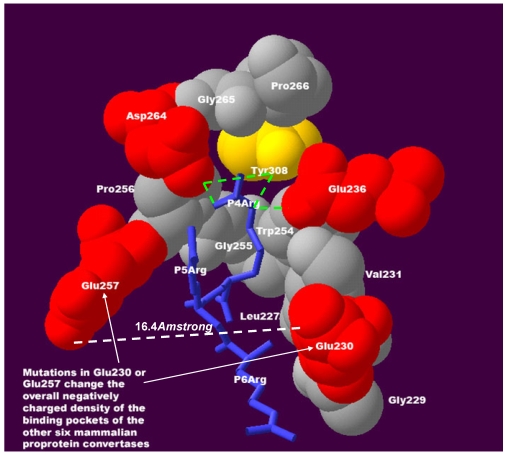
Proprotein convertases are enzymes that proteolytically cleave protein precursors in the secretory pathway to yield functional proteins. Seven mammalian subtilisin/Kex2p-like proprotein convertases have been identified: furin, PC1, PC2, PC4, PACE4, PC5 and PC7. The binding pockets of all seven proprotein convertases are evolutionarily conserved and highly similar. Among the seven proprotein convertases, the furin cleavage site motif has recently been characterized as a 20-residue motif that includes one core region P6-P2' inside the furin binding pocket. This study extended this information by examining the 3D structural environment of the furin binding pocket surrounding the core region P6-P2' of furin substrates. The physical properties of mutations in the binding pockets of the other six mammalian proprotein convertases were compared. The results suggest that: 1) mutations at two positions, Glu230 and Glu257, change the overall density of the negative charge of the binding pockets, and govern the substrate specificities of mammalian proprotein convertases; 2) two proprotein convertases (PC1 and PC2) may have reduced sensitivity for positively charged residues at substrate position P5 or P6, whereas the substrate specificities of three proprotein convertases (furin, PACE4, and PC5) are similar to each other. This finding led to a novel design of a short peptide pattern for small molecule inhibitors: [K/R]-X-V-X-K-R. Compared with the widely used small molecule dec-RVKR-cmk that inhibits all seven proprotein convertases, a finely-tuned derivative of the short peptide pattern [K/R]-X-V-X-K-R may have the potential to more effectively inhibit five of the proprotein convertases (furin, PC4, PACE4, PC5 and PC7) compared to the remaining two (PC1 and PC2). The results not only provide insights into the molecular evolution of enzyme function in the proprotein convertase family, but will also aid the study of the functional redundancy of proprotein convertases and the development of therapeutic applications.
蛋白水解酶原转化酶是一类在分泌途径中蛋白前体进行蛋白水解切割的酶,从而生成具有功能的蛋白。哺乳动物中有七种枯草溶菌素/柯萨奇蛋白酶样蛋白水解酶原转化酶:弗林蛋白酶、PC1、PC2、PC4、PACE4、PC5 和 PC7。这七种蛋白水解酶原转化酶的结合口袋在进化上是保守的,高度相似。在这七种蛋白水解酶原转化酶中,弗林蛋白酶切割位点基序最近被描述为一个 20 个残基的基序,包括弗林蛋白酶结合口袋内的核心区域 P6-P2'。本研究通过检查弗林蛋白酶底物核心区域 P6-P2'周围弗林蛋白酶结合口袋的 3D 结构环境,扩展了这一信息。比较了其他六种哺乳动物蛋白水解酶原转化酶结合口袋中突变的物理性质。结果表明:1)结合口袋中两个位置 Glu230 和 Glu257 的突变改变了结合口袋负电荷的整体密度,并控制了哺乳动物蛋白水解酶原转化酶的底物特异性;2)两种蛋白水解酶原转化酶(PC1 和 PC2)可能对底物位置 P5 或 P6 上的正电荷残基的敏感性降低,而三种蛋白水解酶原转化酶(弗林蛋白酶、PACE4 和 PC5)的底物特异性彼此相似。这一发现导致了小分子抑制剂的短肽模式的新设计:[K/R]-X-V-X-K-R。与广泛使用的抑制所有七种蛋白水解酶原转化酶的小分子 dec-RVKR-cmk 相比,短肽模式 [K/R]-X-V-X-K-R 的精细调谐衍生物可能具有更有效地抑制五种蛋白水解酶原转化酶(弗林蛋白酶、PC4、PACE4、PC5 和 PC7)的潜力,而不是另外两种(PC1 和 PC2)。这些结果不仅提供了对蛋白水解酶原转化酶家族中酶功能分子进化的深入了解,而且还将有助于研究蛋白水解酶原转化酶的功能冗余性和治疗应用的发展。