Department of Neurology, Changhua Christian Hospital, Changhua City 500, Taiwan.
J Biomed Sci. 2010 Feb 13;17(1):9. doi: 10.1186/1423-0127-17-9.
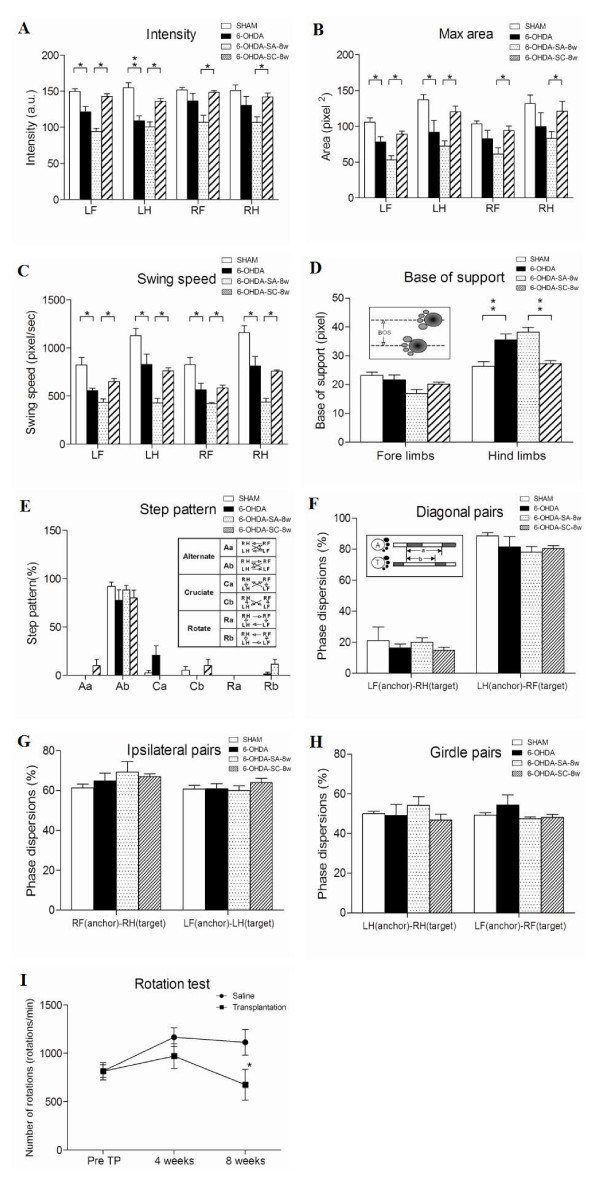
Although gait change is considered a useful indicator of severity in animal models of Parkinson's disease, systematic and extensive gait analysis in animal models of neurological deficits is not well established. The CatWalk-assisted automated gait analysis system provides a comprehensive way to assess a number of dynamic and static gait parameters simultaneously. In this study, we used the Catwalk system to investigate changes in gait parameters in adult rats with unilateral 6-OHDA-induced lesions and the rescue effect of dopaminergic neuron transplantation on gait function. Four weeks after 6-OHDA injection, the intensity and maximal area of contact were significantly decreased in the affected paws and the swing speed significantly decreased in all four paws. The relative distance between the hind paws also increased, suggesting that animals with unilateral 6-OHDA-induced lesions required all four paws to compensate for loss of balance function. At 8 weeks post-transplantation, engrafted dopaminergic neurons expressed tyrosine hydroxylase. In addition, the intensity, contact area, and swing speed of the four limbs increased and the distance between the hind paws decreased. Partial recovery of methamphetamine-induced rotational response was also noted.
虽然步态改变被认为是帕金森病动物模型严重程度的一个有用指标,但在神经功能缺损的动物模型中,系统和广泛的步态分析尚未得到很好的建立。CatWalk 辅助自动步态分析系统提供了一种全面的方法来同时评估许多动态和静态的步态参数。在这项研究中,我们使用 CatWalk 系统来研究单侧 6-OHDA 诱导损伤的成年大鼠的步态参数变化,以及多巴胺能神经元移植对步态功能的挽救作用。6-OHDA 注射后 4 周,患侧的强度和最大接触面积显著降低,所有四个爪子的摆动速度也显著降低。后爪之间的相对距离也增加了,这表明单侧 6-OHDA 诱导损伤的动物需要用四个爪子来补偿平衡功能的丧失。移植后 8 周,移植的多巴胺能神经元表达酪氨酸羟化酶。此外,四肢的强度、接触面积和摆动速度增加,后爪之间的距离减小。也注意到了苯丙胺诱导的旋转反应的部分恢复。