Institute for Occupational Physiology, Augusta Kranken Anstalt, Bochum, Germany.
Eur J Med Res. 2009 Dec 7;14 Suppl 4(Suppl 4):170-6. doi: 10.1186/2047-783x-14-s4-170.
Bronchial challenge tests by inhalation of aerosolized methacholine (MCH) are commonly used in the clinical diagnosis of airway hyperresponsiveness (AHR). While the detection of airway narrowing relies on the patient's cooperation performing forced spirometry, body plethysmographic measurements of airway resistance are less depending on the patient's cooperation and do not alter the respiratory tract by maximal maneuvers. Hence we compared both methods concerning their clinical value and correlation during MCH challenges in patients with asthma.
Cumulative MCH challenges test, consisting of up to 5 steps, evaluated with body plethysmography on each step were performed in 155 patients with bronchial asthma. Airway responses were recorded at each step of MCH application (MasterScreen Body, Cardinal Health, Höchberg). At the baseline test and after crossing the provocation dose (PD) threshold in body plethysmography (PD+100 sReff), forced expirations were performed and FEV(1), FVC, and FEV(1) %FVC were measured. Using regression analysis of the airway parameters and taking the MCH dose as the covariate, we could extrapolate to missing spirometric values and interpolate the estimated MCH dose when crossing the PD threshold (PD-20 FEV(1)) between two consecutive measurements. The administered PD+100 MCH doses for specific airway resistance, sRtot, and sReff were compared with resistance parameters Rtot and Reff, and to PD-20 of FEV(1) and FEV(1) %FVC.
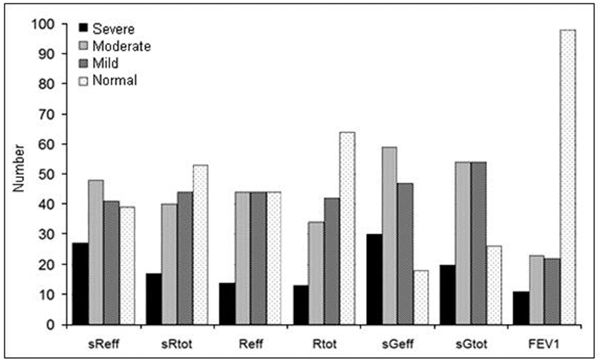
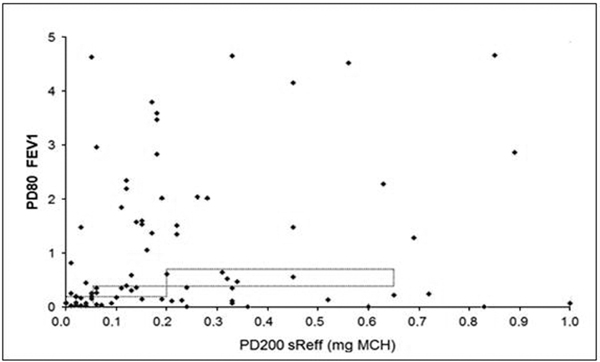
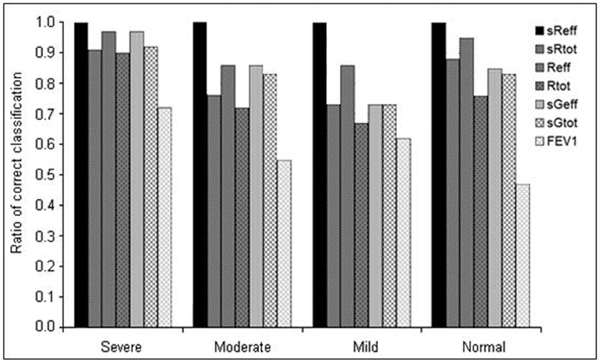
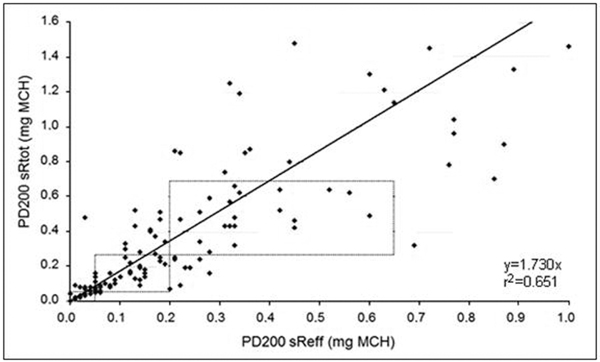
Regarding sReff we found a mild, moderate, or severe AHR in 114 patients (75%), but only 50 (32%) according to FEV1. A statistical analysis showed strongly linear correlated parameters of airway resistance, but no significant correlation between the results of body plethysmography and forced spirometry.
Using MCH challenges, we found specific airway resistance to be the most sensitive parameter to detect AHR. Raw is largely independent of height and gender facilitating the interpretation of measurements carried out longitudinally.
通过雾化吸入乙酰甲胆碱(MCH)进行支气管激发试验是临床诊断气道高反应性(AHR)的常用方法。虽然气道狭窄的检测依赖于患者进行强制肺活量测定的配合,但气道阻力的体描测量较少依赖于患者的配合,并且不会通过最大动作改变呼吸道。因此,我们比较了两种方法在支气管哮喘患者的 MCH 激发试验中的临床价值和相关性。
在 155 例支气管哮喘患者中进行了累积 MCH 激发试验,该试验由多达 5 个步骤组成,每个步骤均进行体描测量。在 MCH 应用的每个步骤记录气道反应(MasterScreen Body,Cardinal Health,Höchberg)。在基线测试和体描测量中超过激发剂量(PD)阈值(PD+100 sReff)后,进行强制呼气,测量 FEV1、FVC 和 FEV1/FVC%。使用气道参数的回归分析,并将 MCH 剂量作为协变量,我们可以外推缺失的肺活量测定值,并在两次连续测量之间插值估计的 MCH 剂量(PD-20 FEV1)。特定气道阻力 sRtot 和 sReff 的给药 PD+100 MCH 剂量与阻力参数 Rtot 和 Reff 以及 PD-20 FEV1 和 FEV1/FVC%进行了比较。
在 114 例患者(75%)中发现 sReff 存在轻度、中度或重度 AHR,但根据 FEV1 仅发现 50 例(32%)。统计分析显示气道阻力的参数具有很强的线性相关性,但体描测量和强制肺活量测定的结果之间没有显著相关性。
使用 MCH 激发试验,我们发现特定气道阻力是检测 AHR 的最敏感参数。未校正的 sRtot 主要独立于身高和性别,便于进行纵向测量的解释。