Aranda-Anzaldo Armando
Laboratorio de Biología Molecular, Facultad de Medicina, Universidad Autónoma del Estado de México, Paseo Tollocan y Jesús Carranza, Toluca, Edo. Méx., México.
Aging (Albany NY). 2009 Jul 29;1(7):598-607. doi: 10.18632/aging.100074.
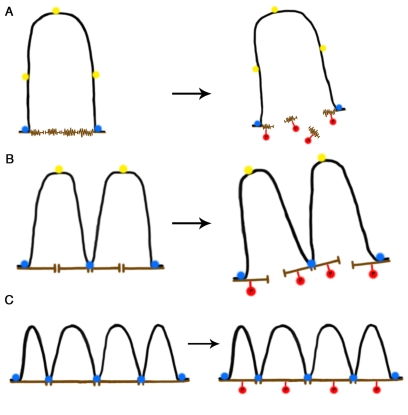
Replicative senescence (RS) that limits the proliferating potential of normal eukaryotic cells occurs either by a cell-division counting mechanism linked to telomere erosion or prematurely through induction by cell stressors such as oncogene hyper-activation. However, there is evidence that RS also occurs by a stochastic process that is independent of number of cell divisions or cellular stress and yet it leads to a highly-stable, non-reversible post-mitotic state that may be long-lasting and that such a process is widely represented among higher eukaryotes. Here I present and discuss evidence that the interactions between DNA and the nuclear substructure, commonly known as the nuclear matrix, define a higher-order structure within the cell nucleus that following thermodynamic constraints, stochastically evolves towards maximum stability, thus becoming limiting for mitosis to occur. It is suggested that this process is responsible for ultimate replicative senescence and yet it is compatible with long-term cell survival.
复制性衰老(RS)限制正常真核细胞的增殖潜能,其发生要么通过与端粒侵蚀相关的细胞分裂计数机制,要么通过细胞应激源(如癌基因过度激活)的诱导而过早发生。然而,有证据表明,RS也通过一个随机过程发生,该过程独立于细胞分裂次数或细胞应激,但会导致一种高度稳定、不可逆的有丝分裂后状态,这种状态可能持续很长时间,并且这种过程在高等真核生物中广泛存在。在此,我展示并讨论证据,即DNA与通常称为核基质的核亚结构之间的相互作用定义了细胞核内的一种高阶结构,该结构遵循热力学约束,随机向最大稳定性演化,从而限制有丝分裂的发生。有人认为,这一过程是最终复制性衰老的原因,但它与细胞的长期存活是相容的。