Department of Orthopaedics and Traumatology, Catholic University, Agostino Gemelli Hospital, Rome, Italy.
BMC Musculoskelet Disord. 2010 Feb 16;11:34. doi: 10.1186/1471-2474-11-34.
Angiogenesis plays a role in the progression of osteosarcoma, as well as in other mesenchymal tumors and carcinomas, and it is most commonly assessed by vascular endothelial growth factor (VEGF) expression or tumor CD31-positive microvessel density (MVD). Tumor VEGF expression is predictive of poor prognosis, and chemotherapy can affect the selection of angiogenic pattern. The aim of the study was to investigate the clinical and prognostic significance of VEGF and CD31 in osteosarcoma, both at diagnosis and after neoadjuvant chemotherapy, in order to identify a potential role of chemotherapy in angiogenic phenotype.
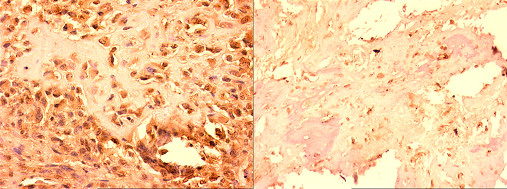
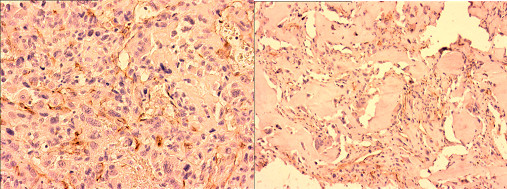
A retrospective analysis was performed on 16 patients with high grade osteosarcoma. In each case archival pre-treatment biopsy tissue and post-chemotherapy tumor specimens were immunohistochemically stained against CD31 and VEGF, as markers of angiogenic proliferation both in newly diagnosed primary osteosarcoma and after multidrug chemotherapy including high-dose methotrexate (HDMTX). The correlation between clinicopathological parameters and the degree of tumor VEGF and CD31 expression was statistically assessed using the chi(2) test verified with Yates' test for comparison of two groups. Significance was set at p < 0.05.
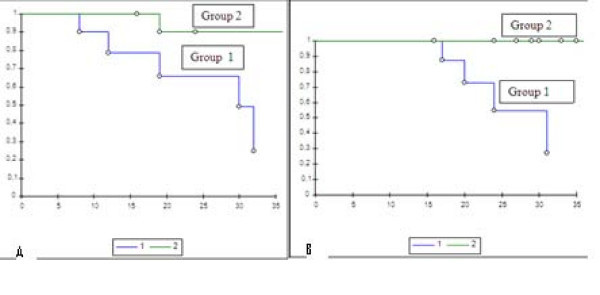
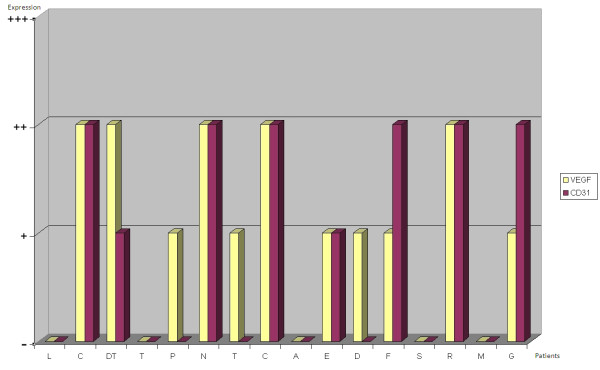
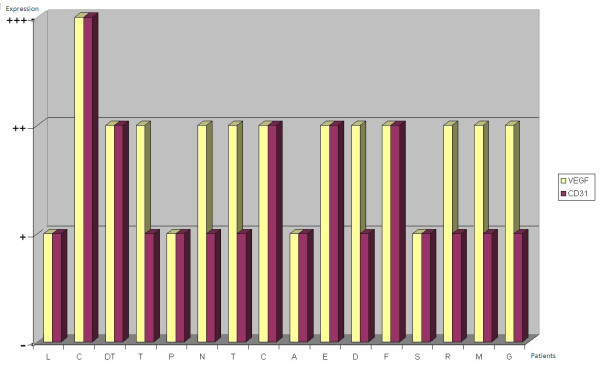
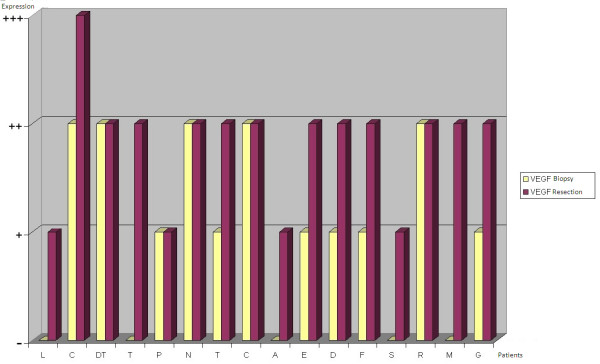
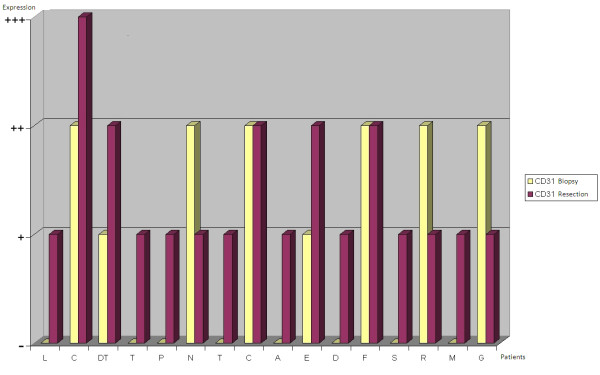
Expression of VEGF was positive in 11 cases/16 of cases at diagnosis. Moreover, 8 cases/16 untreated osteosarcomas were CD31-negative, but the other 8 showed an high expression of CD31. VEGF expression in viable tumor cells after neoadjuvant chemotherapy was observed in all cases; in particular, there was an increased VEGF expression (post-chemotherapy VEGF--biopsy VEGF) in 11 cases/16. CD31 expression increased in 11 cases/16 and decreased in 3 cases after chemotherapy. The data relating to the change in staining following chemotherapy appear statistically significant for VEGF expression (p < 0.05), but not for CD31 (p > 0.05).
Even if the study included few patients, these results confirm that VEGF and CD31 expression is affected by multidrug chemotherapy including HDMTX. The expression of angiogenic factors that increase microvessel density (MVD) can contribute to the penetration of chemotherapeutic drugs into the tumor in the adjuvant stage of treatment. So VEGF could have a paradoxical effect: it is associated with a poor outcome but it could be a potential target for anti-angiogenic therapy.
血管生成在骨肉瘤的进展中起作用,也在其他间充质肿瘤和癌中起作用,通常通过血管内皮生长因子(VEGF)表达或肿瘤 CD31 阳性微血管密度(MVD)来评估。肿瘤 VEGF 表达可预测预后不良,化疗可影响血管生成模式的选择。本研究的目的是探讨骨肉瘤中 VEGF 和 CD31 的临床和预后意义,包括在新辅助化疗前和化疗后,以确定化疗在血管生成表型中的潜在作用。
对 16 例高级别骨肉瘤患者进行回顾性分析。在每个病例中,用免疫组织化学方法对 CD31 和 VEGF 进行染色,作为新诊断的原发性骨肉瘤和多药化疗后(包括高剂量甲氨蝶呤(HDMTX))的血管生成增殖的标志物。使用卡方检验(chi(2) test)对临床病理参数与肿瘤 VEGF 和 CD31 表达程度之间的相关性进行统计学评估,并用 Yates 检验(Yates' test)比较两组间的差异。以 p < 0.05 为显著性水平。
在 16 例病例中,有 11 例/16 例在诊断时 VEGF 表达阳性。此外,未经治疗的 16 例骨肉瘤中有 8 例/16 例 CD31 阴性,但其他 8 例 CD31 高表达。在新辅助化疗后所有病例均观察到活肿瘤细胞中 VEGF 的表达;特别是,在 16 例中有 11 例/16 例 VEGF 表达增加(化疗后 VEGF-活检 VEGF)。在 11 例/16 例病例中,CD31 的表达增加,而在 3 例病例中,CD31 的表达减少。化疗后染色变化的数据在统计学上与 VEGF 表达(p < 0.05)显著相关,但与 CD31 无关(p > 0.05)。
即使研究纳入的患者较少,这些结果也证实了 VEGF 和 CD31 的表达受包括 HDMTX 在内的多药化疗的影响。增加微血管密度(MVD)的血管生成因子的表达可能有助于化疗药物在治疗辅助阶段渗透到肿瘤中。因此,VEGF 可能具有矛盾的作用:它与不良预后相关,但它可能是抗血管生成治疗的潜在靶点。