Cancer Prevention and Control Program, Moores UCSD Cancer Center, University of California, San Diego, La Jolla, CA 92093-0645, USA.
Prev Chronic Dis. 2010 Mar;7(2):A29. Epub 2010 Feb 15.
The prevalence of cigarette smoking in the United States has decreased, but current rates remain above nationally set objectives. A family history of lung cancer may motivate adult smokers to quit and contribute to further reductions in smoking prevalence.
We surveyed adult smokers (N = 838) interviewed as part of the 2005 Health Information National Trends Survey. We examined the association between family history of lung cancer and smoking cessation precontemplation (not considering), contemplation (considering), and preparation.
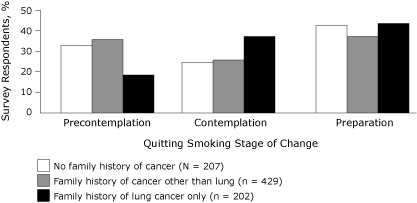
More people who reported a family history of lung cancer were in contemplation/preparation stages (41%) than were in the precontemplation stage (19%). Adults who reported a family history of lung cancer were more likely (odds ratio 2.55 [95% confidence interval, 1.44-4.52]) to be contemplators than precontemplators after adjusting for demographic variables and level of daily smoking.
Family history of lung cancer among adult smokers may be associated with contemplating quitting smoking. Further investigation of family history's role in bolstering motivation to quit smoking may assist in developing or improving smoking cessation interventions for this group.
尽管美国的吸烟率有所下降,但目前的吸烟率仍高于国家设定的目标。肺癌家族史可能会促使成年吸烟者戒烟,并有助于进一步降低吸烟率。
我们调查了作为 2005 年国家健康访谈调查的一部分而接受采访的成年吸烟者(N=838)。我们考察了肺癌家族史与戒烟前的考虑(不考虑)、考虑(考虑)和准备(准备)之间的关联。
报告有肺癌家族史的人更多地处于考虑/准备阶段(41%),而处于前考虑阶段(19%)的人较少。在调整了人口统计学变量和每日吸烟量后,报告有肺癌家族史的成年人更有可能(优势比 2.55 [95%置信区间,1.44-4.52])成为考虑者而不是前考虑者。
成年吸烟者的肺癌家族史可能与考虑戒烟有关。进一步研究家族史在增强戒烟动机方面的作用,可能有助于为这一群体制定或改进戒烟干预措施。