Department of Chemical Ecology and Ecosystem Research, University of Vienna, Althanstrasse 14, A-1090 Vienna, Austria.
J Exp Bot. 2010 Mar;61(5):1375-83. doi: 10.1093/jxb/erq006. Epub 2010 Feb 16.
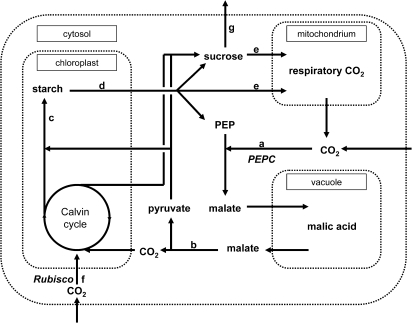
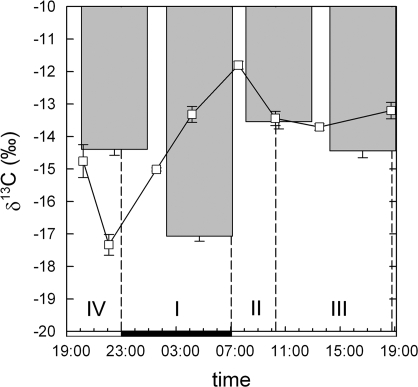
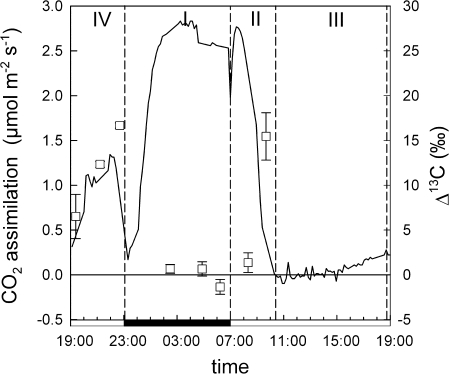
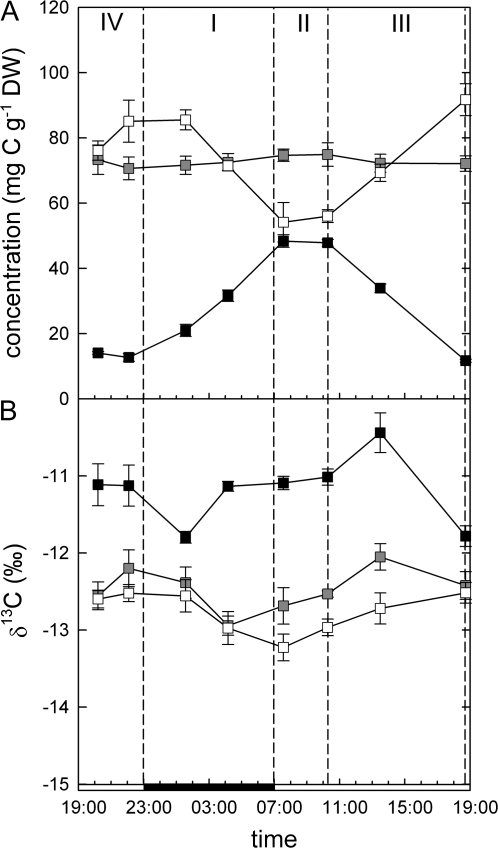
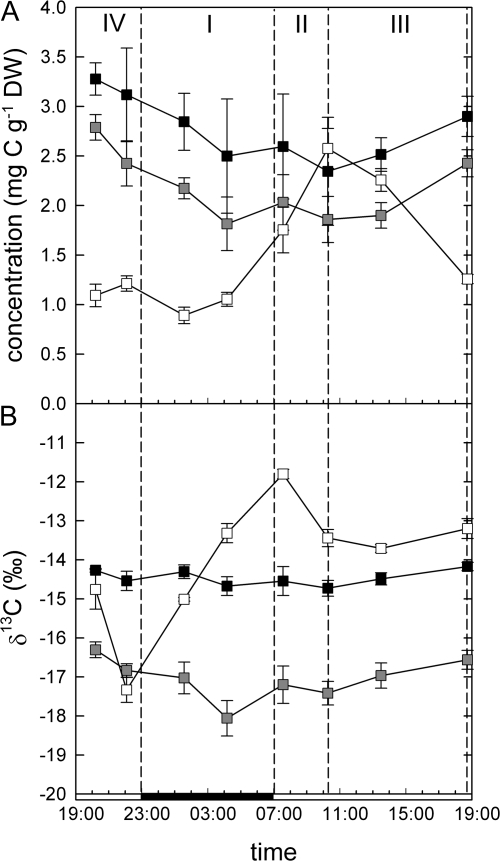
Crassulacean acid metabolism (CAM) plants exhibit a complex interplay between CO(2) fixation by phosphoenolpyruvate carboxylase (PEPC) and ribulose-1,5-bisphosphate carboxylase oxygenase (Rubisco), and carbon demand for CAM maintenance and growth. This study investigated the flux of carbon from PEPC and direct Rubisco fixation to different leaf carbon pools and to phloem sap over the diurnal cycle. Concentrations and carbon isotope compositions of starch, soluble sugars, and organic acids were determined in leaves and phloem exudates of Kalanchoë daigremontiana Hamet et Perr., and related to CO(2) fixation by PEPC and Rubisco. Three types of leaf carbon pools could be distinguished. (i) Starch and malate pools were dominant and showed a pattern of reciprocal mobilization and accumulation (85/54 and 13/48 mg C g(-1) DW, respective, at the beginning/end of phase I). The carbon isotope composition of these pools was compatible with predominant PEPC fixation (delta(13)C values of -13 and -11 per thousand for starch and malate compared to -11 per thousand of PEPC fixed carbon). (ii) Isotopic composition (-17 per thousand and -14 per thousand) and concentration of glucose and fructose (2 and 3 mg C g(-1) DW, respectively) were not affected by diurnal metabolism, suggesting a low turnover. (iii) Sucrose (1-3 mg C g(-1) DW), in contrast, exhibited large diurnal changes in delta(13)C values (from -17 per thousand in the evening to -12 per thousand in the morning), which were not matched by net changes in sucrose concentration. This suggests a high sucrose turnover, fed by nocturnal starch degradation and direct Rubisco fixation during the day. A detailed dissection of the carbon fixation and mobilization pattern in K. daigremontiana revealed that direct fixation of Rubisco during the light accounted for 30% of phloem sucrose, but only 15% of fixed carbon, indicating that carbon from direct Rubisco fixation was preferentially used for leaf export.
景天酸代谢(CAM)植物中存在着磷酸烯醇丙酮酸羧化酶(PEPC)和核酮糖-1,5-二磷酸羧化酶加氧酶(Rubisco)固定 CO2 以及 CAM 维持和生长的碳需求之间的复杂相互作用。本研究调查了 PEPC 和直接 Rubisco 固定的碳在日周期中流向不同叶片碳库和韧皮部汁液的情况。在大花虎尾兰(Kalanchoë daigremontiana Hamet et Perr.)的叶片和韧皮部渗出物中测定了淀粉、可溶性糖和有机酸的浓度和碳同位素组成,并与 PEPC 和 Rubisco 的 CO2 固定相关联。可以区分出三种类型的叶片碳库。(i)淀粉和苹果酸库占主导地位,表现出相互动员和积累的模式(在 I 期开始/结束时分别为 85/54 和 13/48 mg C g(-1) DW)。这些库的碳同位素组成与主要的 PEPC 固定一致(与 PEPC 固定碳相比,淀粉和苹果酸的 δ13C 值分别为-13 和-11 千分位)。(ii)葡萄糖和果糖的同位素组成(-17 和-14 千分位)和浓度(分别为 2 和 3 mg C g(-1) DW)不受日代谢的影响,表明周转率较低。(iii)相反,蔗糖(1-3 mg C g(-1) DW)的 δ13C 值在日周期中变化较大(从晚上的-17 千分位到早上的-12 千分位),但蔗糖浓度没有净变化与之相匹配。这表明蔗糖的周转率很高,由夜间淀粉降解和白天直接 Rubisco 固定提供。对大花虎尾兰的碳固定和动员模式的详细剖析表明,白天光照下直接 Rubisco 固定的碳占韧皮部蔗糖的 30%,但仅占固定碳的 15%,表明直接 Rubisco 固定的碳优先用于叶片输出。