Schenauer Matthew R, Leary Julie A
Departments of Chemistry and Molecular and Cellular Biology, University of California, Davis, California 95616.
Int J Mass Spectrom. 2009 Oct 15;287(1-3):70-76. doi: 10.1016/j.ijms.2009.02.023.
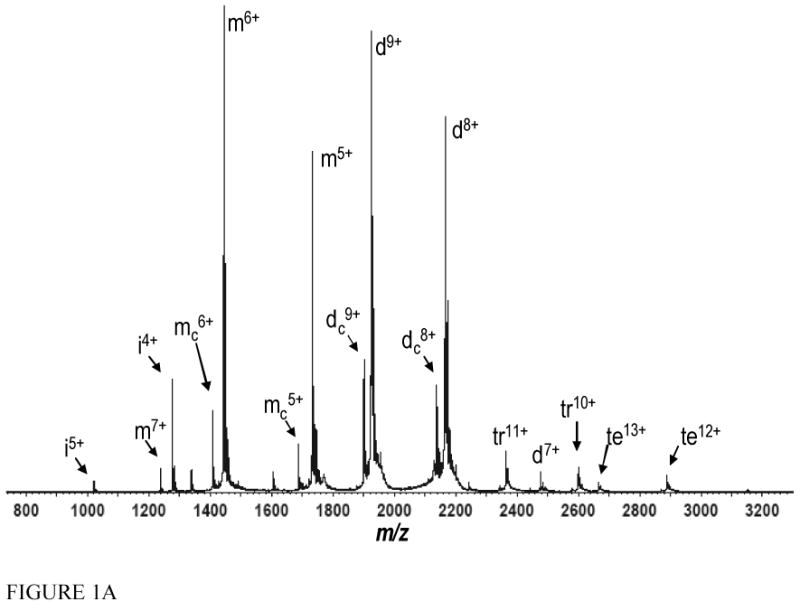
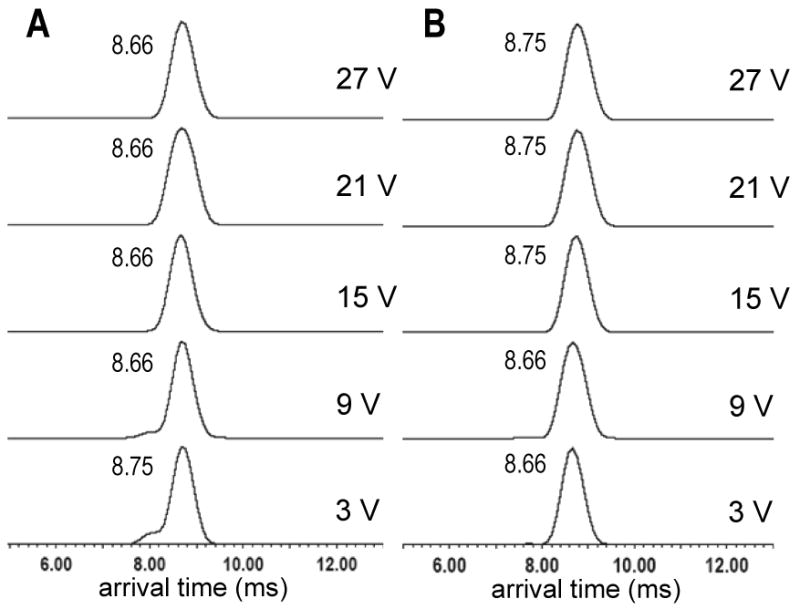
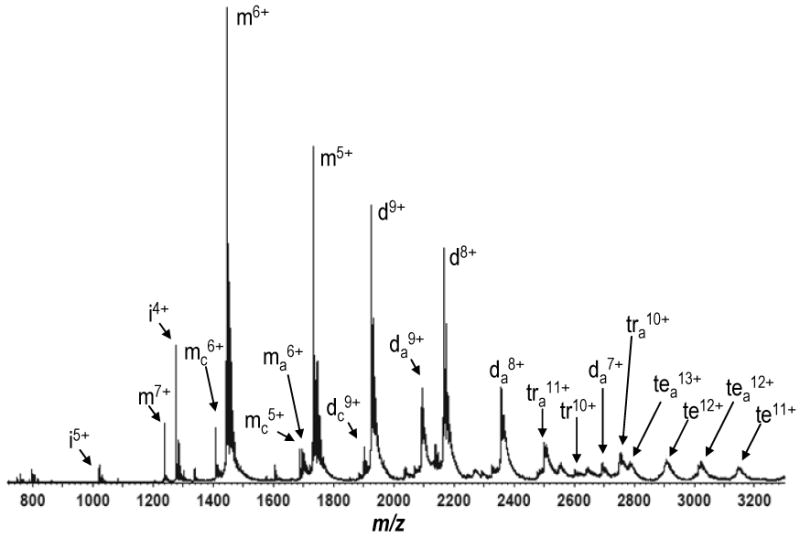
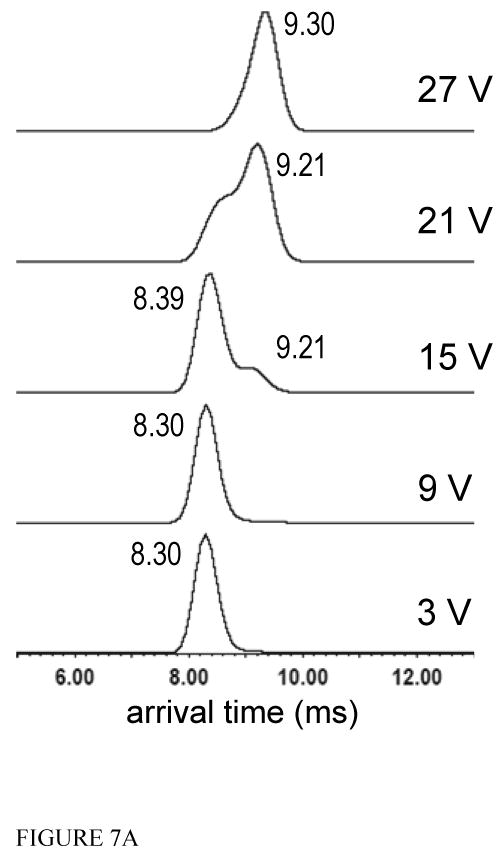
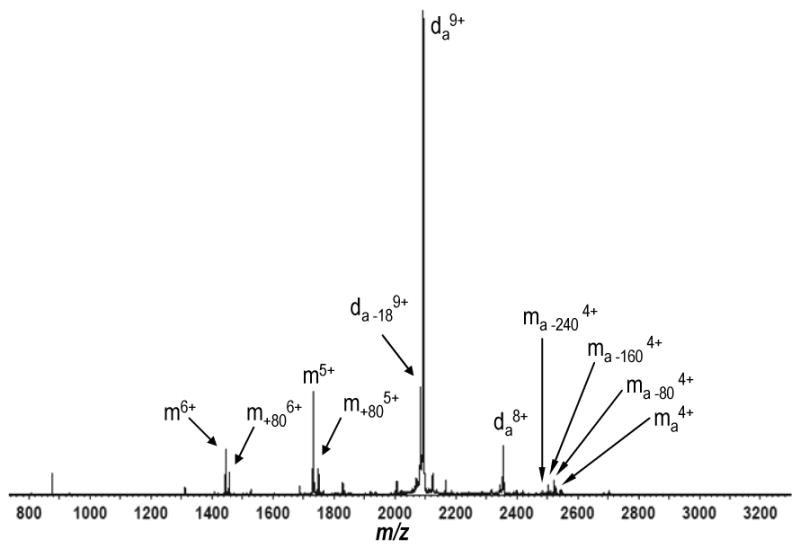
In the present article we describe the gas-phase dissociation behavior of the dimeric form of monocyte chemoattractant protein-1 (MCP-1) using quadrupole-traveling wave ion mobility-time of flight mass spectrometry (q-TWIMS-TOF MS) (Waters Synapt™). Through investigation of the 9(+) charge state of the dimer, we were able to monitor dissociation product ion (monomer) formation as a function of activation energy. Using ion mobility, we were able to observe precursor ion structural changes occurring throughout the activation process. Arrival time distributions (ATDs) for the 5(+) monomeric MCP-1 product ions, derived from the gas-phase dissociation of the 9(+) dimer, were then compared with ATDs obtained for the 5(+) MCP-1 monomer isolated directly from solution. The results show that the dissociated monomer is as compact as the monomer arising from solution, regardless of the trap collision energy (CE) used in the dissociation. The solution-derived monomer, when collisionally activated, also resists significant unfolding within measure. Finally, we compared the collisional activation data for the MCP-1 dimer with an MCP-1 dimer non-covalently bound to a single molecule of the semi-synthetic glycosaminoglycan (GAG) analog Arixtra™; the latter a therapeutic anti-thrombin III-activating pentasaccharide. We observed that while dimeric MCP-1 dissociated at relatively low trap CEs, the Arixtra-bound dimer required much higher energies, which also induced covalent bond cleavage in the bound Arixtra molecule. Both the free and Arixtra-bound dimers became less compact and exhibited longer arrival times with increasing trap CEs, albeit the Arixtra-bound complex at slightly higher energies. That both dimers shifted to longer arrival times with increasing activation energy, while the dissociated MCP-1 monomers remained compact, suggests that the longer arrival times of the Arixtra-free and Arixtra-bound dimers may represent a partial breach of non-covalent interactions between the associated MCP-1 monomers, rather than extensive unfolding of individual subunits. The fact that Arixtra preferentially binds MCP-1 dimers and prevents dimer dissociation at comparable activation energies to the Arixtra-free dimer, may suggest that the drug interacts across the two monomers, thereby inhibiting their dissociation.
在本文中,我们使用四极杆-行波离子淌度-飞行时间质谱仪(q-TWIMS-TOF MS,沃特世公司的Synapt™)描述了单核细胞趋化蛋白-1(MCP-1)二聚体形式的气相解离行为。通过研究二聚体的9(+)电荷态,我们能够监测解离产物离子(单体)的形成与活化能的关系。利用离子淌度,我们能够观察到在整个活化过程中前体离子的结构变化。然后,将由9(+)二聚体的气相解离产生的5(+)单体MCP-1产物离子的到达时间分布(ATD)与直接从溶液中分离得到的5(+) MCP-1单体的ATD进行比较。结果表明,无论解离过程中使用的阱碰撞能量(CE)如何,解离后的单体与溶液中产生的单体一样紧密。溶液来源的单体在碰撞活化时,在可测量范围内也能抵抗显著的解折叠。最后,我们将MCP-1二聚体的碰撞活化数据与非共价结合到半合成糖胺聚糖(GAG)类似物阿加曲班™单分子上的MCP-1二聚体进行了比较;后者是一种治疗性抗凝血酶III激活五糖。我们观察到,虽然二聚体MCP-1在相对较低的阱CE下解离,但与阿加曲班结合的二聚体需要更高的能量,这也导致了结合的阿加曲班分子中的共价键断裂。随着阱CE的增加,游离和与阿加曲班结合的二聚体都变得不那么紧密,到达时间变长,尽管与阿加曲班结合的复合物在稍高的能量下出现这种情况。随着活化能增加,两种二聚体的到达时间都变长,而解离后的MCP-1单体仍然紧密,这表明游离和与阿加曲班结合的二聚体较长的到达时间可能代表相关MCP-1单体之间非共价相互作用的部分破坏,而不是单个亚基的广泛解折叠。阿加曲班优先结合MCP-1二聚体并在与游离阿加曲班二聚体相当的活化能下阻止二聚体解离,这一事实可能表明该药物跨两个单体相互作用,从而抑制它们的解离。