Oxford Centre for Integrative Systems Biology, Department of Biochemistry, University of Oxford, Oxford, United Kingdom.
PLoS Biol. 2010 Feb 9;8(2):e1000306. doi: 10.1371/journal.pbio.1000306.
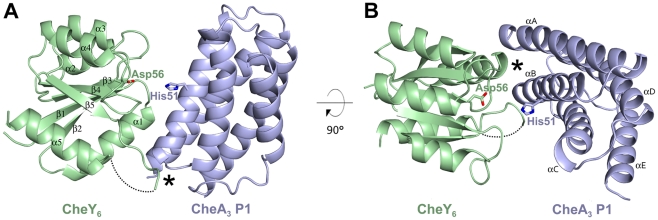
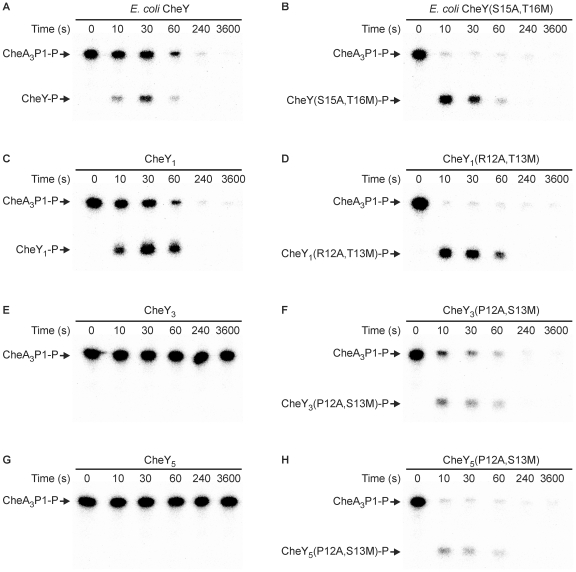
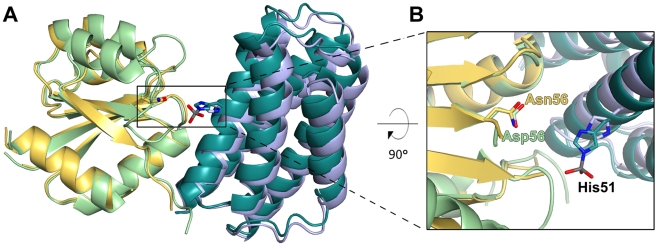
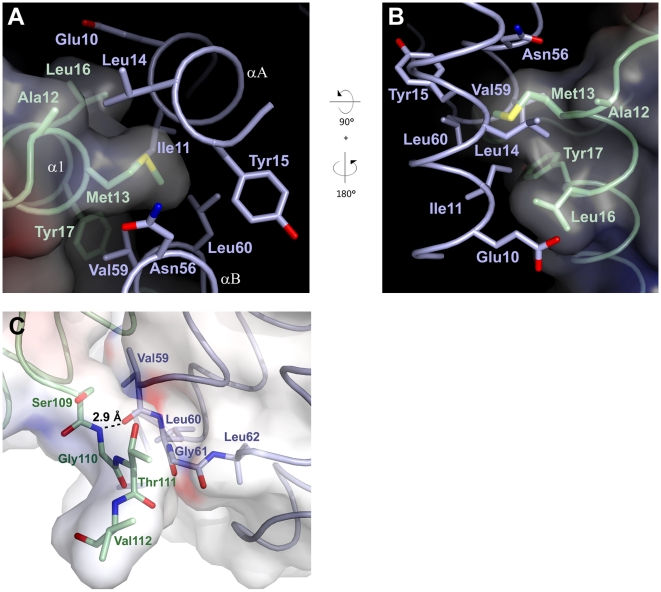
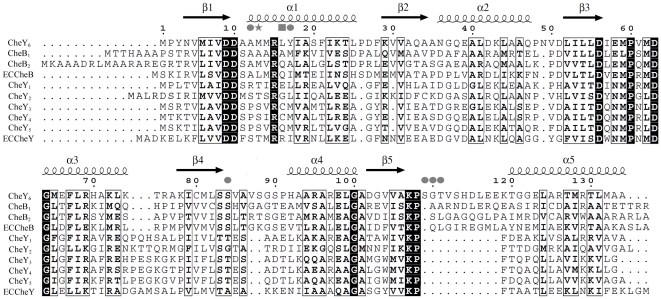
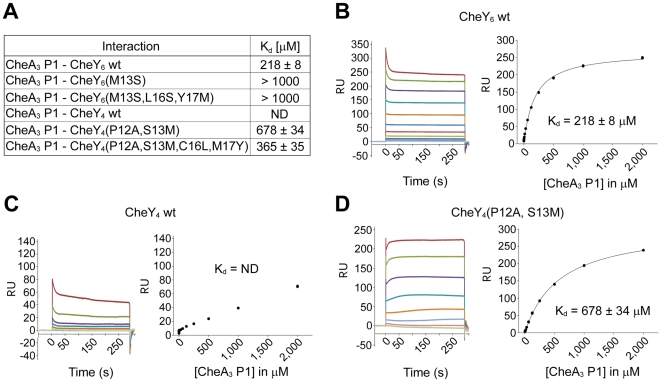
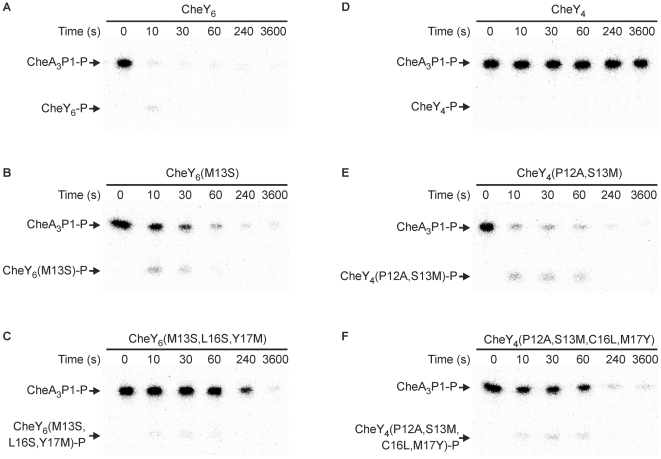
Two-component signal transduction pathways comprising histidine protein kinases (HPKs) and their response regulators (RRs) are widely used to control bacterial responses to environmental challenges. Some bacteria have over 150 different two-component pathways, and the specificity of the phosphotransfer reactions within these systems is tightly controlled to prevent unwanted crosstalk. One of the best understood two-component signalling pathways is the chemotaxis pathway. Here, we present the 1.40 A crystal structure of the histidine-containing phosphotransfer domain of the chemotaxis HPK, CheA(3), in complex with its cognate RR, CheY(6). A methionine finger on CheY(6) that nestles in a hydrophobic pocket in CheA(3) was shown to be important for the interaction and was found to only occur in the cognate RRs of CheA(3), CheY(6), and CheB(2). Site-directed mutagenesis of this methionine in combination with two adjacent residues abolished binding, as shown by surface plasmon resonance studies, and phosphotransfer from CheA(3)-P to CheY(6). Introduction of this methionine and an adjacent alanine residue into a range of noncognate CheYs, dramatically changed their specificity, allowing protein interaction and rapid phosphotransfer from CheA(3)-P. The structure presented here has allowed us to identify specificity determinants for the CheA-CheY interaction and subsequently to successfully reengineer phosphotransfer signalling. In summary, our results provide valuable insight into how cells mediate specificity in one of the most abundant signalling pathways in biology, two-component signal transduction.
双组分信号转导途径包括组氨酸蛋白激酶(HPK)及其反应调节剂(RR),广泛用于控制细菌对环境挑战的反应。一些细菌有超过 150 种不同的双组分途径,这些系统内磷酸转移反应的特异性受到严格控制,以防止不必要的串扰。研究最透彻的双组分信号转导途径之一是趋化作用途径。在这里,我们展示了化学感应 HPK CheA(3)的组氨酸磷酸转移结构域与它的同源 RR CheY(6)的复合物的 1.40Å 晶体结构。CheY(6)上的一个甲硫氨酸手指嵌套在 CheA(3)的一个疏水性口袋中,对于相互作用很重要,并且仅在 CheA(3)、CheY(6)和 CheB(2)的同源 RR 中发现。该甲硫氨酸和相邻的两个残基的定点突变与表面等离子体共振研究相结合,消除了结合,并且从 CheA(3)-P 到 CheY(6)的磷酸转移也被消除。将该甲硫氨酸和相邻的丙氨酸残基引入一系列非同源 CheY 中,极大地改变了它们的特异性,允许蛋白质相互作用和从 CheA(3)-P 快速磷酸转移。这里呈现的结构使我们能够识别 CheA-CheY 相互作用的特异性决定因素,并随后成功地重新设计磷酸转移信号。总之,我们的结果为细胞如何在生物学中最丰富的信号转导途径之一——双组分信号转导中介导特异性提供了有价值的见解。