Laboratoire Psychologie et NeuroCognition (UMR CNRS), CNRS and Université Pierre Mendès France, Grenoble, France.
PLoS One. 2010 Feb 9;5(2):e9108. doi: 10.1371/journal.pone.0009108.
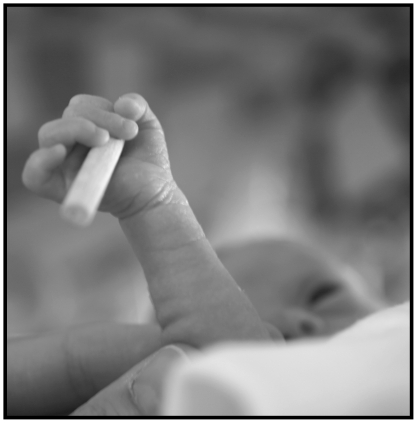
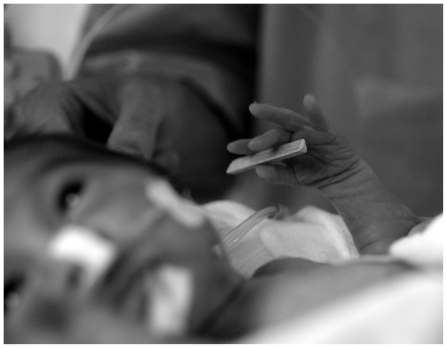
Grasping at birth is well-known as a reflex in response to a stimulation of the palm of the hand. Recent studies revealed that this grasping was not only a pure reflex because human newborns are able to detect and to remember differences in shape features. The manual perception of shapes has not been investigated in preterm human infants. The aim of the present study was to investigate manual perception by preterm infants.
METHODOLOGY/PRINCIPAL FINDINGS: We used a habituation/reaction to novelty procedure in twenty-four human preterm infants from 33 to 34+6 post-conceptional age. After habituation to an object (prism or cylinder) in one hand (left or right) in a habituation phase, babies were given either the same object or the other (novel) object in the same hand in a test phase. We observed that after successive presentations of the same object, a decrease of the holding time is observed for each preterm infant. Moreover, a significant increase of the holding time is obtained with the presentation of the novel object. Finally, the comparison between the current performance of preterm infants and those of full-term newborns showed that preterm babies only had a faster tactile habituation to a shape.
CONCLUSION/SIGNIFICANCE: For the first time, the results reveal that preterm infants from 33 to 34+6 GW can detect the specific features that differentiate prism and cylinder shapes by touch, and remember them. The results suggest that there is no qualitative, but only quantitative, difference between the perceptual abilities of preterm babies and those of full-term babies in perceiving shape manually.
抓握是一种众所周知的反应,即手掌受到刺激时会产生抓握反射。最近的研究表明,这种抓握不仅仅是一种纯粹的反射,因为人类新生儿能够检测和记住形状特征的差异。尚未研究过早产儿对手形的感知。本研究旨在调查早产儿的手形感知。
方法/主要发现:我们使用了 24 名 33 至 34+6 孕周早产儿的习惯化/对新奇事物反应的程序。在习惯化阶段,婴儿习惯了一只手(左手或右手)上的一个物体(棱镜或圆柱体)后,在测试阶段,他们会在手上传达相同的物体或另一个(新奇的)物体。我们观察到,在连续呈现相同物体后,每个早产儿的握持时间都会减少。此外,呈现新奇物体时,握持时间会显著增加。最后,将早产儿的当前表现与足月新生儿进行比较,结果表明早产儿仅对手形的触觉习惯化更快。
结论/意义:这是首次揭示了 33 至 34+6 GW 的早产儿可以通过触摸来检测区分棱镜和圆柱体形状的特定特征,并记住它们。研究结果表明,早产儿和足月婴儿在手形感知方面的感知能力没有质的差异,只有量的差异。