Primate Research Institute, Kyoto University, Inuyama, Aichi, Japan.
PLoS One. 2010 Feb 9;5(2):e9131. doi: 10.1371/journal.pone.0009131.
Humans detect faces with direct gazes among those with averted gazes more efficiently than they detect faces with averted gazes among those with direct gazes. We examined whether this "stare-in-the-crowd" effect occurs in chimpanzees (Pan troglodytes), whose eye morphology differs from that of humans (i.e., low-contrast eyes, dark sclera).
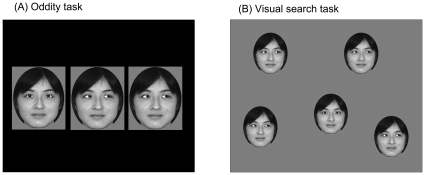
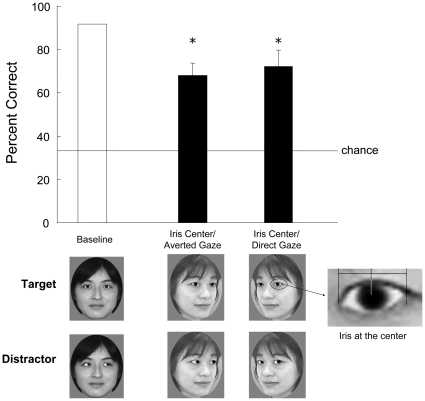
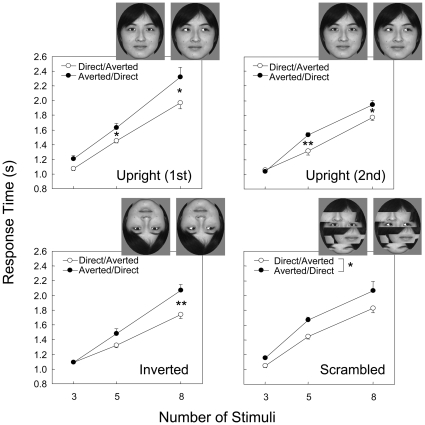
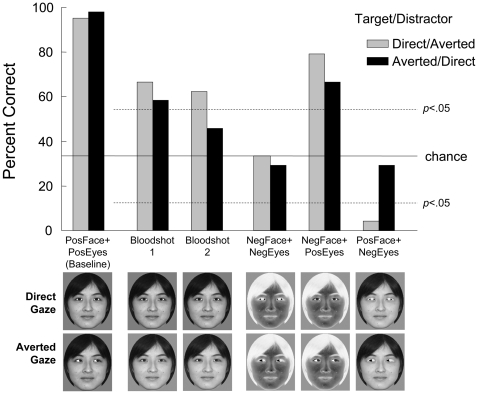
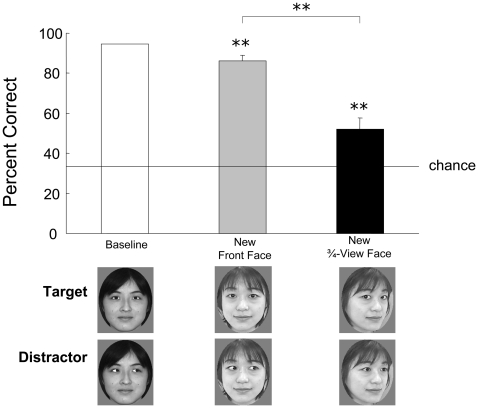
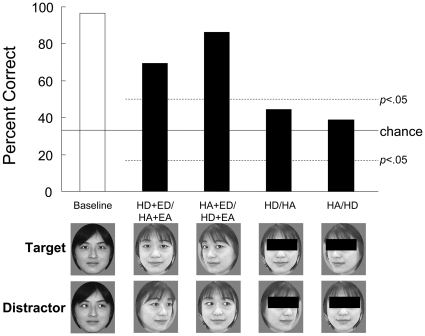
METHODOLOGY/PRINCIPAL FINDINGS: An adult female chimpanzee was trained to search for an odd-item target (front view of a human face) among distractors that differed from the target only with respect to the direction of the eye gaze. During visual-search testing, she performed more efficiently when the target was a direct-gaze face than when it was an averted-gaze face. This direct-gaze superiority was maintained when the faces were inverted and when parts of the face were scrambled. Subsequent tests revealed that gaze perception in the chimpanzee was controlled by the contrast between iris and sclera, as in humans, but that the chimpanzee attended only to the position of the iris in the eye, irrespective of head direction.
CONCLUSION/SIGNIFICANCE: These results suggest that the chimpanzee can discriminate among human gaze directions and are more sensitive to direct gazes. However, limitations in the perception of human gaze by the chimpanzee are suggested by her inability to completely transfer her performance to faces showing a three-quarter view.
人类在检测视线转移的面孔时,比检测视线直接对视的面孔的效率更高。我们检验了这种“众目睽睽”的效应是否也会出现在黑猩猩(Pan troglodytes)身上,因为黑猩猩的眼部形态与人类不同(即低对比度的眼睛、深色巩膜)。
方法/主要发现:一只成年雌性黑猩猩接受了一项训练,要求它在目标(正面人脸)和干扰物(只有眼部注视方向不同)中搜索出目标。在视觉搜索测试中,当目标是直接对视的人脸时,它的表现比目标是视线转移的人脸时更为高效。当人脸是倒置的或面部的某些部位是打乱的时,这种直接注视的优势仍然存在。随后的测试表明,黑猩猩的注视感知受虹膜和巩膜之间对比度的控制,就像人类一样,但黑猩猩只关注眼睛中虹膜的位置,而不关注头部的方向。
结论/意义:这些结果表明,黑猩猩可以区分人类的注视方向,并且对直接注视更为敏感。然而,黑猩猩对人类注视的感知存在局限性,因为它们无法将自己的表现完全转移到呈现四分之三视角的面孔上。